
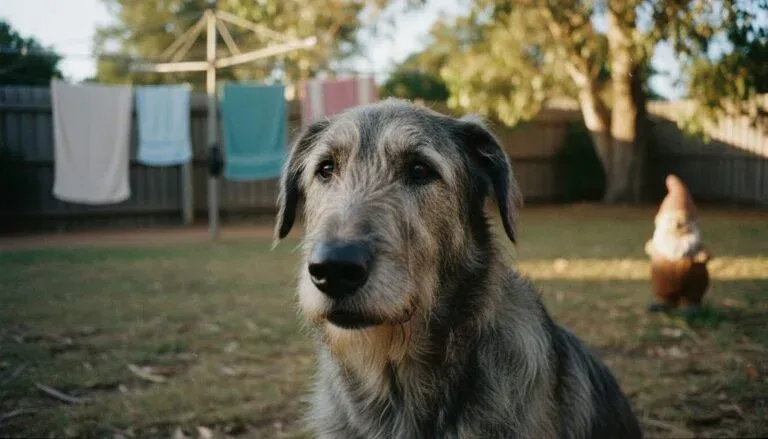
They stand taller than most children, eat more than most teenagers, and live nowhere near long enough. The Irish Wolfhound is a dog that will take up your entire couch, most of your savings account, and all of your heart — then leave you far too soon.
If you’re reading this from Australia and wondering whether one of these ancient giants belongs in your backyard, you’re in the right place. This isn’t a sugarcoated breed overview copied from a kennel club pamphlet. We’re covering the real costs in AUD, the health conditions that keep Wolfhound owners up at night, the temperament quirks nobody warns you about, and whether your home, climate, and lifestyle can genuinely support a dog this size.
Because the Irish Wolfhound isn’t a breed you casually “try out.” It’s a commitment that reshapes your house, your car, and your daily routine. Let’s get into it.
What You’ll Learn
- Breed traits & temperament
- Health concerns to know
- True cost in Australia
- Training & exercise needs
- Is this breed right for you?
Irish Wolfhound at a Glance
| Trait | Details |
|---|---|
| Breed Group | Hound (Sighthound) |
| Origin | Ireland — one of the oldest recorded breeds, dating to 391 AD |
| Height (Male) | 81–86 cm (32–34 in) at the shoulder; 7 ft+ standing on hind legs |
| Height (Female) | 71+ cm (28+ in) at the shoulder |
| Weight (Male) | 54–70 kg (120–155 lbs) |
| Weight (Female) | 41–61 kg (90–135 lbs) |
| Lifespan | 6–8 years (average around 7–7.5 years) |
| Coat Type | Rough, wiry double coat |
| Coat Colours | Grey, brindle, red, black, white, fawn, wheaten |
| Shedding | Low to moderate — no seasonal blowouts |
| Temperament | Gentle, calm, patient, loyal, sensitive |
| Good With Children | Yes — supervision needed due to sheer size, not aggression |
| Good With Other Dogs | Generally excellent |
| Apartment Friendly | No — needs space and a securely fenced yard |
| Hypoallergenic | No |
| Exercise Needs | Moderate — 40–60 minutes daily |
| Trainability | Moderate — intelligent but independent |
| Barking Level | Low |
| AKC Recognition | 1897 |
| ANKC Group | Group 4 — Hounds |
History & Origins
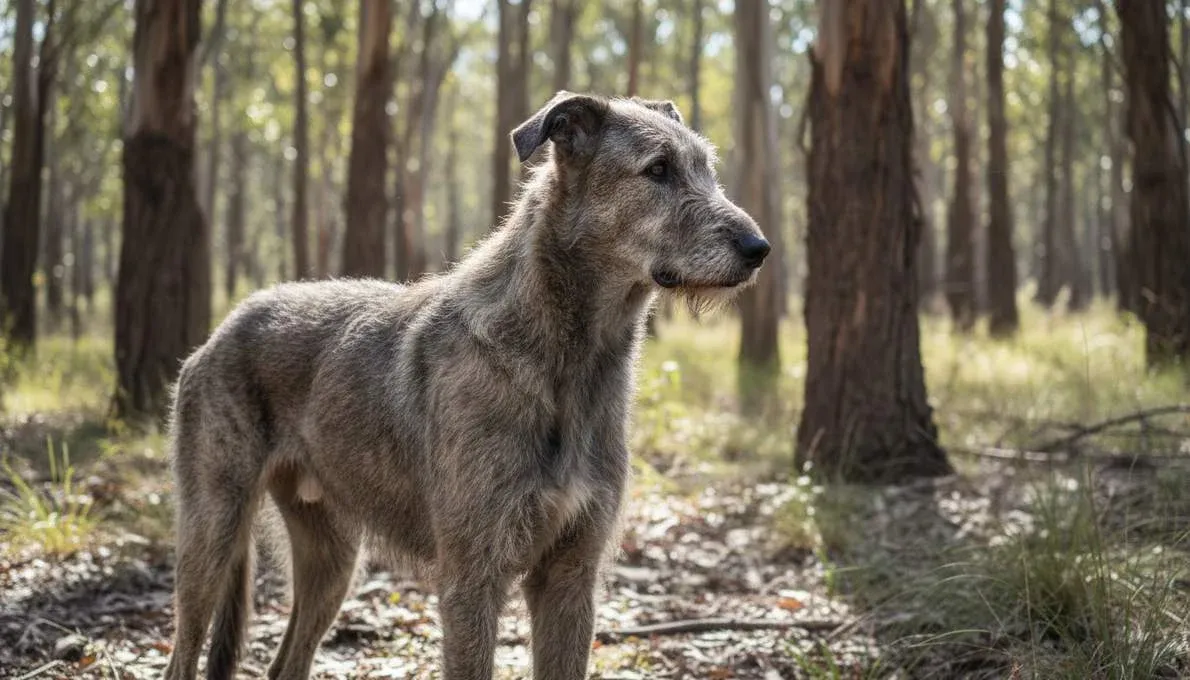
The Irish Wolfhound isn’t just an old breed — it’s one of the oldest documented dog breeds on the planet. The first written record dates to 391 AD, when the Roman Consul Quintus Aurelius Symmachus wrote to his brother thanking him for a gift of seven Irish dogs, noting that “all Rome viewed them in wonder.”
In ancient Ireland, these dogs were known as Cú Faoil — a name that carried deep cultural weight. The word Cú meant “hound of great bravery,” and Irish chieftains sometimes added it to their own names as an honorific. Owning these dogs was a privilege restricted to royalty and nobility, and they were given as diplomatic gifts to kings, emperors, and shahs across Europe and Asia — typically in symbolic packs of seven, bound with silver chains.
These weren’t pampered show dogs. They were war hounds sent into battle to drag enemy soldiers from horseback. They guarded property and livestock. And they hunted the large predators that once roamed Ireland — wolves, boar, and the now-extinct giant Irish elk. A dog needed to be fast enough to catch a wolf and strong enough to kill it. The Irish Wolfhound was both.
Their very success as wolf hunters, combined with the aristocratic habit of gifting them overseas, nearly destroyed them. After Ireland’s last wolf was reportedly killed in 1786, the breed’s purpose evaporated. By 1836, they were listed among animals that had “disappeared from Ireland.”
Captain Graham and the Breed’s Revival
In 1863, a British army officer named Captain George Augustus Graham made it his mission to save the breed. He scoured the Irish countryside for dogs believed to descend from the original wolfhound strains, then crossbred them with Scottish Deerhounds, Great Danes, and small amounts of Borzoi blood to rebuild the population and restore the breed’s imposing size.
Graham founded the Irish Wolfhound Club in 1885 and established the breed standard that breeders still reference today. The American Kennel Club recognised the breed in 1897. In 1902, the Irish Wolfhound became the official regimental mascot of the Irish Guards — a role it still holds.
The Irish Wolfhound in Australia
In Australia, the breed has a quieter but interesting history. Early Irish Wolfhounds were crossed with other breeds to create kangaroo-hunting dogs suited to the Australian landscape. Today, the breed remains relatively rare in Australia, with a small but dedicated community of registered breeders operating under the ANKC (Australian National Kennel Council). The Irish Wolfhound Club of Victoria and similar state-level clubs organise shows, health screening events, and breeder education programs.
Temperament & Personality
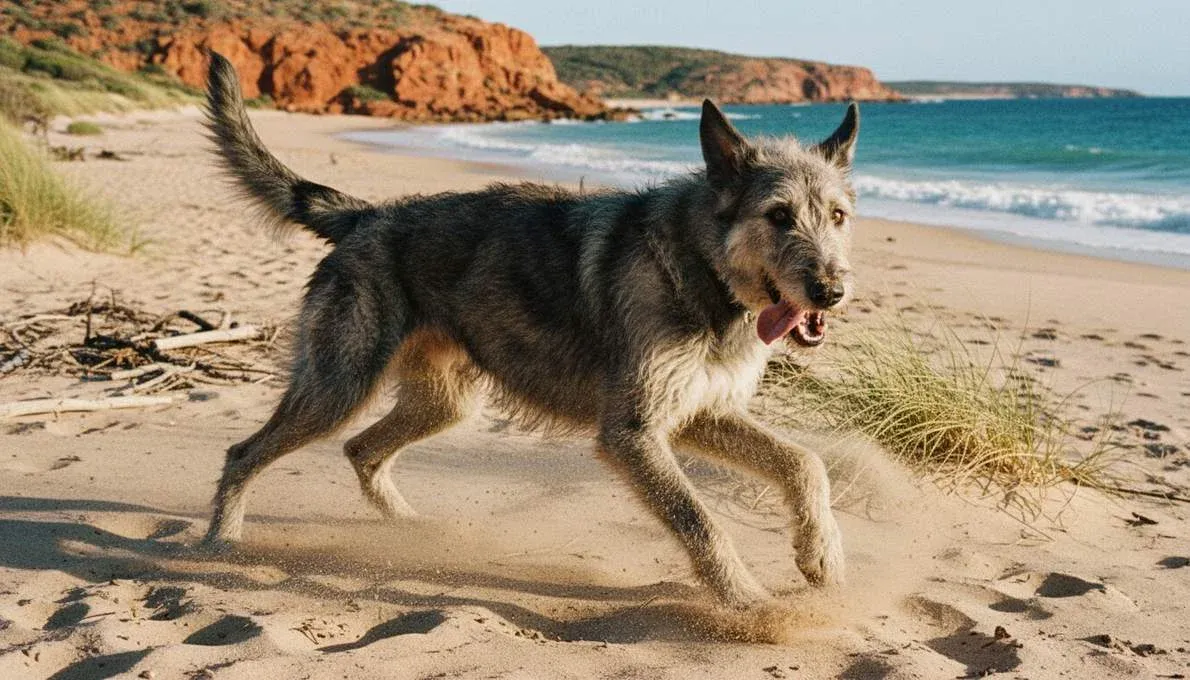
There’s a famous saying among Wolfhound owners: “Gentle when stroked, fierce when provoked.” In practice, the “fierce” part rarely surfaces. The modern Irish Wolfhound is one of the most placid, good-natured large breeds you’ll ever meet.
They’re calm indoors — almost surprisingly so for their size. Most Wolfhound owners will tell you their dog spends the majority of the day sleeping on the coolest floor they can find, occasionally getting up to lean against someone’s legs with their full body weight (this is their version of a hug, and yes, it can knock you over).
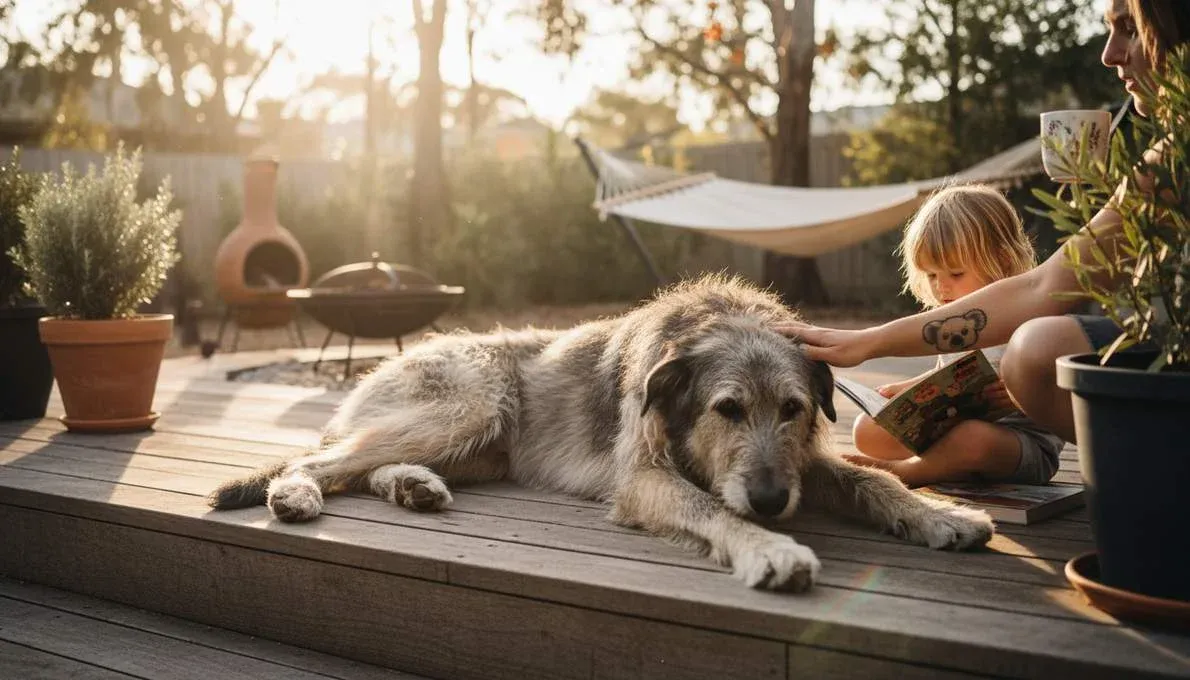
Irish Wolfhounds are generally wonderful with children. They’re patient, tolerant, and rarely reactive. The risk isn’t aggression — it’s physics. A wagging tail at counter height can sweep a toddler off their feet. A playful bump from a 60 kg dog lands differently than one from a Labrador. Supervision is essential, not because the dog is dangerous, but because it’s enormous.
They’re typically excellent with other dogs, especially if socialised early. However, there’s one caveat that catches new owners off guard: the prey drive. Irish Wolfhounds are sighthounds. They were literally bred to chase and kill fast-moving animals. A neighbourhood cat sprinting across your yard can trigger an instinct that no amount of training will fully override. Cats raised alongside a Wolfhound from puppyhood are usually fine. The neighbour’s cat visiting your garden? That’s a different story. Always keep your yard securely fenced, and make that fence tall — these dogs can clear lower barriers.
No. Irish Wolfhounds are not an aggressive breed. They’re not suspicious of strangers, they don’t bark much, and they’re generally terrible guard dogs despite their intimidating size. Their sheer presence is usually deterrent enough for anyone with bad intentions, but the Wolfhound itself would rather greet a stranger with a lean than a growl. If you want a protection dog, this isn’t the breed for you.
One trait that doesn’t get enough attention: Irish Wolfhounds are deeply sensitive dogs. They pick up on household tension, respond poorly to harsh correction, and genuinely wilt if left alone for long periods. They’re not a breed that does well in the backyard while you’re at work all day. They need to be part of the family, and they’ll make sure you know it — usually by parking themselves directly in your path or resting their enormous head in your lap while you’re trying to eat dinner.
Health & Genetic Conditions
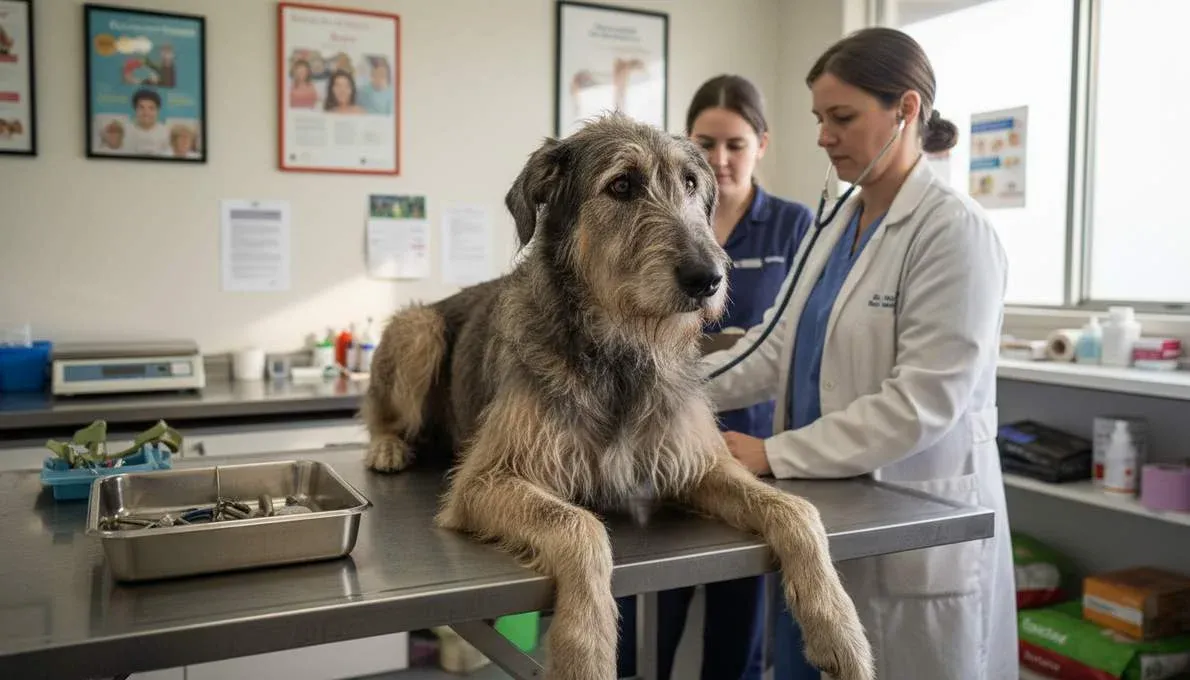
This is the section nobody wants to read, but every prospective owner needs to. Irish Wolfhounds are not an unhealthy breed in the traditional sense — many live happy, active lives with relatively few day-to-day health issues. But they are a giant breed, and giant breeds carry serious genetic risks. Knowing what to watch for can genuinely extend your dog’s life.
This is the big one. Dilated cardiomyopathy is a heart condition where the heart muscle becomes enlarged and weakened, reducing its ability to pump blood effectively. Studies report DCM rates in Irish Wolfhounds between 12% and 45%, depending on the population studied. The Irish Wolfhound Foundation recommends annual heart screening from age two onward. Early detection has become increasingly treatable in recent years, making screening one of the most important things you can do for your dog.
Estimated treatment cost in Australia: $2,000–$8,000+ depending on severity and ongoing medication.
Irish Wolfhounds are roughly 27 times more likely to develop osteosarcoma than the general dog population. This aggressive bone cancer usually presents as sudden lameness or limping. Treatment typically involves amputation of the affected limb followed by chemotherapy. It’s a devastating diagnosis, and survival times even with treatment are often measured in months rather than years.
Estimated treatment cost in Australia: $5,000–$15,000+ for surgery and chemotherapy.
Bloat is an emergency. The stomach fills with gas and can twist on itself, cutting off blood supply. Without immediate veterinary intervention, it’s fatal within hours. Deep-chested breeds like the Irish Wolfhound are particularly vulnerable. Many experienced owners discuss preventative gastropexy (surgically tacking the stomach) with their vet, often performed during desexing.
Estimated emergency treatment cost in Australia: $3,000–$10,000 for emergency surgery.
While not as prevalent in Wolfhounds as in some other large breeds, hip and elbow dysplasia do occur. These conditions cause the joints to develop abnormally, leading to arthritis and pain. Reputable breeders screen breeding dogs for both conditions. Given the small Irish Wolfhound gene pool, this screening is especially important.
Estimated management cost in Australia: $500–$3,000+ annually for medication and joint support; $4,000–$8,000+ for surgical intervention.
This is a developmental disorder where blood bypasses the liver, preventing proper detoxification. Puppies should be screened at 8–12 weeks before going to their new homes. Responsible breeders include this in their health testing protocol. Without surgical correction, affected dogs may have a lifespan of just two to four years.
Estimated surgical cost in Australia: $3,000–$7,000.
Pneumonia (older Wolfhounds are particularly susceptible), progressive retinal atrophy and other eye conditions, hypothyroidism, and age-related loss of hind-end mobility are all reported in the breed. The wiry coat can also mask weight loss, so regular weigh-ins at the vet are worth scheduling.
A note on vet costs: Everything costs more with a giant breed. Medication is dosed by weight, so your Wolfhound may need double or triple the dosage of a medium-sized dog. Anaesthesia, imaging, and surgery all cost more for a 60 kg patient. Budget accordingly, and seriously consider pet insurance from day one.
Lifespan & Longevity
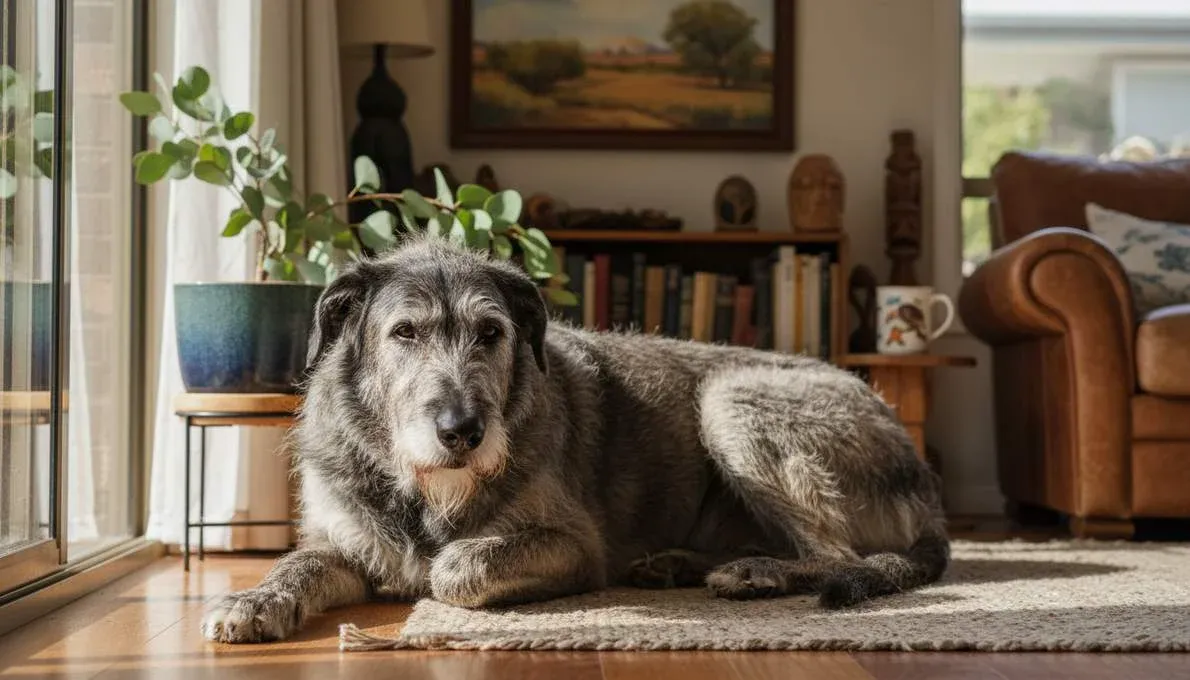
This is the hardest part of owning an Irish Wolfhound. The average lifespan sits between 6 and 8 years, with most studies placing the median around 7 to 7.5 years. Some Wolfhounds reach 10, but they’re the exception, not the rule.
For context, a Golden Retriever averages 10–12 years. A small breed like a Jack Russell can push past 15. When you bring an Irish Wolfhound puppy home, you’re likely looking at 6 to 8 years together. It’s not enough. Every Wolfhound owner will tell you that. But the years you get are extraordinary.
How to Support a Longer Life
While you can’t outrun genetics, you can influence several factors that affect longevity:
| Factor | What You Can Do |
|---|---|
| Cardiac screening | Annual heart checks from age 2. Early DCM detection saves lives. |
| Diet | Feed a high-quality, large-breed-specific diet. Avoid overfeeding. Maintain lean body condition. |
| Exercise | Moderate, consistent exercise. Avoid high-impact activity during puppyhood while bones develop. |
| Weight management | Keep your Wolfhound lean. Extra weight accelerates joint disease and strains the heart. |
| Bloat prevention | Feed 2–3 smaller meals daily. Avoid exercise immediately after eating. Discuss gastropexy with your vet. |
| Desexing considerations | Research links early castration in males to increased osteosarcoma risk. Discuss timing carefully with your vet. |
| Vet relationship | Find a vet experienced with giant breeds. Subtle changes in a stoic breed like this are easy to miss. |
Grooming & Care
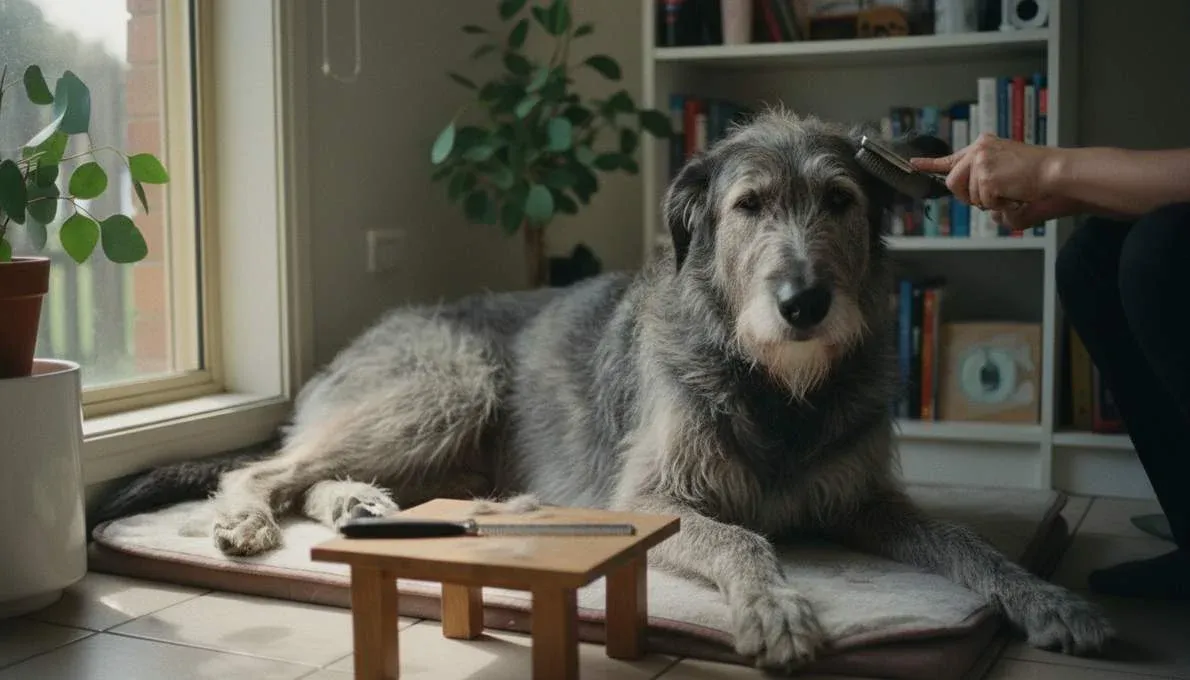
Good news for people who dread grooming sessions: the Irish Wolfhound’s rough, wiry coat is relatively low-maintenance compared to many breeds its size. They don’t have the seasonal coat blowouts you’d deal with from a Husky or a Golden Retriever.
Do Irish Wolfhounds Shed?
Yes, but moderately. They shed lightly throughout the year rather than dumping their coat all at once. You’ll find wiry hairs on furniture and clothing, but it’s manageable with regular brushing. They are not hypoallergenic, so if allergies are a concern, this isn’t the breed for you.
Grooming Schedule
| Task | Frequency & Notes |
|---|---|
| Brushing | Once or twice per week with a slicker brush or pin brush. Focus on the beard, eyebrows, and chest where matting is most common. |
| Bathing | Every 6–8 weeks or as needed. Their wiry coat doesn’t hold odour the way softer coats do. |
| Hand-stripping | 2–3 times per year to remove dead outer coat and maintain the correct wiry texture. Some owners learn to do this at home; others visit a groomer experienced with wire-coated breeds. |
| Nail trimming | Every 2–3 weeks. Overgrown nails cause gait issues and pain, especially in a dog this heavy. |
| Ear cleaning | Weekly check, clean as needed. Their ear shape doesn’t trap moisture as readily as floppy-eared breeds. |
| Dental care | Daily brushing is ideal; 2–3 times per week at minimum. Over 60% of pet dogs develop gum disease, and dental issues can compound other health problems. |
| Eye area | Trim hair around the eyes as needed to prevent irritation. The breed’s signature shaggy eyebrows are charming but need occasional tidying. |
Recommended Australian Grooming Products
For wire-coated breeds, look for products that don’t soften the coat (silicone-based conditioners are the enemy). Australian brands like Rufus & Coco and Bondi Wash offer natural-ingredient options that clean without stripping the coat’s texture. A good stripping knife or Mars Coat King is worth the investment if you plan to hand-strip at home.
Exercise Needs
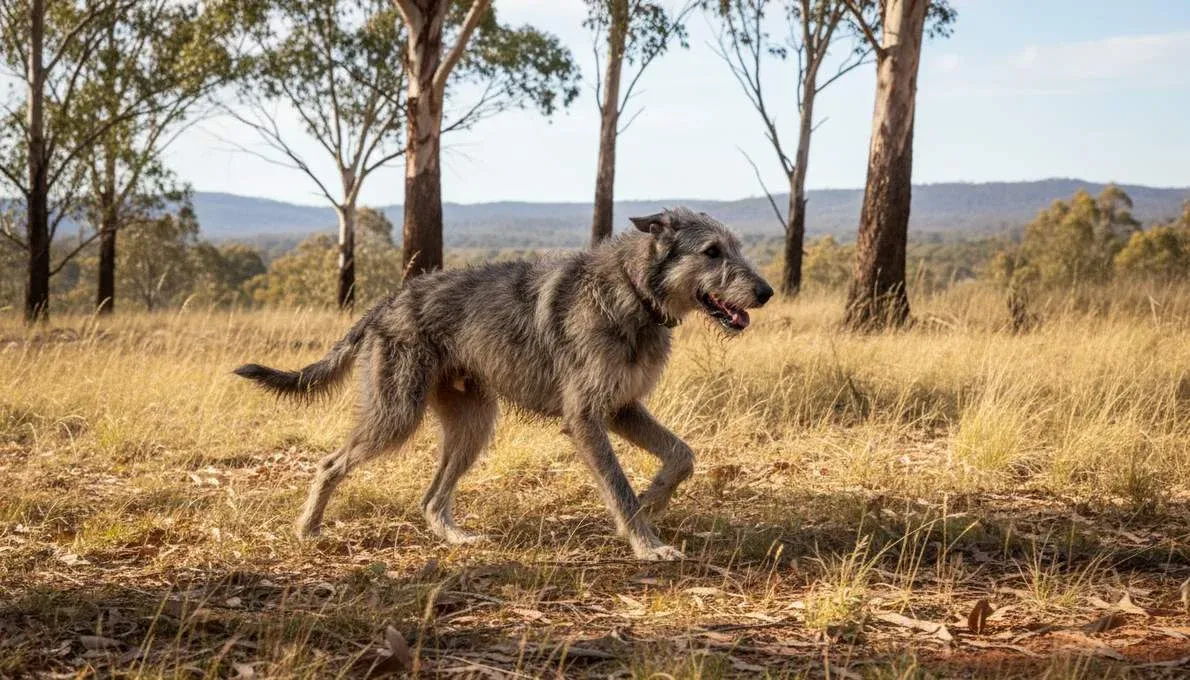
Irish Wolfhounds need less exercise than most people expect. Despite their hunting heritage, they’re not high-energy dogs in the way a Border Collie or Kelpie is. Most adult Wolfhounds are content with 40 to 60 minutes of moderate exercise per day — a decent walk, some off-lead time in a secure area, and maybe a short sprint (they’re sighthounds, so they love a good burst of speed).
Puppy Exercise — Less Is More
This is critical, and it’s where well-meaning owners often make costly mistakes. Irish Wolfhound puppies grow at an extraordinary rate, and their bones, joints, and muscles are developing rapidly. Excessive exercise during this period — long runs, jumping, rough play on hard surfaces — can cause lasting damage to joints and increase the risk of osteochondrosis and dysplasia.
The general rule of thumb for giant breed puppies is 5 minutes of structured exercise per month of age, twice a day. So a 4-month-old puppy gets two 20-minute sessions. Free play on soft ground is fine in addition to this. Avoid stairs, jumping in and out of cars, and slippery floors during the first 12–18 months.
Australian Climate Considerations
⚠️ Hot weather warning: Irish Wolfhounds are a breed that naturally prefers cooler temperatures. They often seek out cold, hard floors in summer and genuinely struggle in Australia’s hotter months. In northern Queensland, western NSW, or any region where summer temperatures regularly exceed 35°C, you need to be extremely careful.
Exercise during summer should happen early in the morning or after dark. Always provide access to shade and fresh water. Consider a cooling mat or kiddie pool. Watch for signs of heat stress: excessive panting, drooling, lethargy, or stumbling. A dog this size can overheat faster than you’d expect.
Southern Australian climates (Melbourne, Tasmania, Adelaide in winter) suit Wolfhounds well. They’re comfortable in cool to cold weather and will happily lie outside in conditions that send smaller dogs running for the heater.
Training Guide
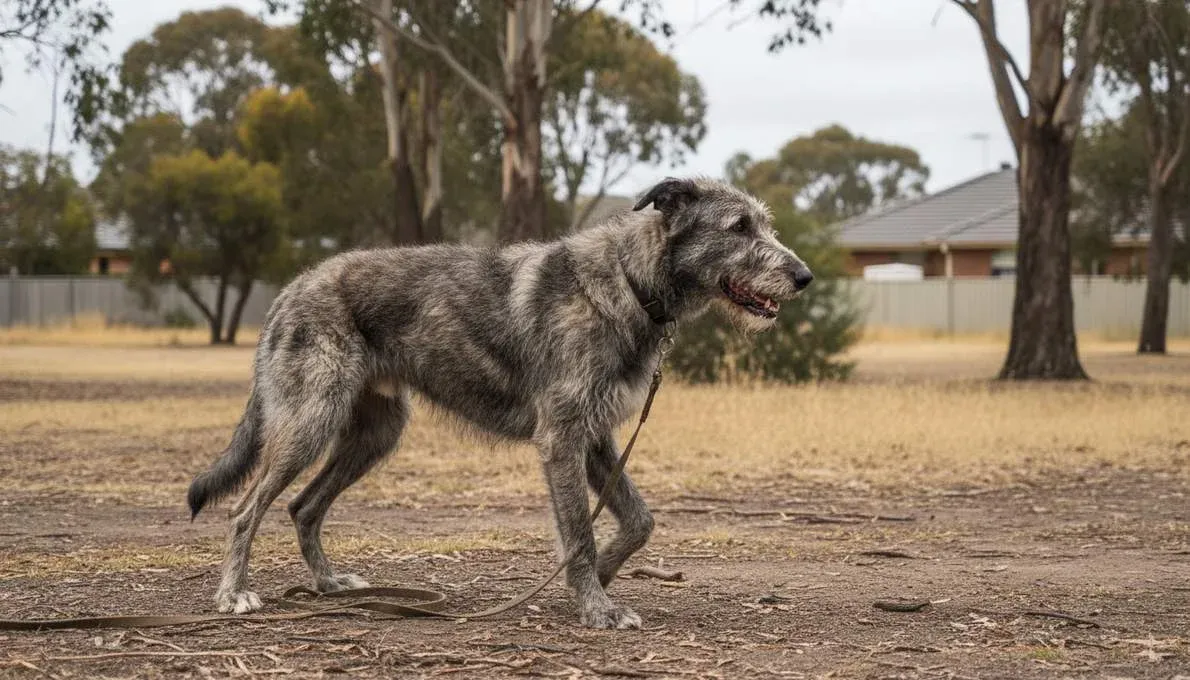
Irish Wolfhounds are intelligent dogs, but “easy to train” comes with an asterisk. They’re not going to snap to attention like a working-line German Shepherd. They process requests at their own speed, and if they don’t see the point of a command, they may politely ignore it.
That said, they’re rarely defiant. They’re sensitive, people-oriented dogs that respond well to positive reinforcement and wilt under harsh correction. Yelling at an Irish Wolfhound doesn’t make it obey faster — it makes it shut down.
Training by Age
| Age | Training Focus |
|---|---|
| 8–12 weeks | Socialisation is the top priority. Expose your puppy to different people, surfaces, sounds, and environments. Start basic name recognition and recall. Crate training and toilet training. |
| 3–6 months | Basic obedience: sit, down, stay, come. Leash manners are essential — this dog will eventually weigh 50–70 kg, so loose-lead walking starts now. Short, positive sessions (5–10 minutes). |
| 6–12 months | Reinforce all basics. Work on “leave it” and impulse control (critical for a sighthound). Continue socialisation. Introduce recall in low-distraction environments. |
| 12–24 months | Adolescence. Expect some regression. Stay consistent and patient. This is when many owners make the mistake of getting frustrated — don’t. Increase recall practice in more challenging environments. |
| 2+ years | Most Wolfhounds mature mentally around 2–3 years. By this stage, training is more about maintenance than teaching. Continue reinforcing recall and manners throughout their life. |
Training Honestly
Will your Irish Wolfhound ever have flawless off-lead recall near wildlife? Probably not. Sighthounds have an instinct to chase that overrides training in high-stimulation moments. Many experienced Wolfhound owners never let their dogs off-lead outside of securely fenced areas, and that’s not a training failure — it’s responsible management of the breed’s hardwired instincts.
The good news? Indoors, Wolfhounds are remarkably well-behaved. They’re not chewers, barkers, or diggers. They mostly just want to be wherever you are, preferably lying on something soft.
Cost of Ownership in Australia
Let’s be blunt: Irish Wolfhounds are an expensive breed to own. Their size means everything costs more — food, medication, beds, crates, car harnesses, and vet bills are all scaled up. Here’s what Australian ownership actually looks like in dollars.
Purchase Price
| Source | Expected Cost (AUD) |
|---|---|
| Registered breeder (ANKC) | $2,000–$4,000 |
| Champion bloodline / show quality | $4,000–$6,000+ |
| Rescue or adoption | $300–$800 |
| Unregistered breeder (not recommended) | $500–$1,500 |
We strongly recommend purchasing from a registered breeder who conducts health screening for DCM, hip/elbow dysplasia, and liver shunt. The extra cost upfront can save thousands in vet bills down the track.
Ongoing Monthly Costs
| Expense | Estimated Monthly Cost (AUD) |
|---|---|
| Dry kibble (premium large-breed) | $90–$120 |
| Wet food diet | $155–$220 |
| Raw diet | $200–$310 |
| Pet insurance | $80–$180 |
| Routine vet care (annualised) | $40–$80 |
| Grooming (if professional) | $50–$100 per session, 4–6x/year |
| Flea, tick & worming | $20–$40 |
| Joint supplements | $30–$60 |
| Miscellaneous (toys, beds, replacements) | $20–$50 |
First-Year Setup Costs
| Item | Estimated Cost (AUD) |
|---|---|
| Puppy purchase | $2,000–$4,000 |
| Initial vet visits, vaccinations, desexing | $500–$1,200 |
| Crate (giant breed size) | $150–$350 |
| Bed (orthopaedic, giant breed) | $100–$300 |
| Collar, lead, harness | $80–$200 |
| Car harness or barrier (crash-tested) | $50–$150 |
| Food and water bowls (elevated) | $40–$100 |
| Puppy training classes | $150–$400 |
| First-year total estimate | $3,070–$6,700+ |
Lifetime Cost Estimate
Over a 7-year lifespan, you’re looking at a total cost of ownership between $25,000 and $50,000+, factoring in routine care, food, insurance, and the near-certainty of at least one major health event. That figure isn’t designed to scare you — it’s designed to prepare you. Irish Wolfhounds deserve owners who can financially support their needs without cutting corners on veterinary care.
Where to Buy an Irish Wolfhound in Australia
Start with state-based breed clubs: the Irish Wolfhound Club of Victoria, the Irish Wolfhound Club of NSW, and similar organisations. The Dogs Australia (ANKC) website lists registered breeders by state. Reputable breeders will have waiting lists — often 6 to 12 months or longer. If someone has Irish Wolfhound puppies available immediately with no health testing documentation, that’s a red flag.
For rescue, organisations like PetRescue and breed-specific rehoming groups occasionally list Wolfhounds, though they’re rare. Irish Wolfhound rescue networks operate largely through word of mouth within the breed community.
Is the Irish Wolfhound Right for You?
This breed isn’t for everyone, and that’s not a cliché — it’s a practical reality. Before you fall in love with the idea of owning one, honestly assess whether your life can accommodate a dog this size, this expensive, and this short-lived.
You have a large home with a securely fenced yard (tall fencing — at least 1.5 to 1.8 metres). You have the financial capacity to handle large, unexpected vet bills. You’re home for a significant portion of the day or can take your dog with you. You live in a cooler climate or can manage heat safely. You’re comfortable with a relatively short lifespan and the emotional weight that carries. You want a calm, affectionate, low-energy companion rather than a high-drive working dog.
You live in an apartment or townhouse with limited space. Your yard is small or unfenced. You work long hours away from home with no pet care arrangement. You’re on a tight budget — these dogs are genuinely expensive to maintain. You want a guard dog or protection dog. You’re in a very hot climate with no effective way to keep the dog cool. You’re not prepared for the emotional reality of a 6–8 year lifespan.
If you love the gentle giant temperament but need a longer-lived breed, consider a Great Dane (8–10 years), a Scottish Deerhound (similar temperament, slightly smaller), or a Greyhound (retired racers are widely available in Australia and share the sighthound calm). If size is appealing but you want a more robust health profile, a Leonberger or Newfoundland may be worth researching.
The Irish Wolfhound is a magnificent, ancient breed that will change your life in ways no other dog can. Here’s the honest summary:
They’re one of the most gentle, loyal, and affectionate breeds in existence — a 60 kg dog that thinks it’s a lapdog, and somehow makes it work.
They come with serious health risks and a heartbreakingly short lifespan — 6 to 8 years is the reality, and the vet bills during those years will be substantial.
They’re not a casual pet — they need space, money, time, and an owner who understands that giant breed ownership is a different game entirely.
If you can meet those requirements, an Irish Wolfhound will give you the most extraordinary years of dog ownership imaginable. They’re worth every challenge. They just aren’t for everyone.
Frequently Asked Questions
How big do Irish Wolfhounds get?
Male Irish Wolfhounds stand 81–86 cm (32–34 in) at the shoulder and can be over 7 feet tall when standing on their hind legs. Females are 71+ cm (28+ in) at the shoulder. Males weigh 54–70 kg (120–155 lbs), females 41–61 kg (90–135 lbs).
What is the lifespan of an Irish Wolfhound?
The average lifespan is 6–8 years, with most living to around 7–7.5 years. Some may reach 10 years, but this is uncommon.
How much does an Irish Wolfhound cost in Australia?
From a registered ANKC breeder, expect to pay $2,000–$4,000. Show-quality puppies can cost $4,000–$6,000+. The total first-year cost is $3,070–$6,700+, and lifetime costs can reach $25,000–$50,000+.
Do Irish Wolfhounds shed a lot?
They shed moderately year-round, not in heavy seasonal blowouts. Their wiry coat requires weekly brushing to manage loose hairs. They are not hypoallergenic.
Are Irish Wolfhounds good family dogs?
Yes, they are gentle, patient, and excellent with children. Supervision is essential due to their enormous size, not aggression.
Are Irish Wolfhounds good guard dogs?
No. They are not aggressive or suspicious of strangers. Their size may deter intruders, but they are more likely to greet someone than guard against them.
Can Irish Wolfhounds live in apartments?
No. They need a large home with a securely fenced yard. Their size and need for space make apartments unsuitable.
How much exercise does an Irish Wolfhound need?
Adults need 40–60 minutes of moderate exercise daily. Puppies require very limited, controlled exercise to protect developing joints.
Are Irish Wolfhounds hard to train?
They are intelligent but independent. They respond best to positive reinforcement and are sensitive to harsh correction. Reliable off-lead recall is difficult due to their strong prey drive.
What health problems do Irish Wolfhounds have?
Major concerns include Dilated Cardiomyopathy (DCM), Osteosarcoma (bone cancer), Gastric Dilatation-Volvulus (bloat), Hip/Elbow Dysplasia, and Portosystemic Shunt. Regular vet screening is crucial.
1. Irish Wolfhound Foundation — General Health — https://www.iwfoundation.org/health-library/general-health
2. Irish Wolfhound Club of America — Health & Longevity — https://www.iwclubofamerica.org/health
3. Irish Wolfhound Club of America — Early History — https://www.iwclubofamerica.org/early-history-starbuck
4. American Kennel Club — Irish Wolfhound History: Behind the Ancient Breed of Ireland — https://www.akc.org/expert-advice/dog-breeds/irish-wolfhound-history-behind-the-breed/
5. PetMD — Irish Wolfhound Dog Breed Health and Care — https://www.petmd.com/dog/breeds/irish-wolfhound
6. Pets Online Australia — Irish Wolfhound Prices in Australia — https://petsonline.com.au/dog-breeds/irish-wolfhound/prices/
7. PubMed — Lifespan and Disease Predispositions in the Irish Wolfhound: A Review — https://pubmed.ncbi.nlm.nih.gov/17970287/
8. Wikipedia — Irish Wolfhound — https://en.wikipedia.org/wiki/Irish_Wolfhound
9. Hill’s Pet — Irish Wolfhound Dog Breed Characteristics — https://www.hillspet.com/dog-care/dog-breeds/irish-wolfhound
10. Petinsurance.com.au — Irish Wolfhound Information — https://petinsurance.com.au/irish-wolfhound/