

If you’re shopping for a small, fluffy, family-friendly Poodle cross in Australia, you’ve probably narrowed it down to two breeds: the Cavoodle and the Cockapoo. They look similar. They’re both Poodle crosses. They’re both marketed as “hypoallergenic” family dogs. And every comparison article online tells you they’re “very similar with only minor differences.”
They’re wrong. These are meaningfully different dogs — and the difference comes down to one thing: the Spaniel parent. A Cavoodle gets half its DNA from a Cavalier King Charles Spaniel. A Cockapoo gets half from a Cocker Spaniel. Those two Spaniels look somewhat alike but carry completely different energy levels, health risks, and genetic baggage. The Cavalier brings a near-universal heart disease that will likely affect your dog in its lifetime. The Cocker brings a fatal kidney disease that’s entirely avoidable with a $70 DNA test. Neither parent breed is “better” — but one may be dramatically better for your specific life.
This comparison gives you the honest information most articles avoid: the health inheritance that matters most, the energy gap that determines daily life, and the uncomfortable truth that Australia’s most popular dog (the Cavoodle) may not actually be the best choice for the majority of buyers.
What You’ll Learn
- Breed traits & temperament
- Health concerns to know
- True cost in Australia
- Training & exercise needs
- Is this breed right for you?
Quick Comparison at a Glance
| Trait | Cockapoo (Spoodle) | Cavoodle (Cavapoo) |
|---|---|---|
| Parent breeds | Cocker Spaniel x Poodle | Cavalier King Charles Spaniel x Poodle |
| Origin as crossbreed | 1960s, USA (oldest designer breed) | Late 1990s, Australia |
| ANKC Recognised | No (designer crossbreed) | No (designer crossbreed) |
| Height | 25-40 cm (varies by Poodle size) | 25-38 cm (varies by Poodle size) |
| Weight | 5-14 kg (varies by Poodle size) | 5-12 kg (varies by Poodle size) |
| Lifespan | 13-18 years | 12-15 years |
| Energy level | Moderate to high | Low to moderate |
| Barking tendency | Moderate to high | Low to moderate |
| Separation anxiety risk | High | Moderate to high |
| Trainability | High (but easily distracted) | High (eager to please) |
| Exercise needs | 45-75 min/day | 30-45 min/day |
| Biggest health risk from Spaniel parent | Familial Nephropathy (fatal kidney disease, DNA testable) | Mitral Valve Disease (heart disease, NOT DNA testable, affects 50%+ of Cavaliers by age 5) |
| Apartment suitability | Good (if exercised) | Excellent |
| First-time owner | Good | Excellent |
| Puppy price (AUD) | $1,500-$6,500 | $2,500-$6,000 |
The Name Confusion
Before we compare anything, let’s clear up the naming chaos. Both breeds go by different names depending on where you are:
| Name Used | What It Means |
|---|---|
| Cavoodle | Cavalier King Charles Spaniel x Poodle. Australian/NZ name. |
| Cavapoo / Cavadoodle | Same dog as Cavoodle. Used in USA, UK, Europe. |
| Cockapoo / Cockerpoo | Cocker Spaniel x Poodle. Used in USA, UK, Europe. |
| Spoodle | Same dog as Cockapoo. Australian name. |
| Cockerdoodle | Occasionally used in Australia for Cockapoo/Spoodle. |
In this article, we’ll use “Cavoodle” and “Cockapoo” as the primary names because these are the terms most Australians search for. But if your breeder calls them Spoodles or Cavapoos, they’re talking about the same dogs.
One important distinction within Cockapoos: the Cocker Spaniel parent can be either an English Cocker Spaniel or an American Cocker Spaniel. These are different breeds with different sizes, temperaments, and health profiles. English Cockers are the working-line dogs — leggier, more athletic, higher drive. American Cockers are smaller, rounder, more companion-oriented. Most Australian Spoodle breeders use English Cockers, but always confirm which type your breeder uses, because it significantly affects the resulting puppies.
The Spaniel Parent
Every Cockapoo vs Cavoodle article focuses on the puppies. The smarter approach is to focus on the parents — because both crosses share a Poodle parent, meaning the differences between them are driven almost entirely by whether the other parent is a Cocker Spaniel or a Cavalier King Charles Spaniel.
The Cavalier is a gentle, affectionate, low-energy lap dog bred for centuries as a companion to royalty. It’s sweet-natured, patient, adaptable, and genuinely one of the easiest breeds to live with. It’s also one of the unhealthiest purebred dogs in existence.
The uncomfortable truth: Mitral Valve Disease (MVD) afflicts over half of all Cavalier King Charles Spaniels by age five, and approximately 90% or more by age ten. MVD is the leading cause of death in the breed — it’s 20 times more prevalent in Cavaliers than in the average dog breed. It’s a degenerative heart condition where the mitral valve deteriorates, allowing blood to flow backwards through the heart. It’s progressive, incurable, and eventually fatal. Treatment manages symptoms but doesn’t stop progression. A UK study found that approximately 43% of Cavaliers die from heart disease. And crucially: MVD is polygenic (caused by multiple genes), meaning there is no single DNA test to screen for it. The only screening is annual cardiac auscultation and echocardiography of breeding stock.
Beyond MVD, Cavaliers are predisposed to syringomyelia (a painful neurological condition where the skull is too small for the brain, affecting up to 70% of the breed to some degree), plus eye conditions, ear infections, and various other issues. The Cavalier is, bluntly, a breed in crisis — and the Cavoodle inherits these genetic risks.
The English Cocker Spaniel is a working gun dog — athletic, energetic, intelligent and bred to flush game from dense undergrowth all day. It’s friendlier and more biddable than many working breeds, but it carries genuine working-dog energy that shows up in every Cockapoo litter. The American Cocker Spaniel is the show/companion variant — smaller, less driven, but still considerably more energetic than a Cavalier.
The Cocker Spaniel’s biggest genetic concern is Familial Nephropathy (FN) — a fatal kidney disease that causes chronic renal failure in young dogs, typically between 6 months and 2 years of age. Affected dogs die within about a year of symptom onset. The critical difference from the Cavalier’s MVD: FN is autosomal recessive and there is a reliable DNA test for it. This means a responsible breeder can test both parents and guarantee that no puppy in the litter will be affected. If both parents test clear, the disease cannot occur. If a breeder cannot provide FN-clear DNA results for both parents, walk away.
Cocker Spaniels are also prone to chronic ear infections (those gorgeous floppy ears trap moisture and create a warm, dark breeding ground for bacteria and yeast), eye conditions including Progressive Retinal Atrophy (PRA, also DNA testable), and hip dysplasia. Overall, the Cocker Spaniel’s health profile is more manageable than the Cavalier’s because the most serious conditions are either DNA testable or preventable with proper care.
[IMAGE: Cavalier King Charles Spaniel and English Cocker Spaniel. Alt text: “The two Spaniel parent breeds that determine Cavoodle vs Cockapoo differences”]

Temperament:
This is the single biggest day-to-day difference between these breeds, and it’s the one most buyers underestimate.
| Temperament Factor | Cockapoo (Spoodle) | Cavoodle (Cavapoo) |
|---|---|---|
| Overall energy | Moderate to high — needs genuine exercise daily | Low to moderate — content with a walk and cuddles |
| Playfulness | Very high — always up for a game, can be “zoomie” | Moderate — playful but settles quickly |
| Calmness indoors | Moderate — settles after exercise, restless without it | High — natural couch companion |
| Affection style | Enthusiastic, bouncy, in-your-face love | Gentle, snuggly, velcro-dog closeness |
| Barking | Moderate to high — alert barker, vocal when excited | Low to moderate — occasional alert bark |
| Separation anxiety | High — Cocker heritage amplifies attachment | Moderate to high — Cavalier is naturally clingy |
| Stranger friendliness | Very high — outgoing, wants to greet everyone | High — friendly but may be slightly reserved initially |
| Dog friendliness | Very high — social butterfly at dog park | High — gentle, non-confrontational |
| Prey drive | Moderate — Cocker is a gun dog, may chase birds/squirrels | Low — Cavalier has minimal prey drive |
| Stubbornness | Moderate — intelligent but easily distracted | Low — eager to please, people-focused |
| Mental stimulation needs | High — needs puzzle toys, training games, variety | Moderate — enjoys enrichment but doesn’t demand it |
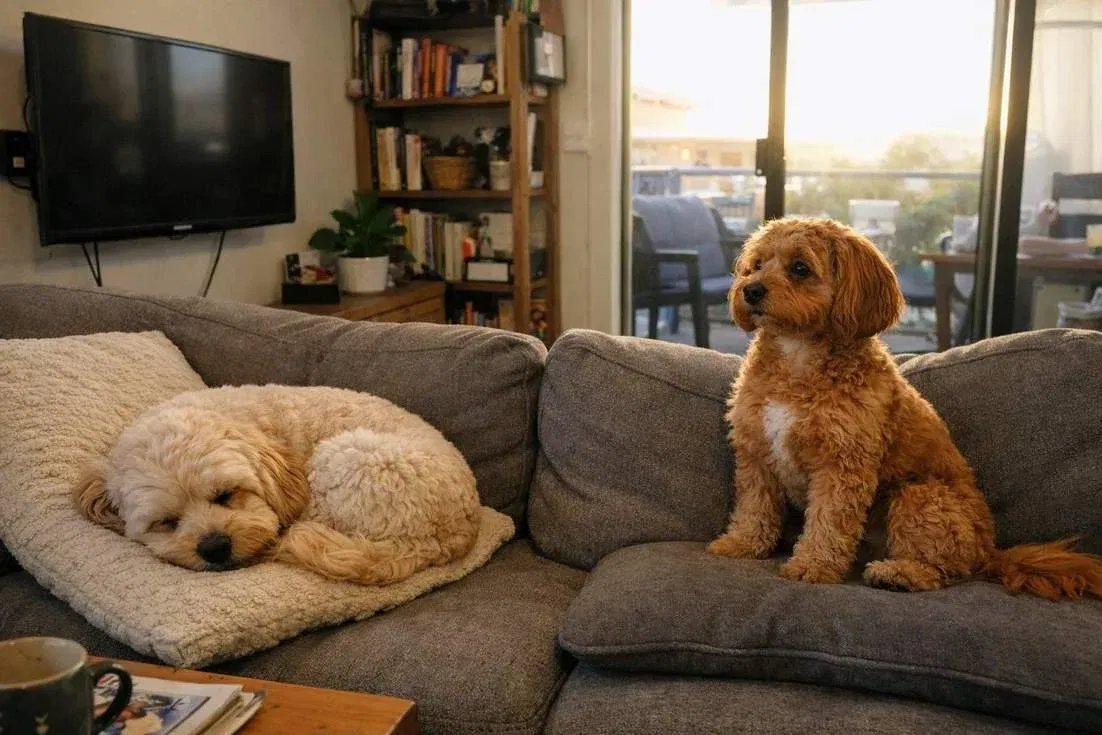
The short version: a Cavoodle adapts to your lifestyle. A Cockapoo expects you to adapt to its lifestyle. If you want a dog that’s happy to sit on the couch while you work from home and then go for a gentle 30-minute walk, the Cavoodle is the better fit. If you want a dog that’s ready for a bush walk, a trip to the dog park, an agility class and then maybe another walk, the Cockapoo will thrive.
Neither temperament is “better” — but the mismatch between owner expectations and dog energy is the number one reason both breeds end up in rescue. Cavoodle owners who expected a higher-energy dog are rarely disappointed. Cockapoo owners who expected a quiet lap dog very often are.
Size and Appearance
Both breeds come in similar size ranges because both use Toy or Miniature Poodles as the Poodle parent. The Cocker Spaniel parent is slightly larger and more athletic than the Cavalier, which can produce marginally bigger Cockapoos — but there’s enormous overlap.
| Size Category | Cockapoo (Spoodle) | Cavoodle (Cavapoo) |
|---|---|---|
| Toy (Toy Poodle parent) | Under 6 kg, 25-30 cm | Under 6 kg, 25-30 cm |
| Miniature (Mini Poodle parent) | 6-14 kg, 30-40 cm | 5-12 kg, 30-38 cm |
| Build | Sturdier, more athletic, leggier (English Cocker influence) | Compact, softer, rounder features (Cavalier influence) |
| Muzzle | Longer, more defined | Shorter, wider, more “teddy bear” |
| Ears | Long, heavily feathered, set lower | Long, silky, set higher |
| Expression | Alert, bright, working-dog intelligence | Soft, sweet, big round eyes |
Coat colours are extensive in both breeds. Cockapoos commonly appear in chocolate, black, golden/buff, red, cream, and parti (multi-coloured) patterns — the Cocker Spaniel brings a wider colour palette including roan and merle markings. Cavoodles are most commonly seen in ruby/red, gold/apricot, black, and tricolour (Blenheim-type markings inherited from the Cavalier). Rare colours like blue merle, chocolate phantom, and tricolour patterns often attract premium pricing in both breeds.
A visual note: Cavoodles tend to look like teddy bears. Cockapoos tend to look like sporty teddy bears. The Cavoodle’s Cavalier heritage gives it larger, rounder eyes, a shorter muzzle, and a softer overall expression. The Cockapoo’s Cocker heritage produces a slightly longer muzzle, a more alert expression, and a leaner body.
Coat and Grooming
Both breeds are marketed as “hypoallergenic” and “non-shedding.” Neither claim is entirely accurate. Both breeds have Poodle-influenced coats that shed less than many breeds, but the degree of shedding depends entirely on which parent’s coat genes dominate — and you won’t know until the adult coat grows in.
| Grooming Factor | Cockapoo (Spoodle) | Cavoodle (Cavapoo) |
|---|---|---|
| Coat types possible | Straight (sheds more), wavy, curly (sheds least) | Straight (sheds more), wavy, curly (sheds least) |
| Most common coat | Wavy to curly (Cocker influence = denser, thicker coat) | Wavy (Cavalier influence = silkier, finer coat) |
| Shedding | Low to moderate (F1 may shed, multigen more predictable) | Low to moderate (F1 may shed, multigen more predictable) |
| Brushing needed | Every 1-2 days (thicker coat tangles faster) | Every 2-3 days (finer coat mats less aggressively) |
| Professional grooming | Every 6-8 weeks ($60-$120/session) | Every 6-8 weeks ($60-$120/session) |
| Annual grooming cost | $500-$1,200 AUD | $500-$1,200 AUD |
| Ear care | Critical — Cocker ears are infection magnets, weekly cleaning essential | Important — floppy ears need regular cleaning |
| Ear infection risk | HIGH (inherited from Cocker Spaniel, #1 ongoing health cost) | Moderate (inherited from Cavalier) |
The grooming commitments are similar, but the Cockapoo has one significant additional burden: ear infections. The Cocker Spaniel has some of the longest, heaviest, most moisture-trapping ears in the dog world, and Cockapoos inherit these. Weekly ear cleaning is non-negotiable. Many Cockapoo owners spend $200-$600+ per year on ear-related vet visits and treatments. Chronic ear infections that require ongoing medication can cost $1,000+ annually. This is the Cockapoo’s hidden cost that nobody mentions in the cute puppy photos.
The “hypoallergenic” claim deserves the same debunking we’ve given before: no dog is truly hypoallergenic. All dogs produce the allergenic protein Can f 1 in their saliva and skin cells. Poodle crosses shed less fur (reducing the distribution of allergens around the home), but they produce the same allergens. A 2011 study in the American Journal of Rhinology and Allergy found no significant difference in home allergen levels between households with so-called hypoallergenic breeds and those with regular breeds. If you have dog allergies, spend extended time with the specific dog before committing, regardless of whether it’s a Cockapoo or Cavoodle.
Health Comparison
This is where the Cockapoo vs Cavoodle decision gets serious. Both breeds inherit health risks from both parent breeds. But the nature and severity of those inherited conditions is dramatically different — and this is the section that most competitor articles gloss over with vague reassurances about “hybrid vigour.”
The Hybrid Vigour Myth (Partly)
Crossbreeds do benefit from heterosis (hybrid vigour) — the genetic diversity from crossing two breeds can reduce the incidence of some conditions. But hybrid vigour doesn’t eliminate genetic diseases. It reduces the risk of recessive conditions (where two copies of a faulty gene are needed), but it doesn’t protect against dominant or polygenic conditions. The Cavalier’s MVD is polygenic and highly heritable — crossing with a Poodle may delay onset or reduce severity, but it doesn’t eliminate the risk. A study from the Royal Veterinary College found that the risk for the most common disorders did not differ significantly between designer crossbreeds like Cockapoos and Cavapoos and their parent breeds.
Cavoodle Health Risks (Inherited from Cavalier)
| Condition | Details |
|---|---|
| Mitral Valve Disease (MVD) | THE BIG ONE. 50%+ of Cavaliers affected by age 5. 90%+ by age 10. Leading cause of Cavalier death (43% die from heart disease). Progressive, incurable. No DNA test exists (polygenic). Crossing with Poodle may delay onset but does NOT eliminate risk. Annual cardiac screening of parents is the only safeguard. Treatment: medication $50-$200/month, cardiologist monitoring $300-$800/year. Average 1-3 years from diagnosis to heart failure in Cavaliers (may be longer in crosses). |
| Syringomyelia (SM) | Skull too small for brain, causing fluid-filled cavities in spinal cord. Affects up to 70% of Cavaliers to some degree (many asymptomatic). Causes head/neck pain, phantom scratching, neurological symptoms. MRI screening available ($1,000-$2,000) but rarely performed by crossbreed breeders. Surgery $6,000-$12,000+ if symptomatic. |
| Episodic Falling Syndrome | Cavalier-specific condition causing muscle stiffness and collapse during exercise/excitement. DNA testable. Autosomal recessive. Breeders should test. |
| Cavalier Curly Coat/Dry Eye | Breed-specific condition combining rough, curly coat with chronic dry eyes. DNA testable. |
| Luxating Patella | Kneecap dislocation. Common in toy/small breeds including Cavaliers and Toy Poodles. Both parents contribute risk. Surgery $1,500-$4,000/knee. |
Cockapoo Health Risks (Inherited from Cocker Spaniel)
| Condition | Details |
|---|---|
| Familial Nephropathy (FN) | Fatal kidney disease. Autosomal recessive. Affects puppies 6 months to 2 years. Death within ~1 year of symptoms. DNA TEST AVAILABLE — responsible breeders test and breed clear. If both parents test clear, puppies cannot be affected. This test is non-negotiable. |
| Progressive Retinal Atrophy (PRA) | Genetic blindness. Affects both Cocker Spaniels and Poodles. prcd-PRA form is DNA testable. Both parents should test clear or carrier (never carrier x carrier). Breeding clear eliminates risk. |
| Chronic Ear Infections | Not genetically fatal but the #1 ongoing health burden. Cocker ears trap moisture, creating bacterial/yeast breeding ground. Weekly cleaning required. Chronic cases: $500-$1,500+/year in vet treatment. Some dogs need lifelong ear medication. |
| Hip Dysplasia | English Cocker Spaniels have moderate susceptibility. Hip scoring of parents recommended. Surgery $4,000-$8,000. More relevant for Miniature Cockapoos than Toy. |
| Phosphofructokinase (PFK) Deficiency | Enzyme deficiency causing exercise intolerance and red blood cell destruction. DNA testable. Cocker and Poodle specific. |
| Von Willebrand Disease | Blood clotting disorder. Poodle-inherited. DNA testable. |
The Critical Difference
Here’s the bottom line: the Cockapoo’s most serious inherited disease (FN) is entirely preventable with a DNA test. The Cavoodle’s most serious inherited disease (MVD) is not DNA testable and affects the vast majority of its Cavalier parent breed. You can buy a Cockapoo and know with certainty that your puppy won’t develop Familial Nephropathy. You cannot buy a Cavoodle and know with certainty that it won’t develop heart disease.
This doesn’t mean every Cavoodle will develop MVD. Cross-breeding with a Poodle may reduce severity and delay onset. Many Cavoodles live long, healthy lives. But the risk is real, unquantifiable at the individual level, and impossible to completely breed out because MVD is polygenic. The best Cavoodle breeders mitigate this risk by using only heart-clear Cavalier parents over 5 years old — but even this doesn’t guarantee their offspring won’t develop the disease, only that the parents hadn’t shown it yet.
This is the honest conversation that the Cavoodle marketing machine doesn’t want you to have.
Exercise and Energy
| Exercise Factor | Cockapoo (Spoodle) | Cavoodle (Cavapoo) |
|---|---|---|
| Daily minimum | 45-75 minutes | 30-45 minutes |
| Type of exercise | Active walks, fetch, swimming, dog park play | Gentle walks, garden play, indoor games |
| Mental stimulation | High — needs puzzle toys, training, sniff walks | Moderate — enjoys enrichment, doesn’t demand it |
| Consequence of under-exercise | Destructive behaviour, excessive barking, hyperactivity | Mild restlessness, attention-seeking |
| Off-leash reliability | Moderate — good recall but Cocker nose may lead them astray | Good — less prey drive, more people-focused |
| Dog sports aptitude | Excellent — agility, flyball, nosework, retrieving | Good — obedience, rally, therapy dog work |
| Rainy day management | Challenging — needs indoor enrichment or will find its own entertainment | Manageable — extra cuddle time usually sufficient |
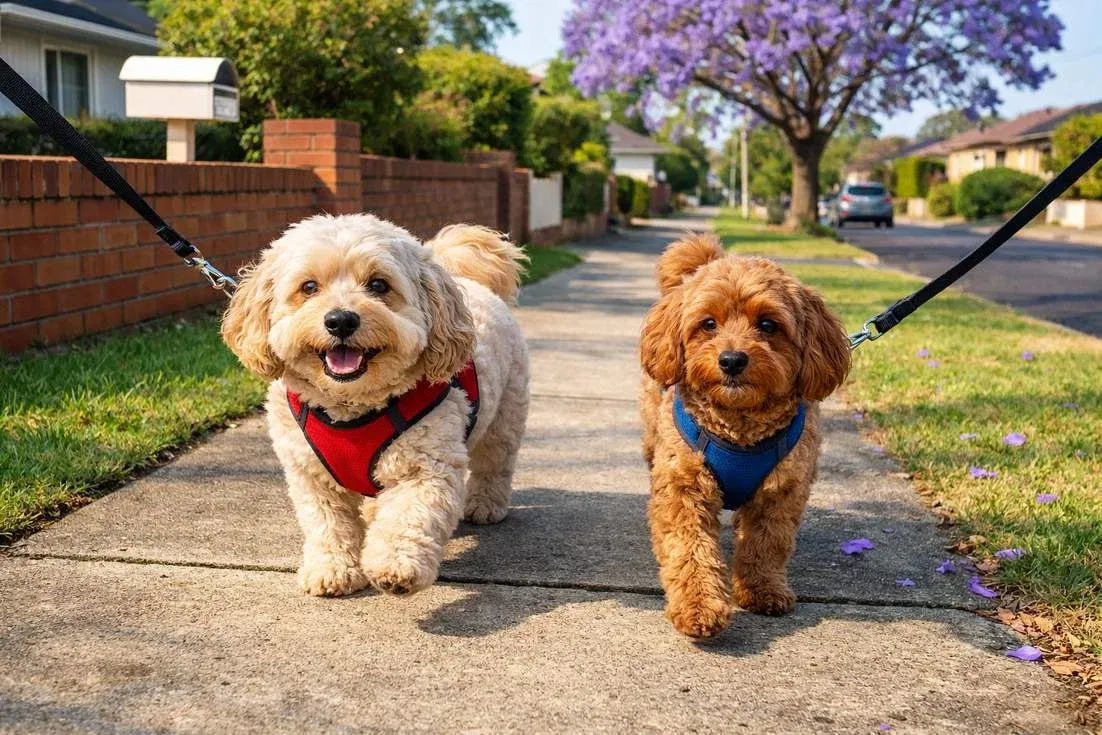
The Cockapoo’s Cocker Spaniel heritage means it has a genuine working-dog brain that needs to be occupied. A bored Cockapoo is a creative Cockapoo — and creativity in a bored dog means chewing, digging, barking, and inventing games you didn’t authorise. The Cocker’s strong nose also means Cockapoos can become obsessive sniffers, tracking scents to the exclusion of everything else (including your recall command). A solid sniff walk — where the dog leads and gets to investigate every smell — is one of the best exercises for a Cockapoo’s mental health.
The Cavoodle’s Cavalier heritage means it genuinely doesn’t need much exercise. A daily 30-minute walk and some playtime is typically sufficient. Cavoodles are world-class adapters — they’ll match your energy. Active family? They’ll keep up. Retirees who prefer gentle strolls? They’ll happily adjust. This adaptability is the Cavoodle’s superpower and the main reason it’s Australia’s most popular dog.
Training: Both Easy, Different Styles
Both breeds are intelligent (Poodle heritage guarantees this) and both are people-oriented, making training relatively straightforward for both. But their learning styles differ.
Cavoodles are classic people-pleasers. They want to make you happy, they respond quickly to praise and treats, and they retain commands well. They’re forgiving of beginner training mistakes and rarely test boundaries aggressively. If you’ve never trained a dog before, a Cavoodle is about as easy as it gets.
Cockapoos are smart but distractible. The Cocker Spaniel’s working heritage means they’re constantly processing environmental information — smells, sounds, movement. They’ll learn a command in three repetitions but then get distracted by a leaf blowing past before they can demonstrate it. Training sessions need to be short, varied, and highly engaging. They respond extremely well to positive reinforcement and clicker training but will tune out if sessions become repetitive. The upside: once they’re engaged, Cockapoos can learn complex tricks and tasks that would bore a Cavoodle.
Socialisation is important for both breeds but critical for Cavoodles specifically. The Cavalier can be naturally reserved, and under-socialised Cavoodles can become anxious or fearful. Early exposure to different people, dogs, environments, and sounds from 8-16 weeks pays dividends for life. Puppy school ($150-$400 for a 6-week course) is highly recommended for both breeds.

Living Arrangements
| Lifestyle Factor | Cockapoo (Spoodle) | Cavoodle (Cavapoo) |
|---|---|---|
| Apartment living | Good (with sufficient daily exercise and enrichment) | Excellent (one of Australia’s best apartment dogs) |
| House with yard | Excellent (loves garden access for exploration) | Excellent |
| Noise level | Moderate to high (alert barking, vocal excitement) | Low to moderate (occasional alert bark) |
| Tolerance for being alone | Poor to moderate (3-4 hours max without anxiety) | Moderate (4-6 hours with enrichment, but prefers company) |
| Work-from-home suitability | Excellent (loves being near you, settles after exercise) | Excellent (natural lap-desk companion) |
| Full-time office (8+ hours alone) | Poor — high separation anxiety risk, will bark and destroy | Poor to moderate — less destructive but still anxious |
| Multi-dog household | Excellent — thrives with canine companionship | Excellent — gentle with other dogs |
| Cat compatibility | Moderate — Cocker prey drive needs management | Good — Cavalier has low prey drive |
| Child suitability | Excellent — energetic match for active kids | Excellent — gentle, patient, ideal for younger children |
| Rental friendliness | Good — small, cute appearance helps | Excellent — small, quiet, non-threatening |
The Cavoodle’s rental-friendliness is a genuinely underappreciated advantage in Australia’s competitive rental market. Small size, low noise, non-threatening appearance, and clean coat make it one of the easiest breeds to get approved for rental properties. Cockapoos are also rental-friendly but the slightly higher barking tendency and higher energy can work against you in strata environments.
Both breeds suffer when left alone for extended periods, but the Cockapoo’s Cocker heritage makes this worse. Cocker Spaniels are bred to work alongside humans all day and their separation anxiety is well-documented. Cockapoos that are left alone regularly (6+ hours) commonly develop destructive behaviour, excessive barking, and stress-related health issues. If you work full-time in an office and nobody else is home, consider doggy daycare ($30-$50/day), a dog walker ($15-$30/visit), or honestly, a different breed.
Australian Climate
Both breeds handle the Australian climate well. Neither has the extreme double coat of a Samoyed or Husky, and their Poodle heritage gives them a single-layer or light double coat that’s more manageable in warmth than many breeds.
Standard heat precautions apply to both: exercise during cool hours in summer (early morning, evening), provide shade and fresh water, never leave in a hot car, be cautious on hot pavement. Cockapoos may tolerate more vigorous exercise in warm weather due to their leaner build, while Cavoodles — with their shorter muzzles (Cavalier influence) — can be slightly more susceptible to heat because brachycephalic features (even mild ones inherited from the Cavalier) reduce cooling efficiency. This is usually minor but worth noting for extreme heat days.
Both breeds are comfortable in all Australian climate zones except extreme tropical heat without air conditioning. Melbourne, Sydney, Brisbane, Perth, Adelaide, Hobart — all fine. Darwin and far north Queensland in summer — exercise with extra caution.
Costs Comparison
| Category | Cockapoo (Spoodle) | Cavoodle (Cavapoo) |
|---|---|---|
| Ethical breeder (DNA tested parents) | $1,500-$4,500 | $2,500-$5,000 |
| Premium breeder (multigen, specific colour) | $4,500-$6,500 | $4,500-$6,000 |
| Toy size (under 6 kg) | $2,000-$5,000 | $3,000-$6,000 (higher demand) |
| Rare colours (merle, phantom, tricolour) | $3,000-$6,500+ | $3,500-$6,000+ |
| Unregistered / Gumtree | $700-$2,000 (risky) | $1,000-$2,500 (risky) |
| Adoption / Rescue | $300-$800 | $400-$1,000 (rare in rescue) |
An important pricing observation: Cavoodles are typically $500-$1,500 more expensive than equivalent Cockapoos. This is driven entirely by demand — the Cavoodle is Australia’s most popular dog breed, and supply-demand dynamics push prices up. During the COVID-19 pandemic, Cavoodle prices reached $7,000-$15,000+. They’ve since normalised but remain at a premium. Cockapoos offer arguably equal or better value because the breed’s most serious genetic condition (FN) is fully preventable with DNA testing, while the Cavoodle’s most serious condition (MVD) is not.
Ongoing Annual Costs (AUD)
| Cost Category | Cockapoo (Spoodle) | Cavoodle (Cavapoo) |
|---|---|---|
| Food (premium quality) | $600-$1,200 | $500-$1,000 |
| Professional grooming | $500-$1,200 | $500-$1,200 |
| Vet (routine) | $400-$700 | $400-$700 |
| Pet insurance | $350-$800 ($30-$65/month) | $400-$900 ($35-$75/month) |
| Ear care (cleaning supplies, vet visits) | $200-$600 (Cocker ears = higher) | $100-$300 |
| Training | $150-$500 (first 1-2 years) | $150-$400 (first 1-2 years) |
| Dental care | $300-$600 (every 1-2 years) | $300-$600 (every 1-2 years) |
| Cardiac monitoring | N/A | $200-$800/year (if murmur develops) |
| TOTAL Annual | $2,500-$5,600 | $2,550-$5,900 |
Lifetime Cost Comparison
| Lifetime Factor | Cockapoo (Spoodle) | Cavoodle (Cavapoo) |
|---|---|---|
| Average lifespan | 13-18 years | 12-15 years |
| Purchase price | $1,500-$4,500 | $2,500-$5,000 |
| Total ongoing costs | $32,500-$100,800 | $30,600-$88,500 |
| Emergency vet fund (breed-specific) | $2,000-$5,000 (ears, general) | $3,000-$10,000 (cardiac especially) |
| ESTIMATED LIFETIME TOTAL | $36,000-$110,000 | $36,000-$104,000 |
Lifetime costs are remarkably similar. The Cockapoo’s longer average lifespan means higher total ongoing costs despite lower annual expenses. The Cavoodle’s cardiac risk pushes emergency vet costs higher, and pet insurance premiums tend to be slightly higher for Cavoodles because insurers factor in the Cavalier’s health profile. Neither breed is “cheap” — budget $3,000-$6,000 annually for comfortable ownership of either.
Finding a Breeder in Australia
Neither breed is ANKC recognised (both are designer crossbreeds), which means there are no kennel club standards, no pedigree papers, and no official breeding oversight. The quality gap between the best and worst breeders is enormous. Puppy farms and backyard breeders are rampant in both breeds, particularly Cavoodles (Australia’s most popular dog = most profitable for mills).
What Every Breeder Should Provide (Both Breeds)
DNA health testing of both parents (at minimum through Orivet or equivalent). Specific health guarantee (minimum 2 years, ideally 3-5 years for genetic conditions). Vaccination, microchipping, first worming. Take-back policy for the life of the dog. Willingness to show you the mother and the home environment. RPBA, MDBA, or RightPaw verification (not equivalent to ANKC but provides some oversight). Transparency about generation (F1, F1B, F2, multigen) and expected adult size.
Breed-Specific Breeder Tests
| Test | Which Breed / Why |
|---|---|
| Familial Nephropathy (FN) DNA test | COCKAPOO — Non-negotiable. Both parents must test CLEAR. Affected puppies will die. |
| prcd-PRA DNA test | BOTH — Progressive Retinal Atrophy affects both Cockers and Poodles. Both parents should be clear or carrier (never carrier x carrier). |
| Cardiac screening (auscultation) | CAVOODLE — Essential. Cavalier parent should be heart-clear and ideally over 5 years old. Annual screening. |
| Cardiac echocardiogram | CAVOODLE — Gold standard for MVD screening. More reliable than auscultation alone. |
| MRI for syringomyelia | CAVOODLE — Ideal but rarely performed (expensive). Ask if breeder’s Cavalier lines have history of SM. |
| Episodic Falling Syndrome DNA test | CAVOODLE — Cavalier-specific. Both parents should test clear. |
| Von Willebrand Disease DNA test | BOTH — Poodle-inherited blood clotting disorder. |
| Hip/elbow scoring | COCKAPOO — Especially if using English Cocker Spaniel parent. |
| PFK Deficiency DNA test | COCKAPOO — Cocker and Poodle specific enzyme deficiency. |
Where to Find Breeders
RightPaw (rightpaw.com.au) — Australia’s most trusted breeder verification platform. Vets breeders for health testing and ethical practices. Lists both Spoodle and Cavoodle breeders. This should be your first stop. Banksia Park Puppies (VIC) — 50+ years breeding, offers both Cavoodles and Spoodles, 5-year genetic health guarantee. Cottage Canines (NSW) — DNA tested, various crossbreeds. Valley View Dogs (VIC) — Specialise in multigenerational Spoodles, 30+ years experience, rare chocolate lines. MDBA (Master Dog Breeders and Associates) — Crossbreed registry with some oversight.
Avoid: Gumtree and Facebook Marketplace unless you can verify full DNA testing results and meet both parents in the home environment. During COVID, the ACCC reported 1,047 puppy scams in the first seven months of 2020, with 184 specifically involving Cavoodles and nearly $1 million in losses. The scam risk remains real.
BSL, Registration and Rental
BSL (Breed-Specific Legislation): Neither breed appears on any Australian restricted or banned breed list. Zero BSL concerns for either breed.
ANKC registration: Neither breed is ANKC recognised. Neither can be shown in ANKC conformation events. Both can participate in ANKC performance events (agility, obedience, rally) through the Associate Register in some states.
Council registration: Standard rates apply. Typically $30-$60/year desexed, $100-$200+ entire. No breed-specific surcharges.
Rental and strata: Both breeds are small, non-threatening and rental-friendly. Cavoodles have a slight advantage due to lower barking tendency and quieter nature. Both breeds’ teddy-bear appearance works in your favour with landlords. RPBA or breeder documentation can support rental applications.
Pet insurance: Both breeds are classified as mixed/crossbreed by all major Australian insurers. Cavoodle premiums are slightly higher due to inherited Cavalier cardiac risk. Confirm coverage for heart conditions (Cavoodle) and ear infections (Cockapoo) before purchasing a policy. Insure before 12 weeks to avoid pre-existing condition exclusions.
Which Breed Should You Choose?
You want a calm, gentle, adaptable companion that fits into almost any lifestyle. You live in an apartment and need a quiet, small dog. You’re a first-time dog owner and want the most forgiving, easiest-to-train option. You’re a retiree or low-energy household that wants affection without high exercise demands. You have young children and want the most gentle, patient option. You understand and accept the MVD risk from the Cavalier side and will budget for cardiac monitoring. You want Australia’s most popular dog (extensive community, resources and vet familiarity).
You lead an active lifestyle and want a dog that can match your energy. You enjoy dog sports, bush walks, beach outings and want a willing participant. You prefer a slightly more robust, athletic build. You value the ability to DNA-test out the most serious genetic conditions (FN is fully preventable). You have older children who want an energetic play partner. You’re comfortable providing 45-75 minutes of daily exercise and mental enrichment. You don’t mind slightly higher barking levels and can manage ear care commitments.
You want coat and size predictability — get a Toy or Miniature Poodle (same intelligence, genuinely low-shedding, ANKC registered, predictable size and temperament). You want the Cavalier’s gentle temperament with kennel club backing — get a Cavalier King Charles Spaniel (accept the health risks knowingly, or find a breeder with extensive cardiac screening). You want the Cocker’s athleticism with breed standard — get an English Cocker Spaniel (yes it sheds, but it’s ANKC registered with established health screening protocols).
These are both excellent family dogs. They’re both Poodle crosses that produce friendly, intelligent, affectionate, low-shedding companions. The marketing makes them sound interchangeable. They’re not.
The Cavoodle is the calmer, quieter, more adaptable choice — Australia’s most popular dog for good reason. It fits almost any lifestyle, requires less exercise, barks less, and has a gentler overall temperament. Its Achilles heel is the Cavalier’s heart: MVD is a near-universal condition in the parent breed, it’s not DNA testable, and crossbreeding reduces but doesn’t eliminate the risk. If you choose a Cavoodle, budget for cardiac monitoring and choose a breeder who screens Cavalier parents aggressively.
The Cockapoo is the more energetic, more athletic, more vocal choice — a dog with genuine working-dog intelligence and drive. It needs more exercise, more mental stimulation, and produces more noise. But its biggest genetic risk (Familial Nephropathy) is fully preventable with a simple DNA test, making it arguably the healthier choice for buyers who prioritise genetic certainty. It’s also typically cheaper to purchase. If you choose a Cockapoo, budget for ear care and commit to the exercise.
The right choice isn’t about which breed is better. It’s about which Spaniel’s legacy — the Cavalier’s gentle heart (with its literal heart problems) or the Cocker’s working energy (with its ear infections and preventable kidney disease) — fits your life.
Frequently Asked Questions
Is a Cockapoo the same as a Spoodle?
Yes. Cockapoo is the international name (used in USA, UK, Europe). Spoodle is the Australian name. Both refer to a Cocker Spaniel x Poodle cross. Cockerdoodle is occasionally used in Australia. They’re all the same dog.
Is a Cavoodle the same as a Cavapoo?
Yes. Cavoodle is the Australian/NZ name. Cavapoo (or Cavadoodle) is used internationally. Both refer to a Cavalier King Charles Spaniel x Poodle cross.
Which breed is better for apartments?
The Cavoodle is the superior apartment dog — calmer, quieter, lower exercise needs, and more content in small spaces. Cockapoos can live in apartments but need more daily exercise and are more vocal, which can cause noise issues in strata buildings.
Which breed is healthier?
The Cockapoo has an advantage in genetic testability: its most serious inherited condition (Familial Nephropathy) is fully preventable with a DNA test. The Cavoodle inherits the Cavalier’s Mitral Valve Disease risk, which is not DNA testable and affects the majority of Cavaliers. However, individual health depends on breeder practices, and many Cavoodles live long, healthy lives.
Which breed lives longer?
Cockapoos tend to live slightly longer on average (13-18 years vs 12-15 years for Cavoodles). This is partly because Cocker Spaniels are generally longer-lived than Cavalier King Charles Spaniels, and partly because the Cavalier’s cardiac burden shortens its lifespan.
Are Cockapoos harder to train than Cavoodles?
Not harder, but different. Cockapoos are very intelligent but more easily distracted (Cocker Spaniel nose and working brain). They learn quickly but need varied, short, engaging training sessions. Cavoodles are classic people-pleasers who respond well to straightforward positive reinforcement. For first-time owners, the Cavoodle is slightly easier.
How much does each breed cost per year in Australia?
Cockapoo: approximately $2,500-$5,600 AUD per year. Cavoodle: approximately $2,550-$5,900 AUD per year. Costs are very similar, with the Cavoodle’s potential cardiac expenses and slightly higher insurance premiums balanced by the Cockapoo’s higher ear care costs.
Do I need to worry about Cavalier heart disease in a Cavoodle?
Yes. Crossing a Cavalier with a Poodle may reduce the severity or delay the onset of Mitral Valve Disease, but it does not eliminate the risk. MVD affects over 50% of purebred Cavaliers by age 5 and is the leading cause of death in the breed. The best protection is choosing a breeder who performs annual cardiac screening (ideally echocardiography) on Cavalier parents and only breeds heart-clear dogs over 5 years old.
1. CavalierHealth.org — Mitral Valve Disease and the Cavalier King Charles Spaniel: https://cavalierhealth.org/mitral_valve_disease.htm
2. UFAW — Cavalier King Charles Spaniel – Mitral Valve Disease: https://www.ufaw.org.uk/dogs/cavalier-king-charles-spaniel-mitral-valve-disease
3. UFAW — Cocker Spaniel – Familial Nephropathy: https://www.ufaw.org.uk/dogs/cocker-spaniel—familial-nephropathy
4. AKC Canine Health Foundation — Gene Discovered for Familial Nephropathy in English Cocker Spaniels: https://www.akcchf.org/research/research-portfolio/0003.html
5. Paw Print Genetics — Familial Nephropathy (Cocker Spaniel Type): https://www.pawprintgenetics.com/products/tests/details/103/
6. PMC — Degenerative Valvular Disease in the Cavalier King Charles Spaniel: Results of the UK Breed Scheme 1991–2010: https://pmc.ncbi.nlm.nih.gov/articles/PMC5259630/
7. RightPaw — How Much Does a Cavoodle Cost: https://www.blog.rightpaw.com.au/post/how-much-does-a-cavoodle-cost
8. RightPaw — Spoodle Breeders Australia: https://rightpaw.com.au/dogs/breed/spoodle
9. Valley View Dogs — Spoodle Information: https://www.valleyviewdogs.com/spoodles.htm
10. MyCavoodle.com.au — COVID-19 Pricing Impact: https://www.mycavoodle.com.au/blogs/news/3-main-reasons-covid-19-inflated-the-price-of-cavoodle-puppies-in-australia
Category Tags: Breeds | Designer Dogs | Poodle Crosses | Family Dogs | Apartment Dogs | First-Time Owner Dogs