
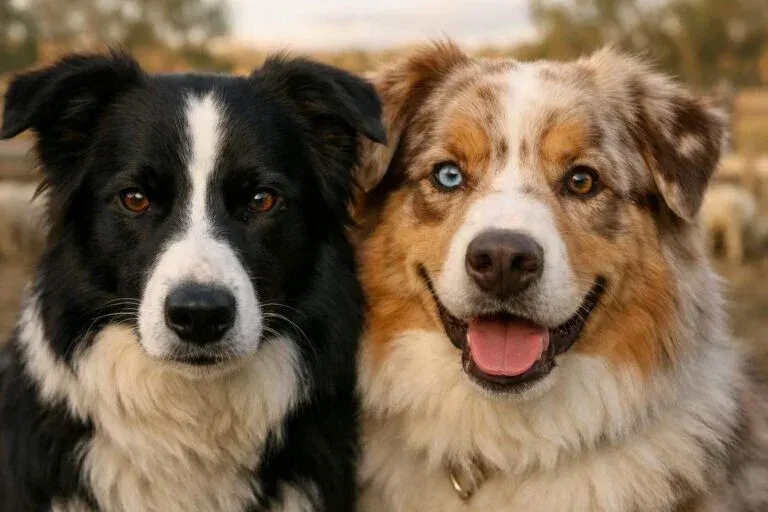
Both of these dogs are smarter than most people’s coworkers. The Border Collie is consistently ranked the most intelligent dog breed on the planet. The Australian Shepherd is right behind it. Both herd, both learn at frightening speed, and both will train you if you’re not paying attention. But living with a Border Collie is a very different experience from living with an Aussie. The Border Collie is the laser-focused valedictorian who finishes the exam early and judges you for being slow. The Australian Shepherd is the enthusiastic class president who aces everything while also organising the school dance. Same IQ bracket, completely different energy. Here’s what actually matters when choosing between them in Australia.
What You’ll Learn
- Breed traits & temperament
- Health concerns to know
- True cost in Australia
- Training & exercise needs
- Is this breed right for you?
Quick Fact at a Glance
| Trait | Border Collie | Australian Shepherd (Aussie) |
|---|---|---|
| Origin | Anglo-Scottish border region | Western United States (not Australia) |
| Size (Height) | 46–56 cm (male) | 46–53 cm (female) | 51–58 cm (male) | 46–53 cm (female) |
| Weight | 14–25 kg | 18–30 kg |
| Lifespan | 12–15 years | 12–15 years |
| Coat Type | Double coat — rough (medium-long) or smooth (short) | Double coat — medium-length, always |
| Shedding Level | High — biannual coat blow | High — biannual coat blow |
| Eye Colour | Usually brown (rarely blue) | Blue, brown, amber, heterochromia common |
| Energy Level | Very High — intense, driven | Very High — enthusiastic, playful |
| Trainability | Exceptional — #1 ranked intelligence | Excellent — eager to please, top-tier |
| Barking Level | Moderate — alert barking, herding context | Moderate–High — more vocal overall |
| Good With Kids | Better with older children (may herd young kids) | Good with all ages — more adaptable |
| Good With Other Dogs | Generally good — can be reserved | Good — more socially outgoing |
| Apartment Friendly | No — needs space and a job | No — needs space and activity |
| Puppy Price (AUD) | $1,500 – $4,000 | $1,500 – $3,500 |
| ANKC Group | Group 5 (Working Dogs) | Group 5 (Working Dogs) |
Where Did they Come From?
The Border Collie was developed along the border between England and Scotland, where it became the premier sheepdog of the British Isles. The breed’s defining moment came in 1893 when a dog named Old Hemp demonstrated an entirely new herding style — using intense eye contact (known as “eye”) and crouching body language to control sheep without barking or nipping. Old Hemp is considered the progenitor of the modern Border Collie. The breed was refined over centuries purely for working ability, not appearance. Function always came first, which is why Border Collies today vary more in looks than most breeds but are remarkably consistent in their drive and intelligence.
The Australian Shepherd, despite its name, is an American breed. The most widely accepted theory is that Basque shepherds from the Pyrenees region of Spain originally brought their herding dogs to Australia, then migrated to the American West in the 1800s, bringing the dogs with them. American ranchers refined the breed to work cattle and sheep across the rugged terrain of the Rocky Mountains. The “Australian” name likely came from the breed’s association with Australian Merino sheep or its blue merle colouring, which was common in dogs imported from Australia. The Aussie gained enormous popularity after World War II through rodeo performances and horse shows, and was recognised by the AKC in 1993.
What this means for you: the Border Collie was bred for one job — herding sheep with obsessive focus and precision. The Aussie was bred as a versatile ranch dog that could herd, guard, and be a family companion. These origins directly explain their temperament differences: the Border Collie is more singularly focused; the Aussie is more well-rounded.
How to Tell Them Apart
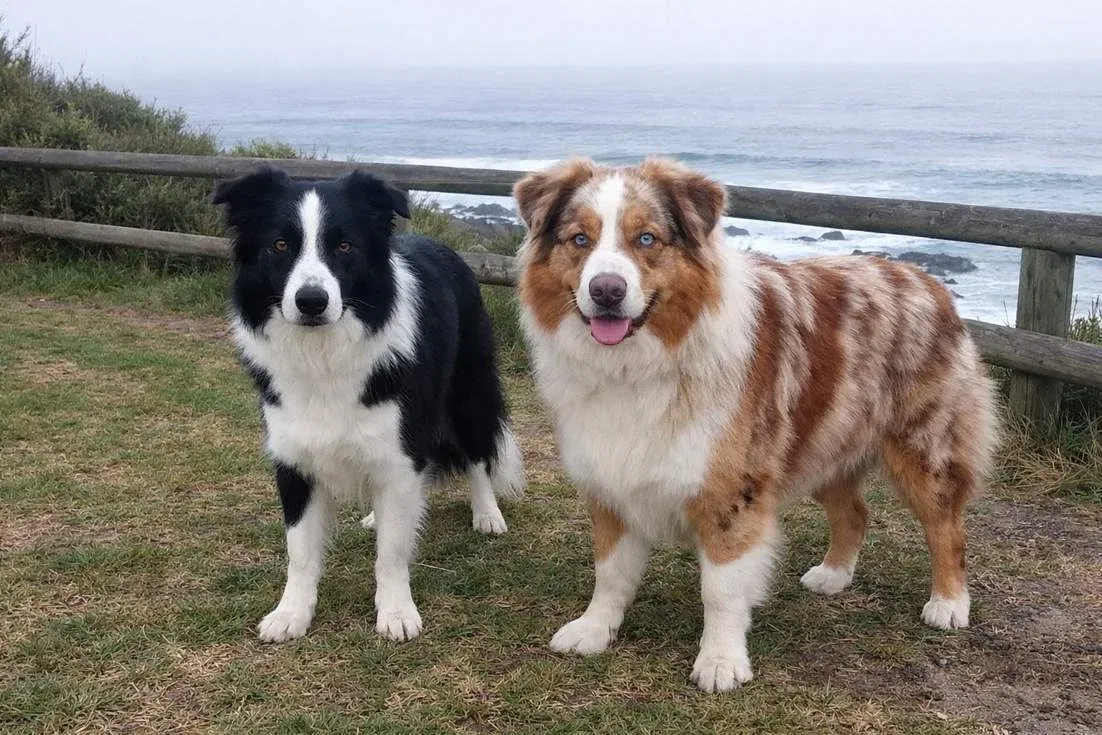
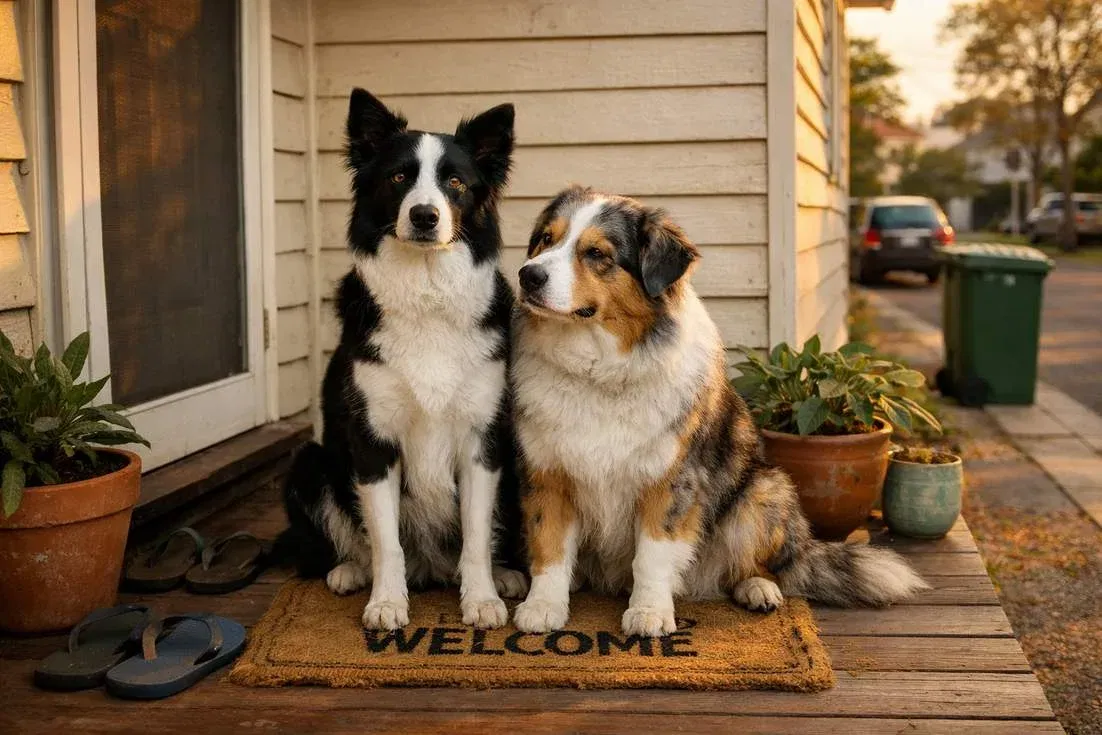
At first glance, these breeds look remarkably similar — medium-sized, fluffy, often merle-patterned. But there are reliable visual differences once you know what to look for.
Build: Aussies are slightly stockier and more muscular, with a wider face and a sturdier frame built for rough ranch work. Border Collies are leaner, more athletic, and more agile — built for speed and quick directional changes when herding.
Tail: This is the easiest tell. Border Collies always have a long, natural tail that hangs low. Many Aussies are born with a natural bobtail (short or absent tail), and historically their tails were docked. If you see a merle herding dog with a bobtail, it’s almost certainly an Aussie.
Eyes: Aussies are famous for heterochromia (two different coloured eyes) and commonly have blue, amber, or marbled eyes. About 32% of Aussies have heterochromatic eyes. Border Collies usually have brown eyes, and blue eyes are uncommon in the breed.
Physical Comparison at a Glance
| Physical Trait | Border Collie | Australian Shepherd |
|---|---|---|
| Build / Frame | Lean, athletic, agile | Stockier, muscular, sturdy |
| Head Shape | Refined, narrower muzzle | Broader head, wider muzzle |
| Tail | Long, natural, hangs low | Bobtail common (natural or docked) |
| Ear Type | Semi-erect (tips fold forward) | Triangular, more significant fold |
| Eye Colour | Usually brown (blue rare) | Blue, brown, amber, heterochromia common |
| Coat Varieties | Rough (medium-long) OR smooth (short) | Medium-length only (always rough) |
| Common Colours | Black/white most iconic; also red, blue merle, tricolour, sable, lilac, brindle | Blue merle, red merle, black, red — often tricolour with tan points |
What Are They Actually Like to Live With?
Both breeds are smart, energetic, and need a job. But the daily experience of living with each is noticeably different.
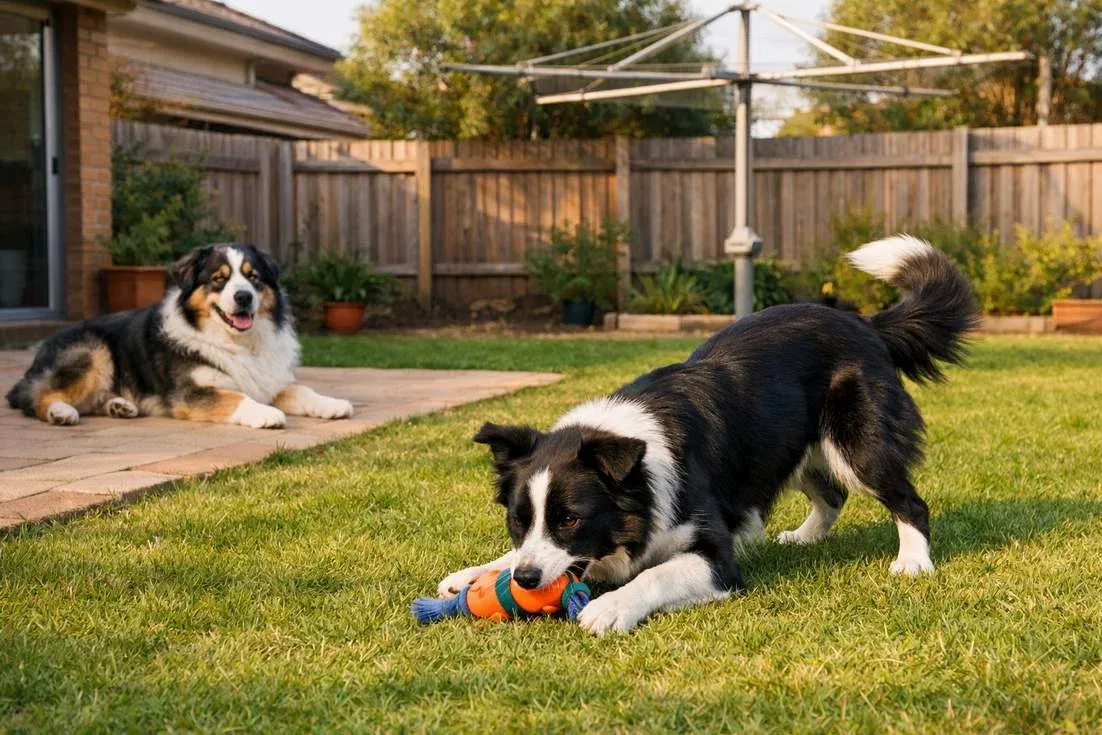
Intensity and focus: This is the single biggest temperament difference. Border Collies are intense. They fixate on tasks with laser-like concentration — the famous “eye” they use to control sheep extends to everything in their environment. A Border Collie will stare at a tennis ball for 20 minutes waiting for you to throw it. They’re always “on,” always processing, always looking for something to work on. Living with a BC has been compared to living with a Mensa student who never sleeps. Aussies are also smart and driven, but they’re more playful about it. They bring enthusiasm and energy rather than obsessive focus. An Aussie will chase the ball, bring it back, do a spin, check on the kids, and then come back for another throw. They have more of an “off switch” than Border Collies, though both breeds need to be taught to relax.
Sensitivity: Border Collies are notably more emotionally sensitive. They pick up on subtle changes in tone, body language, and routine. A harsh correction can shut a Border Collie down for hours. They can be reactive to loud noises, sudden movements, and environmental changes. Aussies are more emotionally resilient and adaptable — still sensitive compared to, say, a Labrador, but more forgiving of handler mistakes and household chaos.
Family and kids: Aussies are the better family dog for households with young children. They’re more adaptable, more socially outgoing, and more tolerant of the unpredictable energy of kids. Border Collies can be wonderful with children but are more likely to try to herd them — nipping at heels, circling, and controlling movement. This herding instinct can frighten young children and is a common behaviour issue in BC households. Both breeds need to be taught that herding family members is not acceptable.
Strangers and social situations: Aussies are more socially confident and generally friendlier with strangers, though they can be protective. Border Collies tend to be more reserved and may be cautious around new people. Neither breed is aggressive, but the BC’s reserve can sometimes be mistaken for standoffishness.
Herding instinct: Both breeds will try to herd anything that moves — children, other dogs, cyclists, joggers, even cars. The key difference is how they herd. Border Collies use “eye” — a silent, intense stare combined with crouching and controlled movement. Aussies use “driving” — they bark, bump, and push. Both styles need to be managed through training and socialisation.
Health Issues
Both breeds are generally healthy and long-lived (12–15 years), sharing many of the same genetic health concerns due to their herding breed background.
Shared concerns: Both breeds are prone to hip dysplasia, Collie Eye Anomaly (CEA), progressive retinal atrophy (PRA), and epilepsy. Responsible breeders in Australia DNA test for these conditions. Both breeds can also carry the MDR1 gene mutation, which causes dangerous sensitivity to certain common medications (including ivermectin, found in some worming products). An MDR1 test is essential before administering any medication.
Border Collie-specific: BCs have a higher incidence of Trapped Neutrophil Syndrome (TNS), a fatal immune disorder, and Neuronal Ceroid Lipofuscinosis (CL), a fatal neurological condition. Both can be detected through DNA testing, and reputable breeders screen for these. Border Collies can also develop obsessive-compulsive behaviours (shadow chasing, light fixation, tail chasing) if under-stimulated or over-stressed.
Australian Shepherd-specific: The Aussie’s biggest genetic risk is related to the merle gene. Breeding two merle-coloured Aussies together can produce “double merle” (homozygous merle) puppies, which have a very high risk of being born deaf, blind, or both. This is a well-documented and preventable tragedy — never buy a puppy from a breeder who mates two merle dogs. Aussies also have a slightly higher incidence of autoimmune conditions and certain cancers compared to Border Collies.
Common Health Costs Comparison
| Health Concern | Border Collie Risk | Australian Shepherd Risk |
|---|---|---|
| Hip Dysplasia | Moderate | $4,000–$10,000+ AUD surgery | Moderate | $4,000–$10,000+ AUD surgery |
| Eye Conditions (CEA, PRA) | Moderate–High | $300–$4,000 AUD | Moderate–High | $300–$4,000 AUD |
| Epilepsy | Moderate | $50–$150 AUD/month medication | Moderate | $50–$150 AUD/month medication |
| MDR1 Drug Sensitivity | Moderate — DNA test essential ($70–$150) | Moderate — DNA test essential ($70–$150) |
| TNS / CL (fatal disorders) | Low if tested (BC-specific) | DNA test $70–$200 | Not applicable |
| Double Merle Defects | Not applicable | HIGH if merle-to-merle bred — preventable |
| Autoimmune Conditions | Low–Moderate | Moderate |
| Est. Annual Vet Costs | $600 – $2,000 AUD | $600 – $2,000 AUD |
The MDR1 gene mutation is a critical safety issue for both breeds. Always test before administering worming products containing ivermectin or similar drugs. Inform your vet that your dog is a herding breed, and carry MDR1 status information with you.
Grooming — Which Is More Work?
| Grooming Task | Border Collie | Australian Shepherd |
|---|---|---|
| Brushing (Normal) | 2–3 times/week (rough) | 1/week (smooth) | 2–3 times per week |
| Brushing (Coat Blow) | Daily — heavy undercoat removal | Daily — heavy undercoat removal |
| Professional Grooming | Optional (every 8–12 weeks) | Recommended (every 6–10 weeks) |
| Shedding Volume | High (rough) | Moderate (smooth) | High |
| Matting Risk | Moderate — behind ears, chest, feathering | Moderate–High — thicker coat mats more easily |
| Bathing | Every 6–8 weeks | Every 4–6 weeks |
| Nail Trimming | Every 2–3 weeks | Every 2–3 weeks |
Australian Shepherds are slightly more grooming-intensive overall because their coat is always medium-length and thick. Border Collies with the smooth (short) coat variety are noticeably easier to maintain. Both breeds should never be shaved — their double coat protects against both heat and cold, and shaving can permanently damage the coat texture.
How Active Are They Really?
| Exercise Factor | Border Collie | Australian Shepherd |
|---|---|---|
| Daily Exercise Needed | 1–2 hours (physical + mental) | 1–1.5 hours (physical + mental) |
| Preferred Activities | Herding trials, agility, flyball, frisbee, obedience | Agility, trick training, hiking, frisbee, ranch work |
| Mental Stimulation Need | Critical — must have a “job” or develops problems | High — needs engagement but slightly more self-entertaining |
| Off-Leash Reliability | Good — with training (strong recall when trained) | Good — with training |
| If Under-Exercised… | Obsessive behaviours, herding family, neurotic pacing, destructiveness | Barking, chewing, digging, hyperactivity |
| Suited to Running Partner | Excellent — thrives on sustained running | Excellent — strong endurance runner |
| “Off Switch” | Harder to achieve — needs to be actively taught | Slightly easier — more natural ability to settle |
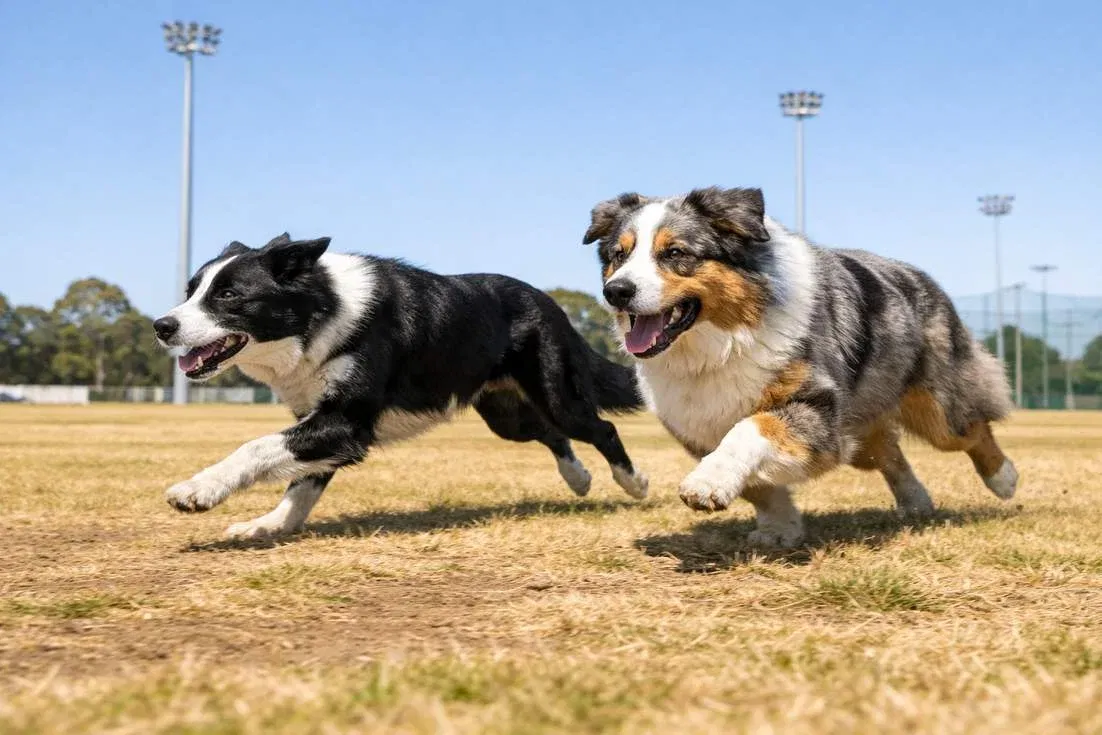
A critical note on mental stimulation: physical exercise alone is not enough for either breed. A tired Border Collie that hasn’t been mentally challenged will still be restless and problematic. Both breeds need puzzle toys, training sessions, nose work, or a structured “job” (even if that job is learning tricks or doing household tasks). Dog sports — agility, flyball, herding trials, obedience — are the best outlets and are widely available across Australia through state kennel clubs.
Training: which one Easier to Train?
Both breeds are among the easiest dogs to train in terms of raw learning speed. The Border Collie is widely regarded as the most intelligent dog breed, and the Aussie isn’t far behind. Both learn new commands in fewer than five repetitions and obey first commands over 95% of the time. But intelligence doesn’t automatically mean easy.
Border Collies learn so fast that they can pick up bad habits just as quickly as good ones. They’re also sensitive to inconsistency — if you give a command differently once, they’ll notice and may become confused or anxious. Their intensity means they can develop obsessive behaviours (fixating on shadows, lights, or specific objects) if not given proper outlets. Training a Border Collie requires precision, consistency, and an understanding of their emotional sensitivity.
Australian Shepherds are more forgiving in training. They’re eager to please, enthusiastic learners, and bring a playful energy to training sessions. They may add their own creative flair to tricks and commands, which can be endearing or frustrating depending on your perspective. Aussies are slightly less prone to anxiety-driven behaviours than Border Collies, making them a better choice for less experienced owners who still want a highly trainable dog.
For first-time herding breed owners: the Aussie is the gentler introduction. Border Collies are better suited to experienced handlers or owners committed to learning herding breed management. Both breeds respond exclusively to positive reinforcement — punishment-based methods will create fear, anxiety, and shutdown in both breeds.
Which Costs More in Australia?
| Cost Category | Border Collie (AUD) | Australian Shepherd (AUD) |
|---|---|---|
| Puppy (Registered Breeder) | $1,500 – $4,000 | $1,500 – $3,500 |
| Working-Line Puppy | $800 – $2,000 (farm-bred) | Less common in Aus |
| Rescue/Adoption | $200 – $600 | $300 – $700 |
| First-Year Setup | $1,500 – $3,000 | $1,500 – $3,000 |
| Monthly Food Cost | $60 – $120 | $70 – $140 |
| Annual Ongoing Costs | $1,500 – $3,000 | $1,500 – $3,000 |
| Pet Insurance (Monthly) | $30 – $70 | $35 – $80 |
| Lifetime Cost (Est.) | $20,000 – $40,000 | $22,000 – $42,000 |
Border Collies have a unique pricing dynamic in Australia: working-line puppies bred specifically for farm work can be significantly cheaper ($800–$2,000) than show-line or companion puppies from registered breeders. This reflects the breed’s strong working dog heritage in Australian agriculture. Aussies don’t have this same working-line price tier in Australia. Both breeds benefit enormously from dog sports, which do come with their own costs (club memberships typically $50–$200 AUD/year, equipment, and event entry fees).
which one for Australian Owners
Climate suitability: Both breeds handle the Australian climate reasonably well. Their double coats insulate against heat as well as cold (never shave them). Both need shade, fresh water, and common-sense heat management on days over 35°C, but neither breed is as heat-sensitive as Arctic breeds. Early-morning and late-evening exercise during summer is standard practice. Both breeds do well across all Australian states and territories with appropriate management.
BSL (Breed-Specific Legislation): Neither breed is affected by BSL in any Australian state or territory. No restrictions, no permits, no concerns.
Working dog heritage: Border Collies have an incredibly strong working dog presence in Australian agriculture. They are the most widely used sheep and cattle dog breed on Australian farms. This means there’s a robust community of Border Collie breeders, trainers, and trial organisations across the country. The Working Sheepdog Association of Australia and state-based working dog associations run herding trials year-round. Australian Shepherds have a smaller but growing presence in Australia, primarily through the show and companion dog community rather than farming.
Dog sports: Both breeds are superstars in Australian dog sports. Agility, flyball, obedience trials, trick dog competitions, and disc dog events are run by state kennel clubs and breed-specific clubs nationwide. Dog sports are strongly recommended for both breeds — they provide the mental and physical stimulation these dogs need and are an excellent way to bond with your dog.
MDR1 warning for Australian owners: Both breeds can carry the MDR1 gene mutation, which causes life-threatening reactions to common medications including ivermectin (found in many cattle and sheep worming products). If you live on a farm or in a rural area where livestock worming products are used, ensure your dog has been MDR1 tested and keep all ivermectin-containing products securely stored. Inform your vet that your dog is a herding breed and may be MDR1-positive.
Rental and council: Both breeds are medium-sized and generally accepted in rental properties. Neither is commonly blacklisted by strata bodies. Their moderate size (14–30 kg) falls within most landlord weight limits. Standard council registration fees apply.
So, which one Should You Get?
- You want the smartest dog on the planet and are prepared to keep that brain occupied.
- You’re interested in competitive dog sports (agility, herding trials, flyball, obedience).
- You’re experienced with herding breeds and understand their sensitivity and intensity.
- You work on a farm or property and want a genuine working sheepdog.
- Your household is calm, predictable, and has older children (8+).
- You want a highly intelligent, trainable dog that’s also a great family companion.
- You have younger children — the Aussie is more adaptable and tolerant of chaos.
- You’re a first-time herding breed owner and want a slightly more forgiving introduction.
- You want a dog that’s social, outgoing, and confident in varied environments.
- You’re active but want a dog that can also learn to relax at home without constant management.
- You want a low-energy couch companion. Neither breed will settle for a short daily walk.
- You work full-time away from home with no plan for daytime stimulation. A bored herding dog will destroy your house creatively and thoroughly.
- You don’t want to deal with shedding. Both breeds shed significantly.
- You have a house full of small children and no experience with herding breeds. The herding instinct (nipping heels, circling, controlling movement) needs active management.
- The Border Collie is the ultimate working dog brain: intense, focused, sensitive, and unmatched in raw intelligence. It’s the right choice for experienced owners, competitive dog sport enthusiasts, and farmers who need a working partner.
- The Australian Shepherd is the versatile all-rounder: smart, playful, social, and slightly more adaptable to family life. It’s the right choice for active families, first-time herding breed owners, and anyone who wants a top-tier companion dog that can also compete in sports.
- In Australia, Border Collies have a deeper working dog infrastructure (farm lines, herding trials, working dog associations), while Aussies are more commonly found through the show and companion dog community. Both breeds are well-served by rescue organisations — herding breed rescues regularly have both BCs and Aussies looking for experienced homes.
Border Collie vs Australian Shepherd: Frequently Asked Questions
Which breed is smarter — a Border Collie or an Australian Shepherd?
The Border Collie is consistently ranked the most intelligent dog breed in the world, based on Stanley Coren’s intelligence rankings and subsequent research. The Australian Shepherd typically ranks in the top 10–15. In practical terms, both breeds are exceptionally intelligent and learn commands in fewer than five repetitions. The difference is more about how they use their intelligence: Border Collies are more focused and task-driven; Aussies are more creative and playful.
Are Australian Shepherds actually from Australia?
No. Despite their name, Australian Shepherds were developed in the western United States. The “Australian” label likely comes from their association with Australian Merino sheep or from the blue merle coat pattern common in dogs imported from Australia. The breed’s true origins trace to Basque sheepherders who migrated from Europe to Australia and then to America.
Which breed is better for families with young children?
Australian Shepherds are generally the better choice for families with young children. They’re more adaptable, socially outgoing, and tolerant of unpredictable household energy. Border Collies can be wonderful with children but are more likely to try to herd them (nipping at heels, circling, controlling movement), which can frighten young kids and requires active management.
What is the MDR1 gene and why does it matter?
MDR1 (Multi-Drug Resistance 1) is a gene mutation common in herding breeds that causes dangerous sensitivity to certain medications, including ivermectin (found in many worming products). Dogs with two copies of the mutant gene can have severe, life-threatening reactions to these drugs. Both Border Collies and Australian Shepherds should be DNA tested for MDR1 status, and all vets treating these breeds should be informed. An MDR1 test costs $70–$150 AUD and is a one-time investment.
What is a double merle and why should I avoid buying one?
A double merle (homozygous merle) is produced when two merle-coloured dogs are bred together. Double merle puppies have a very high risk of being born deaf, blind, or both. This is a well-documented and entirely preventable welfare issue. Never buy a puppy from a breeder who mates two merle dogs. This primarily affects Australian Shepherds (where merle is common) but can also affect merle Border Collies.
Do Border Collies really need a “job”?
Yes, but the “job” doesn’t have to involve actual livestock. Any structured mental activity counts: agility training, trick training, nose work, puzzle toys, fetch routines, or even household tasks (carrying items, finding hidden objects). The key is that a Border Collie’s brain needs regular, structured engagement. Without it, they’ll invent their own job — and you probably won’t like what they come up with.
How much exercise do these breeds actually need?
Both breeds need 1–2 hours of physical exercise daily, plus mental stimulation. However, an experienced farmer once noted that working sheepdogs actually spend most of their day resting between tasks — the key isn’t constant activity but rather meaningful, focused bursts of work followed by genuine downtime. Teaching your dog an “off switch” (the ability to settle and relax on command) is just as important as exercising them.
Can I keep a Border Collie or Aussie in an apartment?
It’s not ideal for either breed. Both need outdoor space for running and play. However, if you’re genuinely committed to 1–2 hours of daily outdoor exercise, regular dog sport training, and plenty of mental enrichment, an Aussie can adapt to apartment living better than a Border Collie. BCs tend to be more reactive to environmental stimuli (sounds, movement) in confined spaces.
Which breed sheds more?
Shedding is comparable for both breeds — both have double coats that shed year-round with dramatic biannual coat blows. Australian Shepherds may shed slightly more overall due to their consistently thick coat. Border Collies with the smooth (short) coat variety shed less than either the rough-coated BC or the Aussie. Neither breed is suitable for people with dog allergies.
Are there Miniature Australian Shepherds?
Yes — the Miniature American Shepherd (originally marketed as the Miniature Australian Shepherd) is a separate, recognised breed that stands 33–46 cm tall and weighs 9–18 kg. It’s essentially a scaled-down Aussie with a similar temperament. This breed is growing in popularity in Australia but has a smaller breeder community. If you love the Aussie personality but want a smaller dog, the Miniature American Shepherd is worth investigating.
1. ANKC Breed Standard — Border Collie: https://ankc.org.au/breeds/breed-standard/?breedId=261
2. ANKC Breed Standard — Australian Shepherd: https://ankc.org.au/breeds/breed-standard/?breedId=574
3. AKC — Border Collie vs Australian Shepherd: https://www.dailypaws.com/dogs-puppies/dog-breeds/border-collie-vs-australian-shepherd
4. PetPlace — Australian Shepherd vs Border Collie: https://www.petplace.com/article/dogs/pet-care/aussie-vs-border-collie
5. Chewy — Border Collie vs Australian Shepherd: https://www.chewy.com/education/dog/general/border-collie-vs-australian-shepherd
6. Pets Online Australia — Border Collie Prices: https://petsonline.com.au/dog-breeds/border-collie/prices/
7. Dogz Online — Border Collie and Australian Shepherd breeders Australia: https://www.dogzonline.com.au/breeds/puppies/border-collie.asp
8. Spirit Dog Training — Australian Shepherds vs Border Collies: https://spiritdogtraining.com/breeds/australian-shepherds-vs-border-collies/
9. Washington State University — MDR1 (ABCB1) gene mutation information: https://vcpl.vetmed.wsu.edu/problem-drugs