

Somewhere in 1950s South Africa, a farmer’s Boerboel killed a leopard in single combat — not once, but four times across several years, before a fifth leopard finally ended the dog’s reign. That story, recorded in the Standard Encyclopaedia of Southern Africa, tells you everything about what this breed is: relentless, fearless, and built for a world most pet dogs would never survive.
The African Mastiff — properly called the Boerboel (pronounced “boo-r-bull”) — is South Africa’s answer to the Mastiff. Bred by Dutch settlers from the 1600s onward to guard remote homesteads against predators including baboons, big cats, and human intruders, this is a working dog that takes its job very seriously. At up to 90 kilograms, the Boerboel is one of the most powerful dog breeds on earth, with a bite force measured at roughly 450 PSI.
But here’s what most breed profiles won’t tell you upfront: this dog is banned or restricted in at least six countries, and multiple Australian vets have publicly called for suburban restrictions.¹ The Boerboel is legal in Australia, but owning one comes with responsibilities that go far beyond a normal family pet.
What You’ll Find in This Guide:
- Breed traits & the real temperament picture
- Health conditions and their costs
- Australian legal status — state by state
- True ownership costs
- Who should (and absolutely should not) own this breed
If you’re comparing large guardian breeds, our large breeds guide covers the full range from gentle giants to serious protectors.
Boerboel Quick Facts
| Attribute | Details |
|---|---|
| Breed Group | Working (AKC) / Utility (ANKC Group 6) |
| Also Known As | Boerboel, South African Mastiff, South African Boerboel |
| Origin | South Africa |
| Size Category | Giant |
| Height (Adult) | Male: 61–70 cm | Female: 56–65 cm |
| Weight (Adult) | Male: 65–90 kg | Female: 50–65 kg |
| Lifespan | 9–11 years |
| Coat Type | Short, dense, smooth |
| Shedding | Moderate (weekly brushing) |
| Exercise Needs | 60+ minutes/day |
| Trainability | 4/5 — intelligent but dominant |
| Good with Children | Yes with older children, supervised |
| First-Time Owner Suitable | 1/5 — experienced owners only |
| Average Puppy Price (AUD) | $3,000 – $8,000+ |
| Australian Legal Status | Legal but not on prohibited list. Check local council. |
Data sourced from AKC Boerboel breed standard and South African Boerboel Breeders’ Society.²

History of the Boerboel
The Boerboel’s story begins in 1652, when Jan van Riebeeck arrived at the Cape of Good Hope on behalf of the Dutch East India Company, bringing with him a Bullenbeisser — a now-extinct “bull-biter” breed believed to have also influenced the Boxer. Over the following centuries, Dutch, German, British, and French settlers all brought large mastiff-type dogs to South Africa, and these dogs interbred with whatever survived the brutal African environment.³
The AKC’s breed history traces how the resulting farm dogs had to be genuine all-rounders: guarding livestock from leopards and baboons by day, protecting families at night, and occasionally hunting big game. Only the toughest, most capable dogs survived to breed, creating an unintentional but ruthlessly effective natural selection process.³
The name itself is Afrikaans: “Boer” means farmer, and “boel” is an informal word for dog. So a Boerboel is, simply, a farmer’s dog. Formal breeding didn’t begin until the 1950s. In the early 1980s, Lucas van der Merwe and Jannie Bouwer drove 5,500 kilometres across South Africa searching for original Boer dogs. They found 250 candidates and selected just 72 for registration — the foundation of the modern breed.
The AKC recognised the Boerboel in 2015. Despite growing international interest, the breed remains relatively rare and is banned in Denmark, parts of Russia, France, Bermuda, and several other jurisdictions.¹ In Australia, the Boerboel is legal to own but not listed under the ANKC — meaning registered breeders operate through breed-specific clubs rather than the national kennel body.
Boerboel Temperament
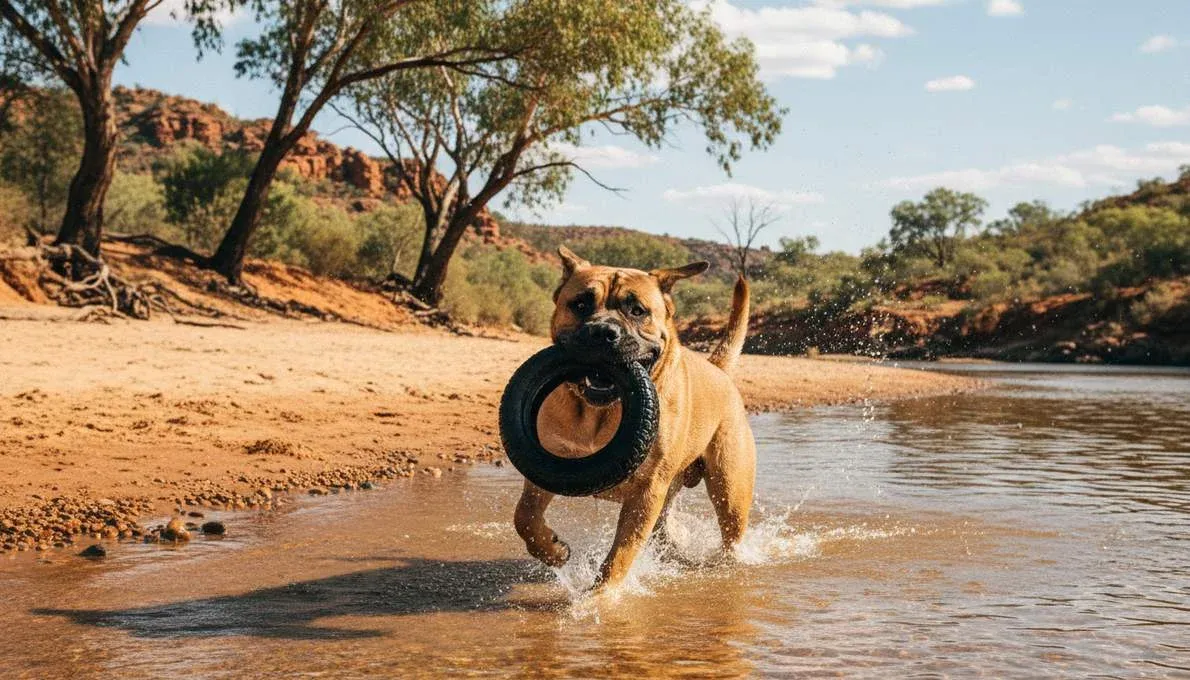
The Boerboel has two faces, and both are real. At home with its family, this is a dog that will lean its entire 80-kilogram body against your legs for a cuddle, follow toddlers around the house with patient attentiveness, and sleep stretched across the entire couch. Away from home or when a stranger approaches, the switch flips — and you’re looking at a dog that was bred to kill apex predators.
Calm Dominance: Boerboels are not hyperactive or nervous. They’re confident, measured, and watchful. This calm energy is exactly what makes them effective guardians — they assess before they act.
Deep Family Loyalty: An AKC-registered breeder described them as “big babies at home, loyal to their family, and so good with children.”⁴ That tracks with the breed’s centuries-long role as a farmstead nanny dog in South Africa.
Territorial Protectiveness: This is not optional — it’s hardwired. Boerboels will position themselves between their family and any perceived threat. Without proper socialisation, this instinct can escalate into aggression toward guests, delivery drivers, or other dogs.
Intelligence With Stubbornness: They’re smart enough to test boundaries and remember which rules you’ve enforced inconsistently. Training a Boerboel is less about repetition and more about establishing genuine leadership.
Experienced Boerboel owners often describe the breed’s personality as “velcro with an off switch.” At home, they’re shadows — following you room to room, sleeping at your feet. But the moment something feels wrong, the entire demeanour changes in a heartbeat.
The Boerboel’s reputation as a “nanny dog” in South Africa is well-documented, but context matters. These dogs can be wonderfully gentle with children they’ve been raised with. The risk isn’t aggression toward kids — it’s sheer size. A 70-kilogram dog can knock a toddler over without any malicious intent whatsoever.
If your Boerboel starts body-blocking visitors from approaching your children — stepping between them, stiffening, lowering its head — that’s guarding behaviour, not aggression. Redirect with a calm “enough” command and reward the stand-down. Never punish protective instincts; redirect them.
This is breed-dependent and individual. Some Boerboels coexist happily with other dogs they’ve grown up with. Others, particularly intact males, can be same-sex aggressive. The breed’s history includes intolerance toward unfamiliar canines, and off-leash dog parks are generally not recommended.
None of this should scare you away if you’re a confident, experienced handler. But it does mean the Boerboel requires a level of commitment that casual dog ownership doesn’t prepare you for. If a Labrador Retriever (→ bestdog.au/labrador-retriever/ is a bicycle, the Boerboel is a semi-trailer — both get you where you’re going, but the skills required are worlds apart.

Boerboel Health Issues
The hardest part of loving a giant breed is knowing their time is shorter. At 9 to 11 years average lifespan, every year with a Boerboel matters — and understanding their health risks early gives you the best chance of maximising that time.
PetMD’s veterinary team notes that while Boerboels are predisposed to several conditions, responsible breeders screen for genetic problems that commonly affect the breed.⁵
Prevalence: Very common in giant breeds.
Symptoms: Limping, reluctance to rise, decreased activity.
Treatment Cost (AUD): $3,000–$8,000+ for surgical correction (total hip replacement).
Prevention: Request OFA or PennHIP results from breeder. Maintain lean body weight. Feed large-breed puppy food for controlled growth.
This is the one that can kill within hours. The stomach fills with gas and twists, cutting off blood supply. Deep-chested breeds like the Boerboel are at highest risk.⁵
Symptoms: Distended abdomen, dry heaving, restlessness, drooling.
Treatment Cost (AUD): $5,000–$10,000+ emergency surgery.
Prevention: Feed two smaller meals (not one large meal), avoid exercise 30 minutes after eating, and ask your vet about prophylactic gastropexy — a preventative surgery where the stomach is tacked to the abdominal wall. Many vets recommend this for all large barrel-chested dogs.
The heart muscle thins and the chambers enlarge, reducing pumping efficiency.
Symptoms: Coughing, exercise intolerance, lethargy, fainting.
Treatment Cost (AUD): Ongoing medication $100–$300/month; echocardiogram $400–$800.
Prevention: Annual heart screening after age 4. No cure, but early detection and medication significantly extend quality of life.
Ectropion (eyelid rolls outward) exposes the eye to irritation. Entropion (eyelid rolls inward) causes eyelashes to scratch the cornea. Both are common in Boerboels due to their facial structure.⁵
Treatment Cost (AUD): $1,500–$3,500 for surgical correction per eye.

Boerboel Lifespan
The average Boerboel lifespan is 9 to 11 years — shorter than medium-sized breeds, but standard for giant dogs. Some well-bred, well-maintained Boerboels reach 12 or beyond.
Key longevity factors:
- Weight management — obesity is the single biggest controllable risk factor for joint disease and heart strain
- Prophylactic gastropexy to eliminate GDV risk
- Twice-yearly vet visits after age 5
- Joint supplements (glucosamine, omega-3) started early
- Large-breed-specific diet throughout life
Boerboel Grooming Guide
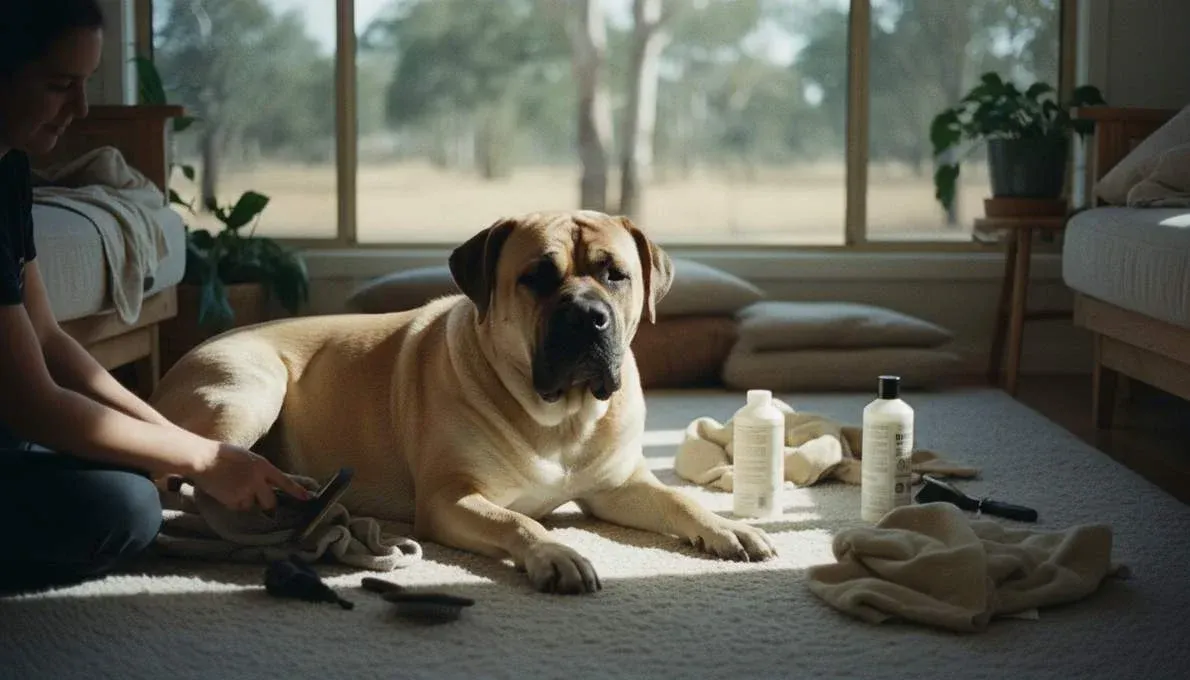
Grooming a Boerboel is straightforward compared to long-coated breeds. The short, dense coat is low-maintenance, but their sheer size means everything takes longer and costs more.
Grooming Schedule
| Task | Frequency | Time | Notes |
|---|---|---|---|
| Brushing | Weekly | 15 mins | Rubber curry comb or grooming glove |
| Bathing | Monthly or as needed | 30–45 mins | Fido’s Everyday Shampoo or Dermcare |
| Nail Trimming | Every 2–3 weeks | 15 mins | Heavy-duty large-dog clippers |
| Dental Care | Daily brushing ideal | 5–10 mins | Greenies Large or PAW by Blackmores dental chews |
| Wrinkle Cleaning | Every 2–3 days | 5 mins | Damp cloth between facial folds to prevent infection |
| Drool Management | Daily | Ongoing | Keep a towel handy — less than most mastiffs but still notable |
Boerboel colours recognised by the AKC include red, brown, reddish-brown, fawn, and cream, typically with a black mask. Black Boerboels exist but are controversial within the breed community and not accepted by all registries.
Boerboel Exercise Needs
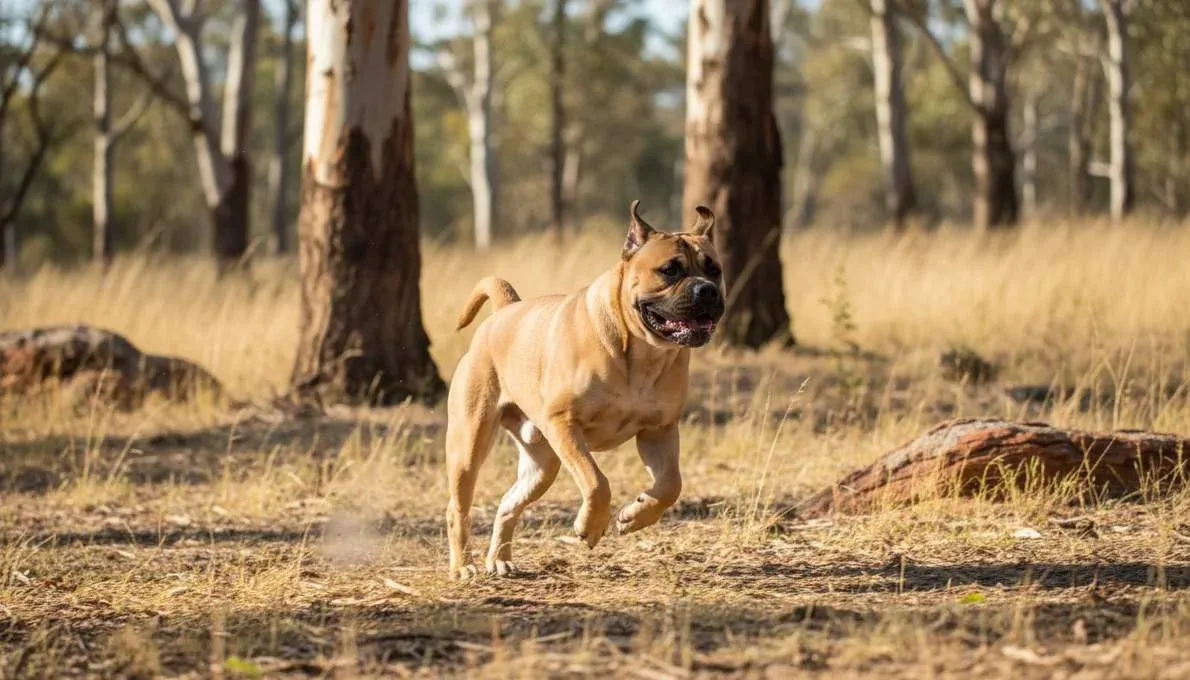
Don’t mistake “calm at home” for “low energy.” Boerboels need a minimum of 60 minutes of daily exercise, split between structured walks and free play in a securely fenced yard. This is a breed that was built to patrol farmsteads all day — a 10-minute stroll around the block won’t cut it.
First-time giant breed owners are often shocked by how much mental stimulation a Boerboel demands. A physically tired Boerboel that’s mentally bored will find its own entertainment — and when that entertainment involves 90 kilograms of muscle versus your garden fence, the fence always loses.
Exercise caution in Australian heat. While not brachycephalic, the Boerboel’s massive body generates significant heat during exercise. Walk during cool hours, provide constant water access, and watch for excessive panting or drooling. The breed does well in Australian climates but needs shade and shelter.
Dogs Australia’s exercise guide recommends tailoring activity to breed, age, and individual fitness.⁶
If your Boerboel starts digging craters in the yard or chewing through door frames, that’s not rebellion — it’s boredom with physical consequences. Add a puzzle feeder, a training session, or a sniff walk (letting the dog lead at its own pace, exploring scents) and the destructive behaviour typically stops within a week.
Boerboel Training Guide
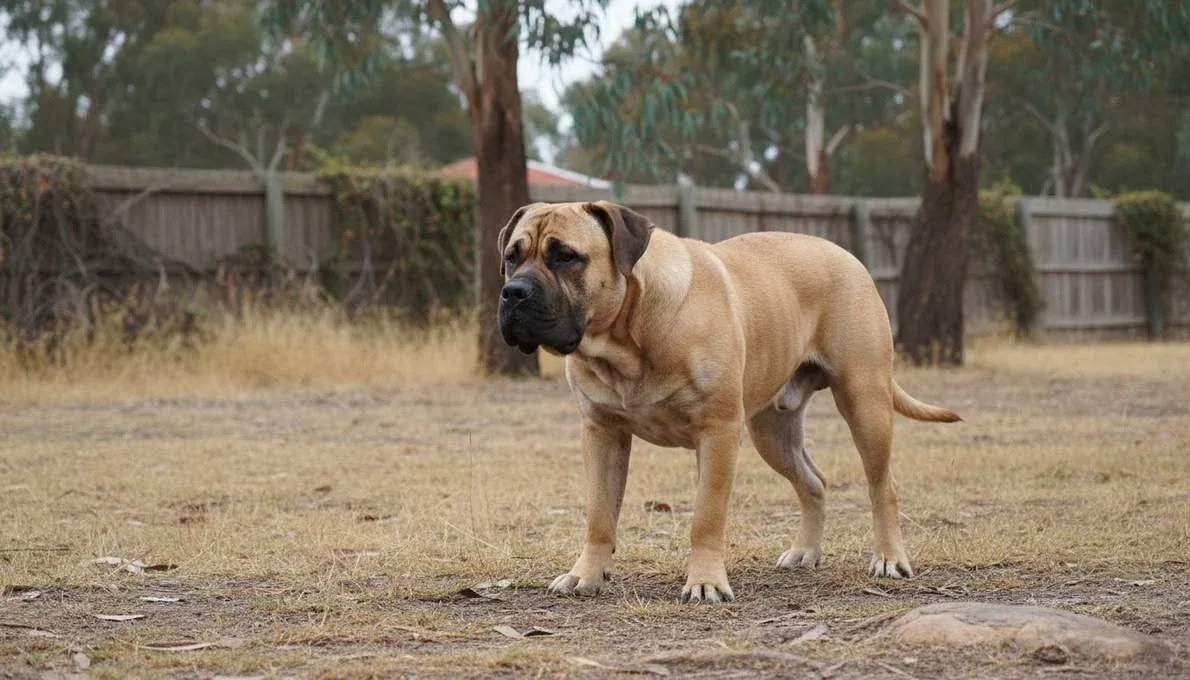
Training a Boerboel isn’t optional — it’s a public safety responsibility. An untrained 90-kilogram dog with guarding instincts is genuinely dangerous, and incidents involving Boerboels in Australia have made headlines.¹ The good news: Boerboels are intelligent, eager to please their person, and respond well to firm, consistent positive reinforcement.
The AKC breed profile emphasises that Boerboels are “dominant and confident, also bright and eager to learn.”² The key is establishing leadership through structure, not force. Harsh corrections make a Boerboel shut down or push back — neither outcome is safe.
Socialisation & Training Timeline
| Age | Training Focus | Priority |
|---|---|---|
| 8–12 weeks | Name, crate, potty, gentle handling | Socialisation begins NOW |
| 3–5 months | Sit, stay, come, leash manners | Expose to strangers, sounds, environments |
| 5–9 months | Impulse control, “leave it”, drop | Manage guarding instincts early |
| 9–18 months | Advanced obedience, reliable recall | Critical: adolescent testing phase |
| 18+ months | Maintenance training, ongoing socialisation | Never stops — Boerboels need lifelong training |
Between 9 and 18 months, your Boerboel will test every boundary you’ve established. This is normal adolescent behaviour amplified by 70+ kilograms of muscle and a dominant personality. The dogs that end up surrendered to rescue are almost always from this age bracket, owned by people who weren’t prepared. If you get through adolescence with consistent training, you’ll have one of the most loyal, obedient companions imaginable.
A veteran Boerboel breeder once put it this way: “A Boerboel doesn’t obey you because it has to. It obeys you because it’s decided you’re worth following. Earn that respect, and you’ll never need to raise your voice.”
Boerboel Price & Costs
Giant breeds are expensive. There’s no way around it — everything from food to vet bills scales with body weight, and a Boerboel is roughly three to four times the weight of a Labrador.
Initial Costs:
| Expense | Approx. Cost (AUD) |
|---|---|
| Puppy Price (Registered Breeder) | $3,000 – $8,000+ |
| Adoption / Rescue Fee | $400 – $800 |
| Initial Vet + Vaccinations | $300 – $500 |
| Desexing (giant breed) | $400 – $800 |
| Prophylactic Gastropexy | $500 – $1,500 (often combined with desexing) |
| Secure Fencing (1.8m+ required) | $2,000 – $5,000+ |
| Essential Supplies (XXL crate, bed, bowls) | $500 – $900 |
| TOTAL INITIAL COST | $7,100 – $17,500+ |
Annual Ongoing Costs:
- Food (premium large-breed, e.g., Black Hawk Working Dog or Advance Large): $1,500–$2,500
- Vet & Preventatives (flea/tick/worming — dosed by weight): $800–$1,200
- Pet Insurance (giant breed premiums): $800–$1,500
- Joint Supplements: $300–$600
- Training (ongoing group or private): $500–$1,200
- TOTAL ANNUAL: $3,900–$7,000
Lifetime Cost Estimate: $45,000–$80,000+ (based on 10-year average lifespan)
Finding a breeder in Australia can be challenging. Start with breed-specific clubs or search PetRescue for occasional surrenders. International imports are possible but add significant cost and quarantine logistics.

Is an African Mastiff Right for You?
Experienced large-breed owners with a secure property, time for daily training and exercise, and the financial capacity for giant-breed vet costs. Ideally someone who has previously owned a working or guardian breed (Rottweiler, German Shepherd, Bullmastiff).
- Home Size: House with a large, securely fenced yard (1.8m+ fencing minimum)
- Yard: Essential. Boerboels are not apartment dogs.
- Climate: Handles Australian conditions well but needs shade and water
- First-time dog owners — this breed requires experienced handling, full stop
- Apartment or townhouse dwellers — insufficient space and fencing
- Families with toddlers as the only children — accidental injury risk from size alone
- Anyone unable to commit to ongoing professional training
- People frequently away from home — Boerboels develop separation anxiety that manifests destructively
- Anyone looking for an off-leash dog park companion — unreliable with strange dogs
If the Boerboel’s intensity isn’t right for your situation, that’s a sign of good judgement, not failure. Consider the Bullmastiff for a slightly less dominant guardian temperament, or the Rhodesian Ridgeback if you want a large African breed with more sociability toward strangers.
- Perfect for: Experienced, confident owners who want a deeply loyal guardian with the presence to back it up
- Think twice if: You’ve never owned a large working breed, lack secure fencing, or have very young children
- First-time owner rating: Not recommended. The Boerboel’s combination of size, dominance, and protective instinct requires breed-specific experience.
Still weighing your options? Browse our breeds directory or compare with similar breeds like the Bullmastiff and Rhodesian Ridgeback
African Mastiff FAQs
Is the African Mastiff the same as a Boerboel?
Yes. “African Mastiff” is a common informal name for the Boerboel (South African Mastiff). They are the same breed. The official AKC name is Boerboel, while “African Mastiff” is widely used in casual contexts and search queries.²
Are Boerboels legal in Australia?
Yes, as of 2025 Boerboels are not on Australia’s prohibited breed list. The five banned breeds are Pit Bull Terrier, Dogo Argentino, Fila Brasileiro, Japanese Tosa, and Presa Canario. However, individual councils may classify dogs as “dangerous” based on behaviour, and some vets have called for suburban restrictions on large guardian breeds. Always check your local council.¹
Are Boerboels good family dogs?
With experienced owners, proper socialisation, and ongoing training — yes. Boerboels are famously gentle with children in their own family. However, their size creates accidental injury risk with toddlers, and their guarding instincts require careful management around visitors.⁴
How much does a Boerboel cost in Australia?
Expect $3,000 to $8,000+ AUD from a reputable breeder. Add $4,000–$9,000+ for initial setup (fencing, gastropexy, supplies). Annual costs run $3,900–$7,000. Lifetime ownership cost is estimated at $45,000–$80,000+.
How long do African Mastiffs live?
Average Boerboel lifespan is 9 to 11 years. Weight management, joint care, and preventative gastropexy surgery are the biggest factors in reaching the upper end of that range.⁵
Do Boerboels get along with other dogs?
It depends heavily on socialisation. Some Boerboels coexist well with dogs they’ve been raised with. Same-sex aggression (particularly between intact males) is a known breed tendency. Off-leash dog parks are generally not recommended.²
Are Boerboels aggressive?
Not inherently, but they are protective. A well-socialised Boerboel with competent training is calm and stable. A poorly socialised or untrained Boerboel can be genuinely dangerous due to the combination of guarding instincts and physical power. The breed’s reputation issues come from irresponsible ownership, not inherent aggression.
1. Wikipedia — Boerboel (Legal Status, Bans)
https://en.wikipedia.org/wiki/Boerboel
2. AKC — Boerboel Breed Profile
https://www.akc.org/dog-breeds/boerboel/
3. AKC — Boerboel History: Behind the South African Farm Dog
https://www.akc.org/expert-advice/dog-breeds/boerboel-history-south-african-farm-dog/
4. Daily Paws — Boerboel (South African Mastiff) Dog Breed
https://www.dailypaws.com/dogs-puppies/dog-breeds/boerboel
5. PetMD — Boerboel Breed Health and Care
https://www.petmd.com/dog/breeds/boerboel
6. Dogs Australia — Exercise & What You Need to Consider
https://dogsaustralia.org.au/getting-a-dog/exercise-and-what-you-need-to-consider/