
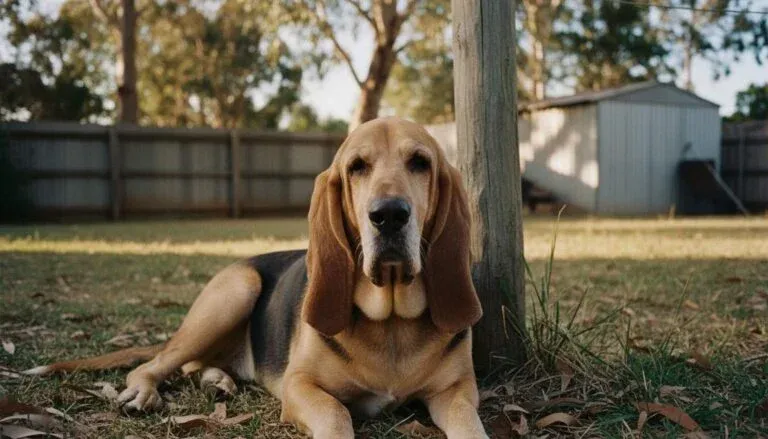
The Bloodhound has the most powerful nose in the entire canine kingdom. It can follow a scent trail that’s over 300 hours old. It can track a single person through a crowded city. Its trailing evidence is admissible in court in multiple countries. When police need to find a missing child, a fugitive, or a disaster survivor, the Bloodhound is the dog they call.
It will also use that same world-class nose to locate and eat your socks, dig through the kitchen bin at 3 AM, and follow an interesting smell into traffic if you’re not paying attention. The Bloodhound is a magnificent contradiction: one of the most talented working dogs ever bred, wrapped in a package of droopy ears, saggy skin, industrial-grade drool, and the training compliance of a particularly stubborn teenager.
If you’re imagining a stately, obedient hound sitting regally by the fireplace, you’re thinking of a painting, not a real Bloodhound. Real Bloodhounds are goofy, vocal, relentlessly affectionate, stubbornly independent, and capable of producing enough slobber to fill a small bucket. They smell. Not just with their noses — they also have a distinctive “hound odour” that no amount of bathing fully eliminates.
And yet, Bloodhound owners are among the most devoted in the dog world. Once you’ve been knocked over by a 50 kg puppy that’s ecstatic to see you, once you’ve watched that nose work a trail with single-minded genius, once you’ve had those soulful, droopy eyes stare into yours from across the couch — you’re hooked. This guide covers everything you need to know about owning a Bloodhound in Australia: the real costs, the health risks that keep vets busy, and the honest truth about living with a dog that’s equal parts genius and chaos.
What You’ll Learn
- Breed traits & temperament
- Health concerns to know
- True cost in Australia
- Training & exercise needs
- Is this breed right for you?
Bloodhound at a Glance
| Attribute | Details |
|---|---|
| Breed Group | Hound (ANKC Group 4) |
| Origin | Belgium/France, medieval era |
| Height | Males 64–69 cm, Females 58–63 cm |
| Weight | Males 41–50 kg, Females 36–45 kg |
| Lifespan | 10–12 years (some studies report shorter averages) |
| Coat Type | Short, smooth, dense single coat |
| Colours | Black & tan, liver & tan, red |
| Hypoallergenic | No — moderate shedding |
| Grooming Needs | Low to moderate — weekly brushing, daily wrinkle & ear care |
| Exercise Needs | High — 60+ minutes daily |
| Trainability | Low to moderate — intelligent but famously independent |
| Good With Kids | Yes — gentle and patient |
| Barking Level | High — bays, howls, and is vocally expressive |
| Drool Level | Extreme — plan accordingly |
| AKC Popularity | #52 of 200 breeds |
History & Origins
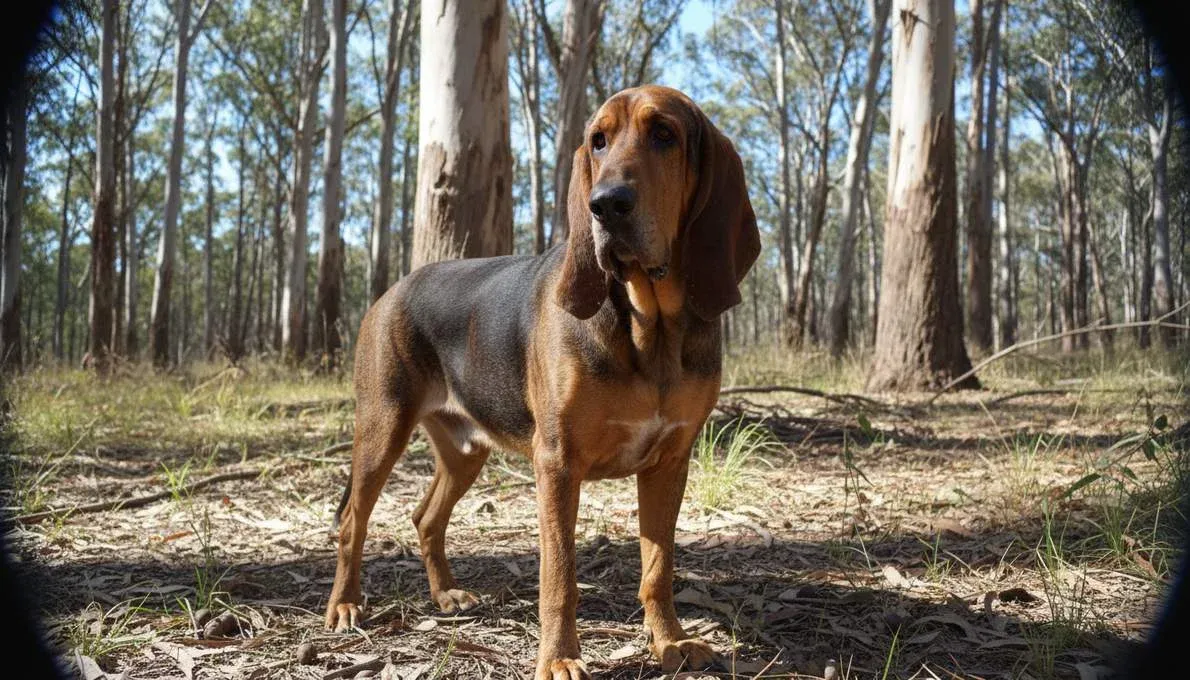
The Bloodhound is one of the oldest scent hound breeds in existence. Its lineage traces back over a thousand years to the St. Hubert Hound, bred by monks at the Saint-Hubert Monastery in Belgium’s Ardennes region. These dogs were selectively bred for scenting ability above all else, and the monks gifted pairs to French royalty annually, cementing the breed’s aristocratic connections.
The name “Bloodhound” has nothing to do with tracking blood. It means “blooded hound” — a dog of pure, aristocratic breeding. William the Conqueror brought St. Hubert Hounds to England in 1066, where they were refined into the modern Bloodhound during the Elizabethan era. Original coat colours included pure white and pure black, but these were bred out over centuries, leaving today’s black & tan, liver & tan, and red varieties.
The Bloodhound’s tracking ability became legendary. In medieval England, they tracked poachers, highwaymen, and escaped prisoners. In the American South, they were used (infamously) to track runaway slaves. In the modern era, their trailing evidence has been accepted in courts across the United States and Europe. A trained Bloodhound can follow a scent trail that’s 12–14 days old across varied terrain — a feat no technology has replicated.
In Australia, Bloodhounds have been used in search-and-rescue operations and are trained to track missing persons. The breed is uncommon here compared to the US and UK, but a dedicated community of breeders maintains quality lines. The Bloodhound is registered with the ANKC in Group 4 (Hounds).
Temperament & Personality
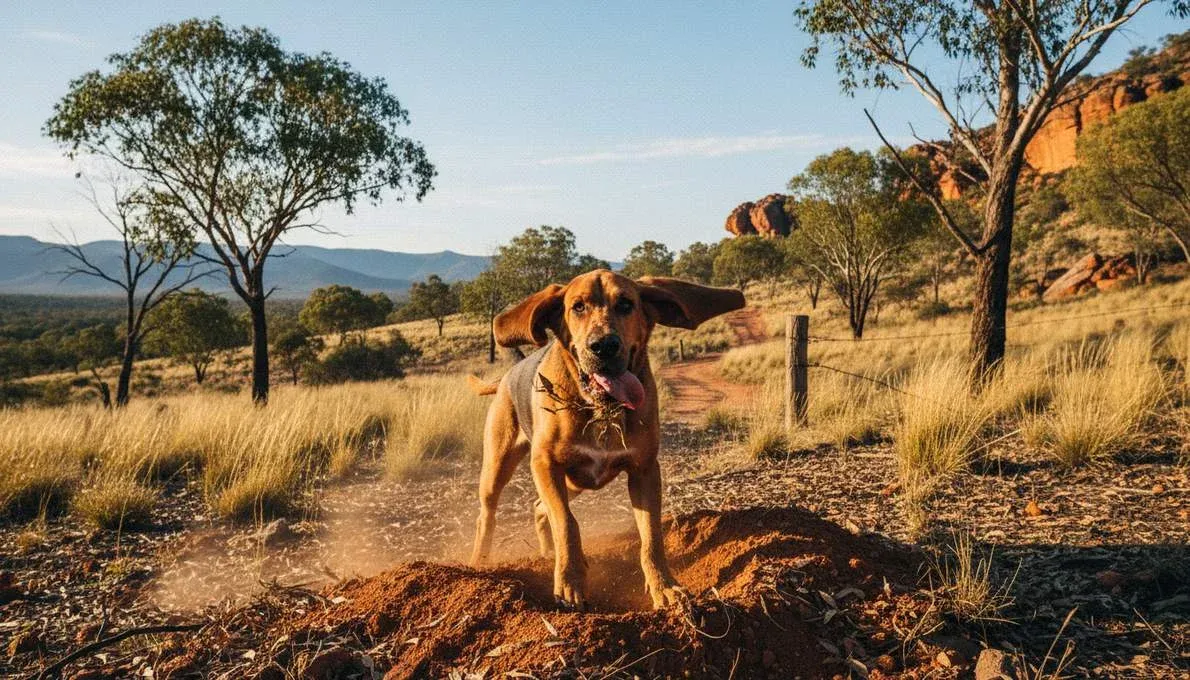
The Bloodhound’s temperament is a study in contradictions. This is a dog that was ranked dead last for obedience intelligence by canine psychologist Stanley Coren — not because it’s stupid (it absolutely isn’t), but because it is spectacularly uninterested in doing what you want it to do unless the task involves following a scent. A Bloodhound on a trail is focused, tireless, and brilliant. A Bloodhound being asked to “sit” for the fourteenth time may look at you with those mournful eyes and simply… not.
At home, Bloodhounds are affectionate, gentle, and surprisingly mellow when their exercise needs are met. They love their families deeply and are excellent with children — patient, tolerant, and protective without being aggressive. They’re pack dogs that crave company and will shadow you around the house, usually leaving a drool trail behind them.
With strangers, Bloodhounds are generally friendly, though some can be initially reserved. They are not guard dogs. A Bloodhound might alert-bark when someone approaches, but it’s more likely to greet a burglar with a wagging tail and a request for belly rubs than to defend the house.
The Bloodhound’s most challenging trait is its nose-driven independence. When a Bloodhound catches an interesting scent, everything else ceases to exist — your commands, the road, other dogs, gravity. This is not disobedience; it’s hardwired single-mindedness that has been selectively bred for over a thousand years. A Bloodhound off-lead in an unfenced area is a Bloodhound you may not see again for hours.
Vocally, Bloodhounds are expressive. They bay, howl, bark, and produce a range of sounds that neighbours may not appreciate. The classic Bloodhound “bay” is a deep, resonant howl that carries impressively far. Apartment living is not recommended.
One more thing: Bloodhounds eat things they shouldn’t. Socks, towels, toys, rocks, remote controls — their combination of powerful jaws, persistent curiosity, and complete disregard for consequences makes them prolific garbage raiders and foreign body surgery candidates. Bloodhound-proofing your home is not optional.
Health & Genetic Conditions
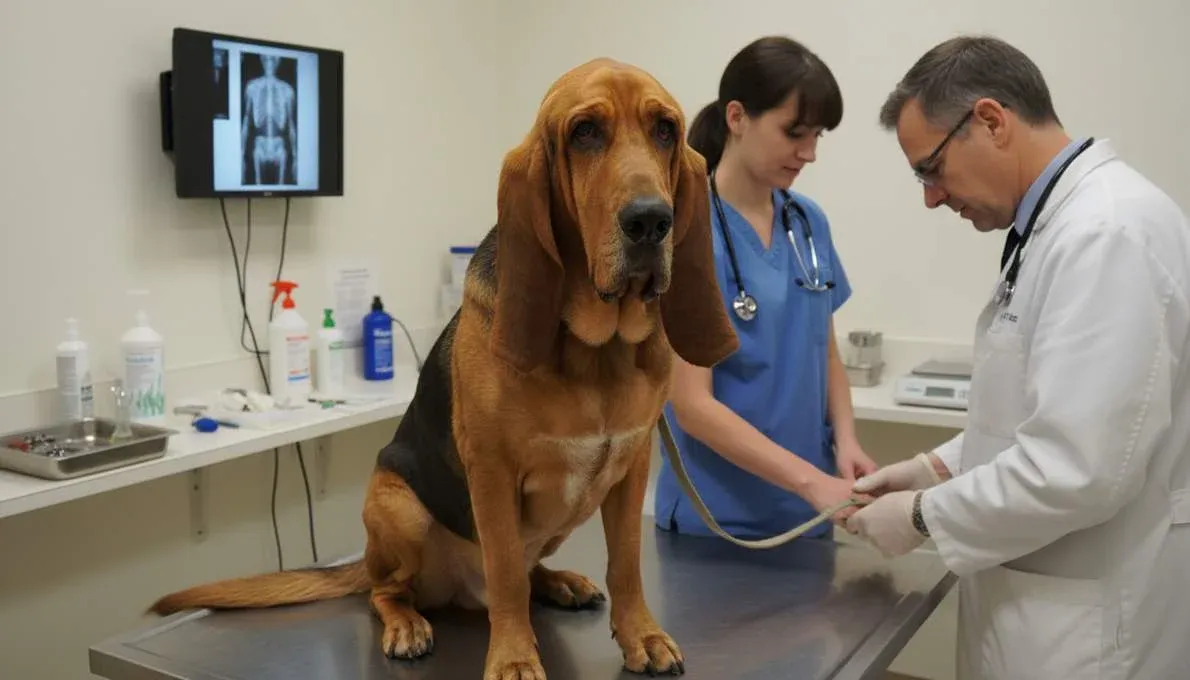
Bloodhounds are not the healthiest breed. Their distinctive conformation — deep chest, loose skin, heavy ears, droopy eyes — predisposes them to several significant health issues. A UK breed survey found the median Bloodhound lifespan at approximately 8.25 years, though American and Australian sources typically cite 10–12 years. The discrepancy may reflect differences in breeding lines and veterinary care.
Bloat (gastric dilatation-volvulus) is the leading cause of death in Bloodhounds, responsible for roughly one-third of breed deaths in some surveys. This alone should shape how you feed, exercise, and insure your dog.
The number one killer in the breed. The deep chest makes Bloodhounds extremely susceptible. The stomach fills with gas and can twist, cutting off blood supply to organs. GDV is a surgical emergency — without treatment within hours, it is fatal.
Prevention & costs: Feed 2–3 smaller meals daily, not one large one. No vigorous exercise for 1–2 hours before or after meals. Use a slow-feeder bowl. Prophylactic gastropexy during desexing ($500–$1,000 AUD added) is strongly recommended for Bloodhounds. Emergency GDV surgery: $5,000–$12,000+ AUD.
Common in large breeds. The Bloodhound’s mean hip score is higher than ideal, meaning the breed as a whole carries significant risk. Both conditions cause arthritis, pain, and mobility issues. Responsible breeders hip and elbow score breeding stock.
Estimated costs: X-rays and scoring: $300–$600 AUD. Conservative management: $500–$1,500 AUD/year. Total hip replacement: $5,000–$10,000+ AUD per joint.
Those magnificent, long, pendulous ears are a magnet for moisture, debris, and infection. Bloodhound ears need checking and cleaning at least weekly — more often in humid Australian climates. Chronic ear infections are one of the most common vet visits for the breed. Untreated ear infections can cause permanent damage.
Estimated costs: Ear cleaner: $15–$25 AUD. Single ear infection treatment: $100–$300 AUD. Chronic management: $400–$1,000+ AUD/year.
The Bloodhound’s droopy facial skin creates several eye problems. Ectropion (outward-rolling lower eyelids) exposes the inner eye to irritants. Entropion (inward-rolling eyelids) causes eyelashes to scratch the cornea. Cherry eye (prolapsed third eyelid gland) is also common. Persistent pupillary membranes (PPM) can affect vision.
Estimated costs: Entropion/ectropion surgery: $1,000–$3,000 AUD per eye. Cherry eye repair: $800–$2,000 AUD. Eye drops and ongoing management: $200–$600 AUD/year.
Those iconic wrinkles trap moisture, bacteria, and yeast. Without daily cleaning of facial folds, infections develop quickly. Puppies with deeper folds are more affected, but any Bloodhound can develop skin fold issues. Daily wiping with medicated or antimicrobial wipes is essential.
Cardiomyopathy (heart muscle disease, particularly in males over 5), aortic stenosis, patellar luxation, hypothyroidism, and bowel obstruction from eating foreign objects. Bloodhounds are also prone to obesity, which worsens every other condition on this list.
Bottom line: Bloodhounds are expensive to insure and expensive to treat. Get pet insurance while your Bloodhound is a puppy and before pre-existing conditions develop. Discuss prophylactic gastropexy with your vet. Budget for ear and eye maintenance as ongoing costs, not occasional ones.
Lifespan & Longevity
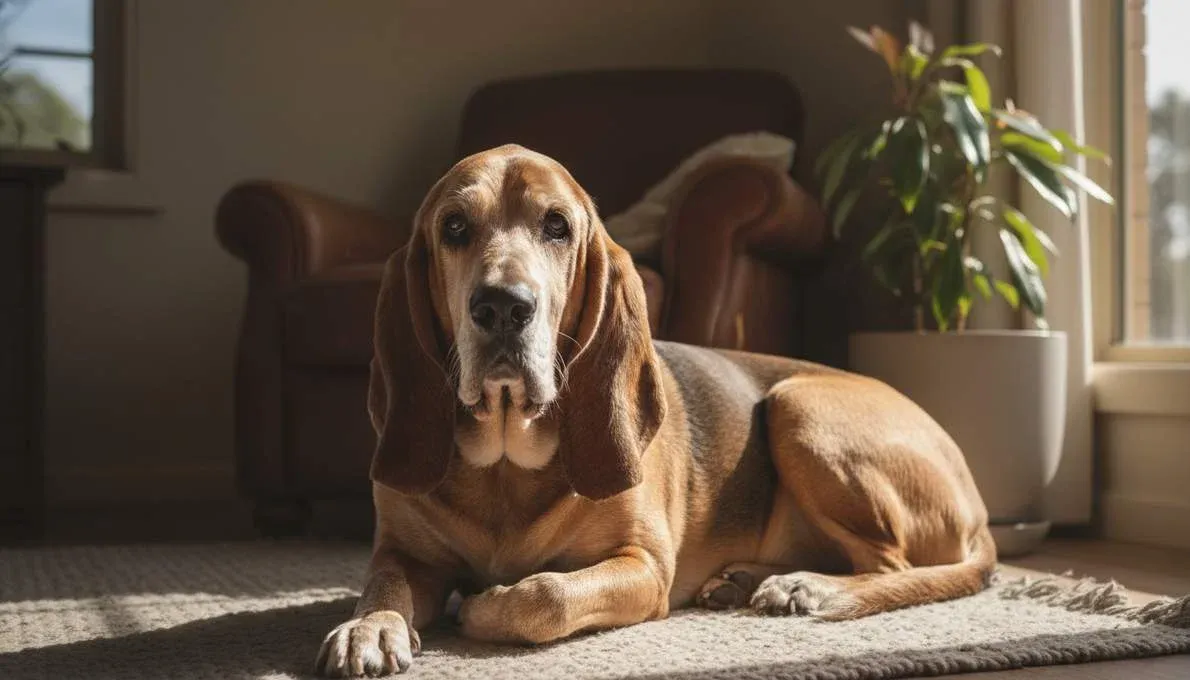
The commonly cited Bloodhound lifespan is 10–12 years, though some breed health surveys suggest a shorter reality. A 2013 UK study found a median age of death around 8.25 years, making it one of the shorter-lived large breeds. American and Australian breeders report that well-bred, well-cared-for Bloodhounds regularly reach 10–12 years, with some living to 13–14.
The single biggest factor in longevity is bloat prevention. A Bloodhound that avoids GDV and maintains a healthy weight has a substantially better chance of reaching double digits.
Age-Specific Care Tips
| Life Stage | Key Considerations |
|---|---|
| Puppy (0–18 months) | Controlled exercise to protect joints. Start ear cleaning routine immediately. Puppy-proof ruthlessly — Bloodhound puppies eat everything. Socialisation with people, animals, environments. Begin grooming handling. Discuss gastropexy with vet. |
| Young adult (1.5–3 years) | Peak energy. Needs structured exercise and mental stimulation (scent games are ideal). Hip/elbow X-rays. Monitor for ear infections and eye issues. Begin bloat prevention feeding routine. Extremely silly at this age. |
| Adult (3–7 years) | Weight management is critical. Annual eye exams. Bi-annual dental checks. Continue ear and skin fold maintenance. Heart screening from age 5. Watch for signs of hypothyroidism (weight gain, lethargy, coat changes). |
| Senior (7+ years) | Bi-annual vet visits. Joint supplements and pain management. Heart monitoring. Senior diet to control weight. Adjust exercise for comfort. Many Bloodhounds slow significantly by age 8–9. |
Grooming & Care
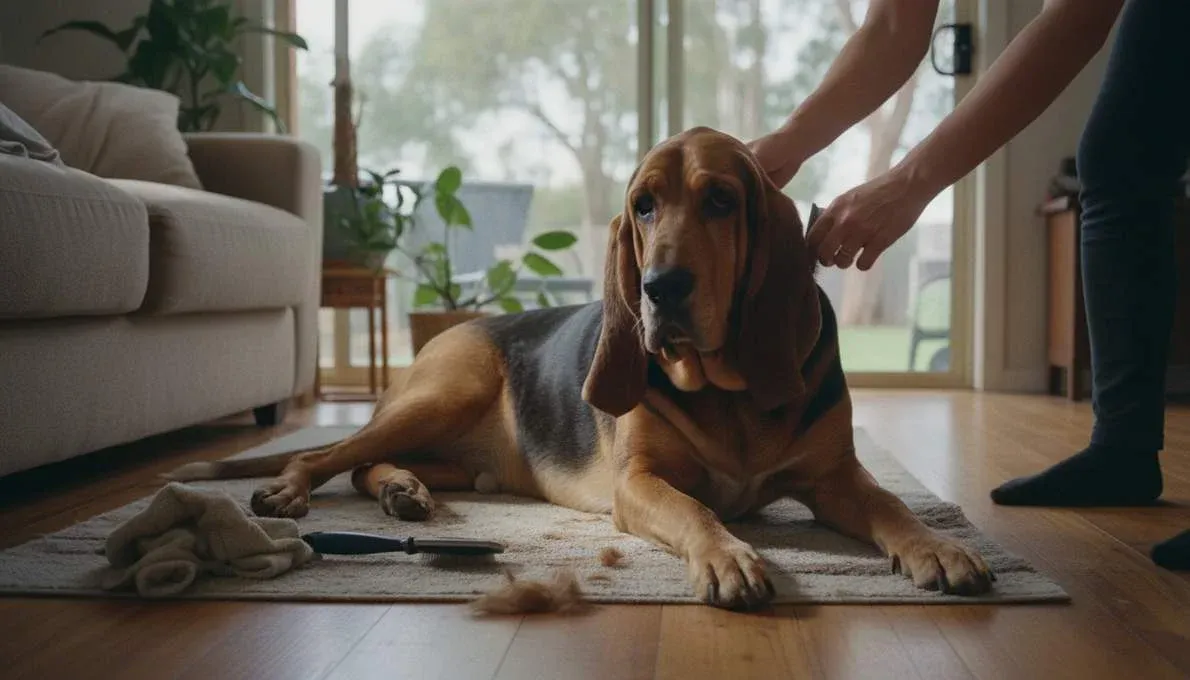
The Bloodhound’s short coat is easy to maintain compared to long-coated breeds. But “easy coat” does not mean “easy care.” The breed’s grooming demands come from its ears, eyes, skin folds, and drool — not its fur.
| Grooming Task | Frequency | Estimated Cost (AUD) |
|---|---|---|
| Coat brushing | Weekly | Hound mitt or bristle brush ~$15–$30 |
| Ear cleaning & inspection | 2–3 times per week | Ear cleaner ~$15–$25 |
| Skin fold/wrinkle cleaning | Daily (face folds) | Antimicrobial wipes ~$15–$25 |
| Bathing | Every 4–6 weeks (odour management) | DIY ~$20–$30 or professional bath ~$60–$100 |
| Drool management | Constant (after eating, drinking, exercise, sleep, existing…) | Towels. Many towels. Everywhere. |
| Nail trimming | Every 2–3 weeks | $15–$25 or DIY |
About the smell: Bloodhounds have a characteristic “hound odour” that is part of the breed. It comes from their oily skin and cannot be fully eliminated. Regular bathing helps, but if you need your house to smell pristine, a Bloodhound is not the dog for you. Many Bloodhound owners simply accept the scent as part of the deal.
About the drool: Bloodhounds are world-class droolers. After drinking water, eating, exercise, or a good head-shake, strings of slobber will decorate your walls, clothes, furniture, and any visitors who get too close. Keep towels in every room. Warn guests. Embrace it or reconsider the breed.
Exercise Needs
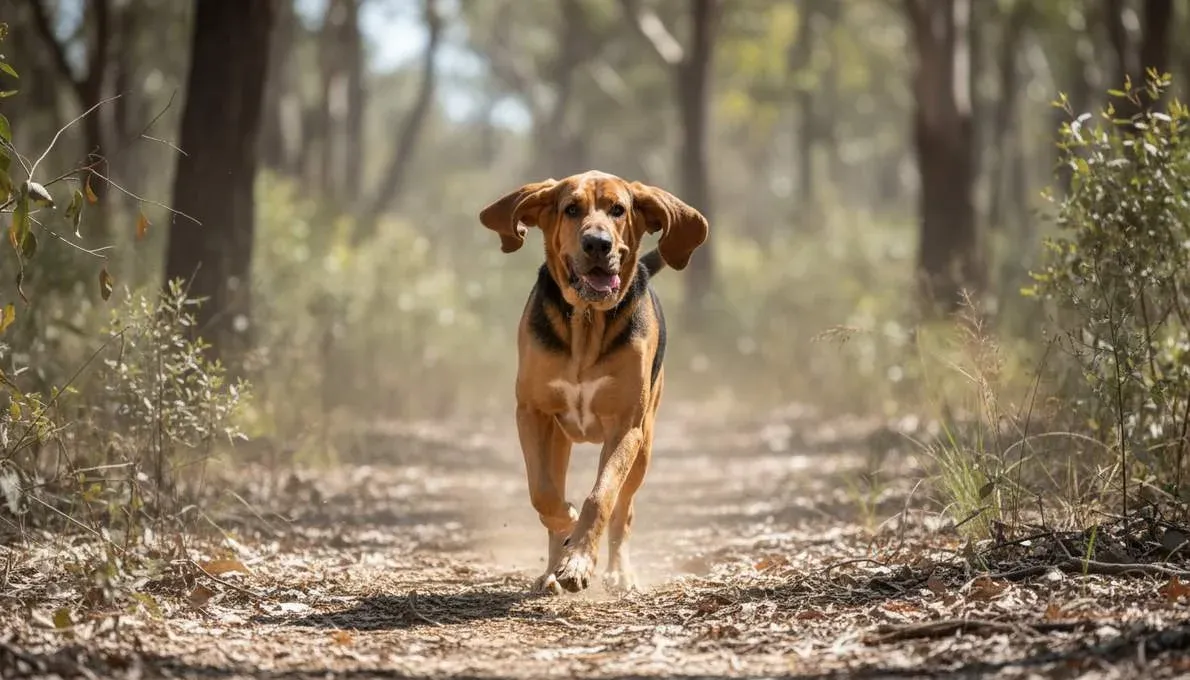
Bloodhounds are active dogs that need at least 60 minutes of exercise daily. They’re not sprinters — they’re endurance athletes built for long, nose-down walks and trail work. A bored Bloodhound with insufficient exercise will bay, dig, destroy furniture, and eat things that require surgical removal.
The best exercise for a Bloodhound is anything that engages its nose. Scent trails (hide treats or toys in the garden and let them track), long walks through varied environments, and structured scent work or tracking classes are ideal. A Bloodhound following a scent trail is doing its life’s work — there is no better enrichment for this breed.
Off-lead exercise is risky with Bloodhounds. Once they catch a scent, recall is effectively zero. Exercise off-lead only in fully fenced, secure areas. Bloodhound fencing needs to be solid and at least 1.8 metres high — these dogs are surprisingly athletic when motivated.
Australian Climate Considerations
Bloodhounds tolerate cold well but struggle in heat. Their size and heavy build make them vulnerable to heat stress in Australian summers. In temperatures above 28°C, limit exercise to early morning and late evening. Provide shade, constant water access, and consider a cooling mat or wading pool. Their short coat offers minimal sun protection on lighter-skinned areas, so dog-safe sunscreen can help on exposed pink skin.
Training Guide
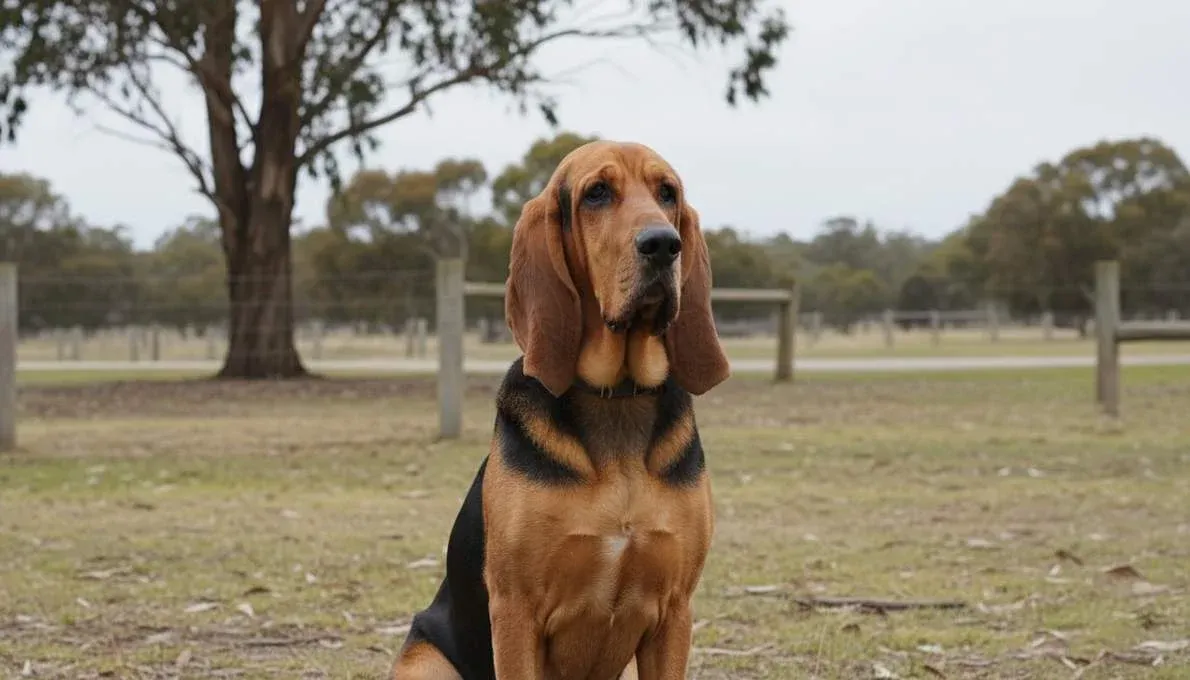
Let’s be honest: training a Bloodhound is an exercise in patience. Stanley Coren ranked the Bloodhound last among breeds for working and obedience intelligence. This doesn’t mean they’re unintelligent — far from it. It means they were bred for independent scent work, not obedience, and they see your commands as suggestions rather than instructions.
Positive reinforcement with high-value food rewards is the only effective approach. Bloodhounds respond to patience, consistency, and repetition. They shut down completely under harsh corrections. Short training sessions (5–10 minutes) work better than long ones, because a Bloodhound’s attention span for obedience is genuinely limited.
| Age | Training Focus | Tips |
|---|---|---|
| 8–16 weeks | Socialisation (critical), crate training, name recognition, basic handling, “come” foundation | Start NOW. Bloodhound puppies are silly and distractible but form early habits. Use food heavily. |
| 4–6 months | Lead walking (essential — they’ll be 40+ kg soon), sit, stay, drop it/leave it, household rules | Invest in a front-clip harness. A pulling Bloodhound on a flat collar will drag you. “Leave it” saves surgical bills. |
| 6–18 months | Recall practice (manage expectations), impulse control, “settle” command, counter-surfing prevention | Adolescence is peak chaos. They’re huge, clumsy, mouthy, and still think they’re puppies. Don’t give up. |
| 18+ months | Scent work and tracking (channel instincts productively), ongoing obedience refreshers, reliable lead manners | A Bloodhound doing scent work is a happy, focused dog. Tracking classes are the single best thing you can do for this breed. |
Honest difficulty rating: 8/10. Bloodhounds are among the hardest breeds to obedience-train. They’re not defiant — they’re wired for a different job. Accept that your Bloodhound will never be a precision obedience dog, focus on essential safety commands, and channel its brilliance into scent work. That’s where these dogs truly shine.
Cost of Ownership in Australia
Bloodhounds are a large breed with above-average health costs. The purchase price is moderate, but ongoing costs — especially food, insurance, and potential surgeries — add up substantially.
Upfront Costs
| Item | Estimated Cost (AUD) |
|---|---|
| Registered puppy from reputable breeder | $2,000–$4,500 |
| Initial vet check, vaccinations, microchip | Usually included in purchase price |
| Desexing + prophylactic gastropexy | $500–$1,500 |
| Large crate, bed, bowls, lead, front-clip harness | $350–$650 |
| Puppy school + ongoing obedience classes | $250–$500 |
| Secure fencing review/upgrade | $0–$2,000+ (depends on existing setup) |
Ongoing Annual Costs
| Item | Estimated Annual Cost (AUD) |
|---|---|
| Quality large-breed dog food | $1,200–$2,200 |
| Pet insurance (large breed, high-risk category) | $800–$1,800 |
| Annual vet check + vaccinations | $300–$500 |
| Ear care products + vet ear treatments | $200–$800 |
| Flea, tick & worming prevention (large dog doses) | $300–$500 |
| Joint supplements | $200–$500 |
| Council registration | $30–$100 |
| Towels, cleaning supplies, drool containment | $100–$200 (seriously) |
| Toys, treats (durable — they destroy everything) | $200–$400 |
Total estimated first-year cost: $5,500–$10,000+ AUD. Annual ongoing costs: $3,500–$7,000+ AUD. Pet insurance for Bloodhounds is more expensive than average because the breed’s claim rates are significantly higher — lock it in early before any pre-existing conditions develop.
Where to Find a Bloodhound in Australia
Bloodhounds are uncommon in Australia. Check DogzOnline (dogzonline.com.au) for current Bloodhound litters, or contact your state’s canine body (Dogs NSW, Dogs Victoria, Dogs Queensland, etc.) for breeder referrals. There are only a handful of active registered breeders nationally, so expect waiting lists of 6–12+ months. Prices from registered breeders typically range from $2,000–$4,500 AUD.
Bloodhounds occasionally appear in rescue — PetRescue (petrescue.com.au) and general hound rescue groups are worth monitoring. Adoption fees are typically $200–$600 AUD. Be aware that rehomed Bloodhounds may come with established behavioural habits that require patient management.

Is a Bloodhound Right for You?
Have a good sense of humour and can tolerate drool, odour, and selective hearing. Have a large, securely fenced yard (1.8m+ fencing). Enjoy long walks and outdoor activities. Want a deeply affectionate, gentle family dog that’s great with kids. Are interested in scent work, tracking, or trailing activities. Have experience with independent or hound breeds. Can commit to ear, eye, and skin fold maintenance.
Live in an apartment or townhouse — they’re too big, too vocal, and too active. Need a clean, odour-free home — Bloodhounds smell and drool extensively. Want an obedient, off-lead dog — reliable off-lead recall is essentially unachievable with most Bloodhounds. Have close neighbours who are sensitive to noise — Bloodhound baying carries for blocks. Want a low-maintenance breed — the ear, eye, skin, and feeding management is constant. Are house-proud about your furniture, walls, and ceilings (yes, drool can hit ceilings during a good head-shake).
If you love the Bloodhound’s tracking ability but want a smaller, more manageable package, a Basset Hound is essentially a short-legged Bloodhound with similar temperament in a more compact frame. If you want a large, gentle family hound with less drool, a Rhodesian Ridgeback is calmer and cleaner. For a tracking dog with better obedience trainability, a German Shepherd or Belgian Malinois will follow commands while also following a trail — but they’re very different temperaments. For the droopy-eared hound look with a more biddable personality, a Beagle is a popular choice in a much smaller size.
The Bloodhound is not a dog for everyone. It’s loud, drooly, smelly, stubborn, and capable of eating your furniture. It requires secure fencing, patient training, constant ear care, and a genuine tolerance for mess. Its health risks are real and its lifespan, while decent for its size, is shorter than many people expect.
But the Bloodhound is also one of the most extraordinary dogs on the planet. That nose is genuinely unmatched in the animal kingdom. The affection is overwhelming. The personality is unforgettable. There is no experience quite like watching a Bloodhound lock onto a scent trail and work it with thousand-year-old instinct, and then come home and collapse across your lap like a 50 kg baby.
If you’re ready for the mess, the noise, and the bills — and you have the space, the patience, and the sense of humour to match — a Bloodhound will give you a decade of the most entertaining, loveable, exasperating companionship you’ve ever had. Just hide the socks.
Frequently Asked Questions
Are Bloodhounds good family dogs?
Excellent family dogs. Bloodhounds are gentle, patient, and affectionate with children and typically get along well with other pets. Their size means supervision with small children is necessary (they’re clumsy, not aggressive), but their temperament with families is one of the breed’s greatest strengths.
What is the Bloodhound’s temperament?
Gentle, affectionate, independent, and nose-driven. Bloodhounds are pack-oriented dogs that bond deeply with their families. They’re friendly with strangers, patient with children, and generally non-aggressive. Their independence and single-minded scent-tracking instinct make them challenging to train for obedience, but their devotion to their people is unwavering.
How long do Bloodhounds live?
The standard cited lifespan is 10–12 years. Some UK health surveys have recorded shorter averages (around 8 years), while well-bred dogs in favourable conditions can reach 12–14. Bloat prevention, weight management, and proactive health screening are the biggest factors in longevity.
Do Bloodhounds drool a lot?
Yes. Enormously. Bloodhounds are one of the heaviest-drooling breeds in existence. They drool after eating, drinking, exercising, sleeping, and sometimes just breathing. The loose jowls and lip structure make drool inevitable. If drool is a dealbreaker, this is not your breed. Towels in every room are standard practice for Bloodhound households.
Do Bloodhounds bark a lot?
Bloodhounds are vocal dogs. They bay — a deep, resonant howl that is distinctly different from a bark and carries a surprising distance. They also bark, whine, and produce various expressive vocalisations. They’re not constant barkers, but when triggered by a scent, boredom, or separation anxiety, they can be very loud. Not suitable for noise-sensitive living situations.
Are Bloodhounds easy to train?
No. Bloodhounds are consistently ranked among the most difficult breeds to obedience-train. They’re intelligent but bred for independent scent work, not taking direction. Positive reinforcement, patience, and realistic expectations are essential. Focus on safety basics (lead manners, leave it, recall in enclosed spaces) and channel their brilliance into scent work rather than expecting precision obedience.
How much does a Bloodhound cost in Australia?
Expect $2,000–$4,500 AUD from a registered breeder. The breed is uncommon in Australia with limited breeders, so waiting lists are typical. Unregistered puppies can be found for less, but health risks increase significantly. Adoption through rescue organisations costs $200–$600 AUD. Ongoing annual costs run $3,500–$7,000+ AUD.
What are common Bloodhound health problems?
Bloat (GDV) is the number one concern and the leading cause of death in the breed. Hip and elbow dysplasia, chronic ear infections, eye conditions (ectropion, entropion, cherry eye), skin fold dermatitis, cardiomyopathy, and bowel obstruction from eating foreign objects are all common. Pet insurance is strongly recommended.
Do Bloodhounds smell bad?
Bloodhounds have a natural “hound odour” that is part of the breed. Their oily skin produces a distinctive musky scent that bathing can reduce but not eliminate. If a pristine-smelling home is important to you, a Bloodhound is not the right fit. Most owners come to accept (and some even appreciate) the scent as part of the Bloodhound experience.
Can Bloodhounds be trusted off lead?
Generally, no. Bloodhounds have an overwhelming instinct to follow scent trails, and when they lock onto a scent, they effectively become deaf to commands. Off-lead exercise should only happen in fully fenced, secure areas. Even well-trained Bloodhounds cannot be reliably recalled once they’re tracking. A long line (10–15 metre training lead) is a useful compromise for open-space exercise.
1. PetMD — Bloodhound Dog Breed Health and Care: https://www.petmd.com/dog/breeds/bloodhound
2. Pets4Homes — Hereditary Health & Conformation Issues of the Bloodhound: https://www.pets4homes.co.uk/pet-advice/hereditary-health-and-conformation-issues-of-the-bloodhound-dog.html
3. WebMD — What to Know About Bloodhounds: https://www.webmd.com/pets/dogs/what-to-know-bloodhounds
4. Dogster — 10 Common Bloodhound Health Issues: https://www.dogster.com/ask-the-vet/bloodhound-health-issues-vet-answer
5. Gallant — 5 Most Common Bloodhound Health Concerns: https://www.gallant.com/blog/5-common-bloodhound-health-concerns/
6. Embrace Pet Insurance — Bloodhound Breed Profile: https://www.embracepetinsurance.com/dog-breeds/bloodhound
7. Chewy — Bloodhound Breed Information: https://www.chewy.com/education/dog-breeds/bloodhound
8. Burke’s Backyard — Bloodhound Breed Profile (Australia): https://www.burkesbackyard.com.au/fact-sheets/pets/pet-road-tests/dogs-breeds/bloodhound/
9. Pets Online Australia — Bloodhound Prices in Australia: https://petsonline.com.au/dog-breeds/bloodhound/prices/
10. PuppyList Australia — Cost of Buying a Bloodhound in Australia: https://puppylist.com.au/breeds/bloodhound/price/