
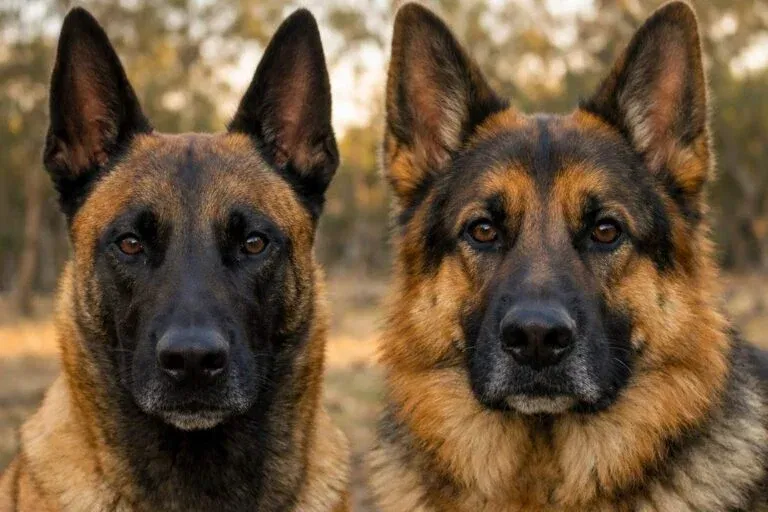
They look like cousins at the dog park, they both work in law enforcement, and they’ll both make you feel like the safest person on your street. But if you’re comparing a Belgian Malinois to a German Shepherd, you’re comparing two very different lifestyles — not just two different dogs. The short version: a Malinois is a full-time job disguised as a dog, while a German Shepherd is a serious working breed that can actually switch off at the end of the day. Here’s what that means for your life in Australia.
What You’ll Learn
- Breed traits & temperament
- Health concerns to know
- True cost in Australia
- Training & exercise needs
- Is this breed right for you?
Quick Facts at a Glance
| Trait | Belgian Malinois | German Shepherd |
|---|---|---|
| Origin | Belgium (Malines region) | Germany |
| Size (Height) | 56–66 cm | 55–65 cm |
| Weight | 20–34 kg | 22–40 kg |
| Lifespan | 12–16 years | 9–13 years |
| Coat Type | Short, straight double coat | Medium-length double coat (stock or long stock) |
| Shedding Level | Moderate | High — heavy seasonal blowouts |
| Energy Level | Very high — relentless | High — with an off-switch |
| Trainability | Very easy for experienced handlers | Easy — more forgiving of beginner mistakes |
| Barking Level | Moderate to high (alert barkers) | Moderate to high (territorial barkers) |
| Good With Kids | With supervision — herding instinct may cause nipping | Yes — with supervision, more tolerant of chaos |
| Good With Other Dogs | With supervision — can be dog-selective | With supervision — generally better with other dogs |
| Apartment Friendly | No — needs space and extensive exercise | Not ideal — but possible with committed exercise |
| Puppy Price (AUD) | $1,500 – $3,500 | $2,000 – $4,500 |
| ANKC Group | Group 5 — Working Dogs | Group 5 — Working Dogs |
| Australian Popularity | Rising fast — still niche | Top 5 most popular breed nationally |
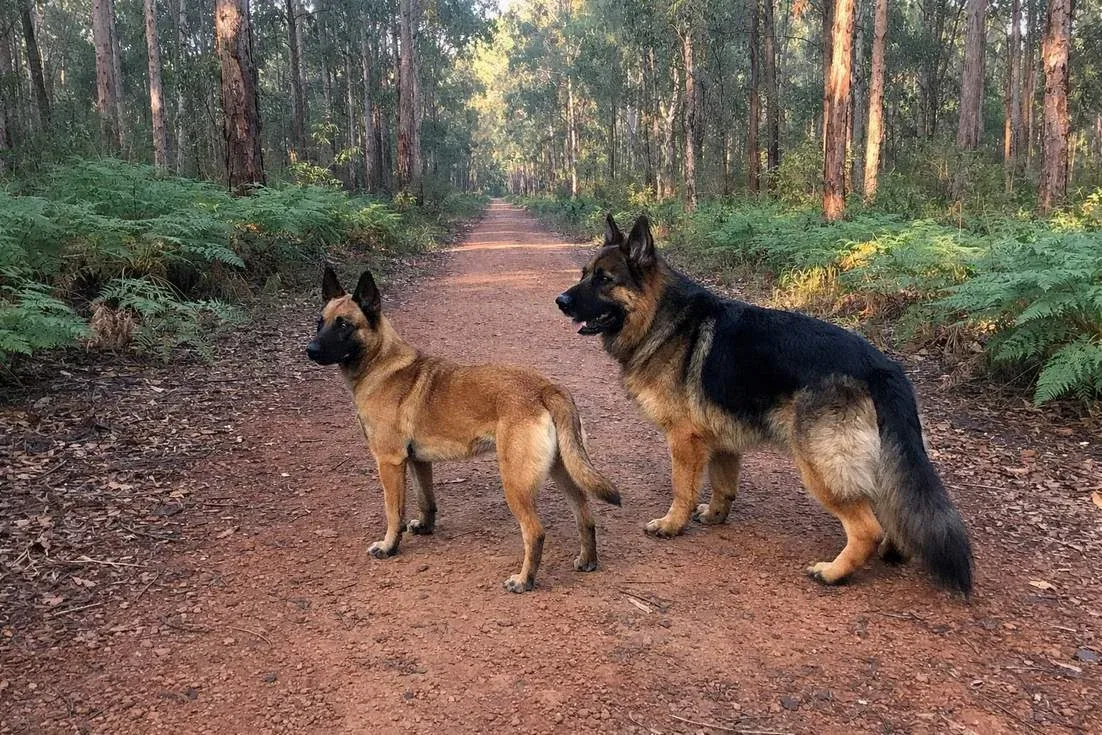
Where Did the they Come From?
The Belgian Malinois was developed in the Malines region of Belgium in the late 1800s as one of four varieties of Belgian Shepherd Dog. Originally a livestock herding dog, the Malinois was quickly recognised for its exceptional drive, speed, and trainability. By the early 1900s, it was already being used in Belgian police work, and by both World Wars it served in military roles. Today, it’s the preferred breed for military and police K-9 units worldwide, including the Australian Defence Force, Australian Federal Police, and state police services.
The German Shepherd was developed by Captain Max von Stephanitz in Germany in 1899 with the explicit goal of creating the ideal working dog. Originally bred for sheep herding in a “tending” style (walking the flock boundaries rather than driving), the breed’s intelligence and versatility quickly saw it transition into police, military, and service roles. The German Shepherd has been one of the world’s most popular breeds for over a century and consistently ranks in Australia’s top 5.
What their origins tell you about today: both breeds were built to work, but the Malinois was refined for intensity and speed, while the German Shepherd was refined for versatility and adaptability. That difference in breeding philosophy shows up in every aspect of daily life with these dogs.
How to Tell Them Apart
At a distance, these two breeds look remarkably similar — both are large, upright-eared, double-coated dogs with confident, athletic movement. Up close, the differences are clear.
The Belgian Malinois is leaner and more square-proportioned, with a lighter frame built for speed and endurance. It typically weighs 20–34 kg and stands 56–66 cm. The head is more wedge-shaped and elegant, with ears sitting high and pointing straight up from the crown. The coat is short, smooth, and always fawn to mahogany with a black mask and black-tipped hairs.
The German Shepherd is heavier and longer-bodied, typically weighing 22–40 kg at 55–65 cm. It has a broader head with ears that angle slightly outward. The trademark sloping topline (especially in show lines) gives it a distinctive silhouette. The coat is thicker and medium-length, coming in black and tan, black and red, sable, all-black, and occasionally white or blue. German Shepherds also come in a long stock coat (long-haired) variety.
The easiest way to tell them apart: if it looks like a lean, fawn-coloured athlete that could outrun a car, it’s probably a Malinois. If it’s a bigger, fluffier, black-and-tan dog with a sloping back, it’s a German Shepherd.
Physical Comparison at a Glance
| Physical Trait | Belgian Malinois | German Shepherd |
|---|---|---|
| Build / Frame | Lean, square, athletic | Stocky, longer body, deeper chest |
| Head Shape | Refined wedge, flat skull | Broader, more domed skull |
| Ear Type | Triangular, erect, high-set | Large, erect, slightly angled outward |
| Tail | Medium length, slight curve | Long, bushy, slight hook at rest |
| Coat Length | Short, smooth double coat | Medium double coat (stock or long stock) |
| Colour Options | Fawn to mahogany with black mask | Black/tan, black/red, sable, all-black, bi-colour |
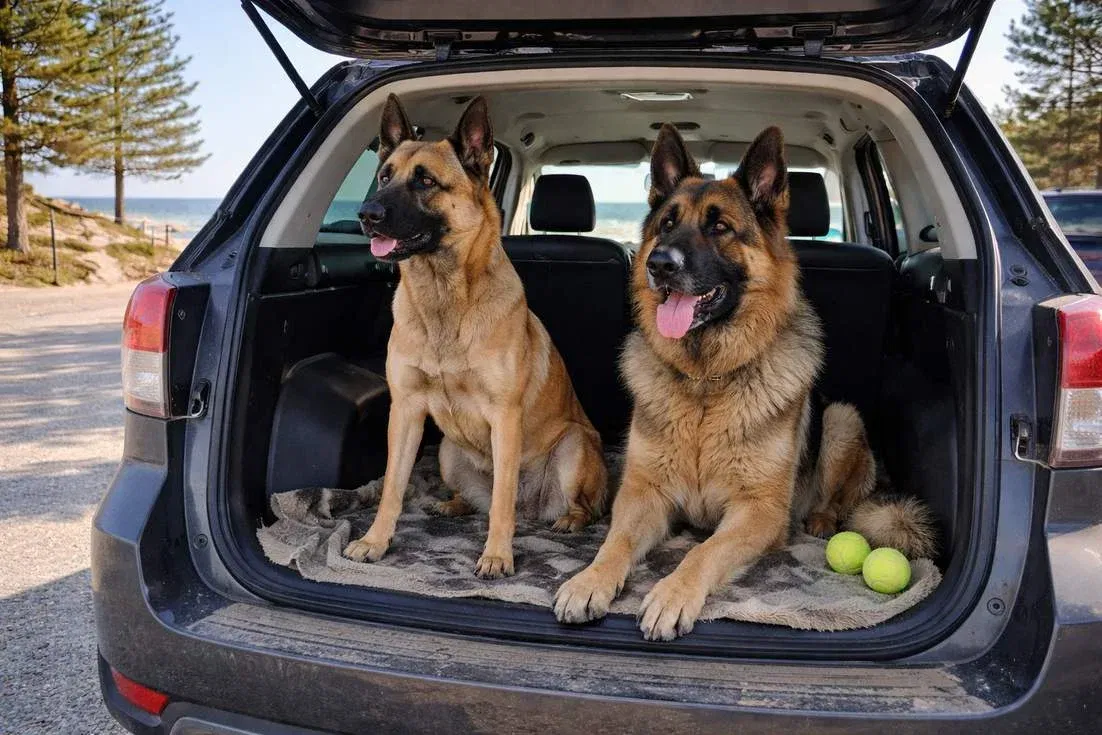
Personality — What Are They Actually Like to Live With?
This is where the real gap between these breeds shows up, and it’s bigger than most people expect.
The Belgian Malinois is an intensity machine. This is a dog that wakes up ready to work and doesn’t stop until you make it stop — and even then, it’s watching you, waiting for the next task. Malinois bond fiercely to their primary handler and can be aloof or suspicious of strangers. They’re extremely sensitive to their handler’s emotions and energy, which makes them brilliant working dogs but also means they absorb household stress like a sponge. An anxious owner will have an anxious Malinois. They have strong herding instincts that can manifest as nipping at children’s heels, chasing cats, or trying to “manage” the movement of everything in the house.
The German Shepherd is also a high-energy working breed, but it has something the Malinois often lacks: an off-switch. A well-exercised German Shepherd can settle on the couch in the evening. It can tolerate the chaos of a family home with kids running around. It’s protective and alert but generally more forgiving of inconsistency than a Malinois. German Shepherds bond deeply with the whole family rather than fixating on one handler, and they’re typically better with visitors once properly introduced.
Here’s the real-world test: if you work from home, a German Shepherd will lie near your desk and occasionally ask for a pat. A Malinois will lie near your desk, stare at you without blinking for two hours, and then start dismantling the room because you haven’t given it a job. If you have kids under 10, a German Shepherd is significantly more forgiving. If you’re a single person who runs 10 km a day and wants a dog that trains with you for two hours, the Malinois will think you’re finally speaking its language.
Health Issues
The Malinois is generally the healthier breed with fewer genetic issues, largely because its breeding pool has been more tightly managed around working ability rather than conformation showing. The German Shepherd, particularly from show lines, carries a heavier burden of hereditary conditions — partly due to its extreme popularity driving less selective breeding over decades.
Shared Health Risks
Both breeds are prone to hip and elbow dysplasia, which should be screened before breeding. Both can develop progressive retinal atrophy (PRA), a degenerative eye condition. Skin allergies affect both breeds, though they’re more common in German Shepherds.
Belgian Malinois-Specific Risks
Malinois-specific health concerns include epilepsy, cataracts, and occasionally thyroid issues. Their biggest health risk is actually injury-related — due to their extreme athleticism and high drive, cruciate ligament tears, muscle strains, and stress injuries from overwork are common. This breed doesn’t know its own limits, so you have to set them.
German Shepherd-Specific Risks
German Shepherds face a longer list of breed-specific conditions: degenerative myelopathy (a progressive spinal cord disease leading to hind limb paralysis), exocrine pancreatic insufficiency (EPI — a digestive condition requiring lifelong enzyme supplements), bloat/gastric dilatation-volvulus (GDV — a life-threatening stomach torsion requiring emergency surgery), pannus (a chronic eye condition), and perianal fistulas. The show-line tendency toward exaggerated rear angulation also contributes to increased joint stress and mobility issues in some dogs.
Common Health Costs Comparison (AUD)
| Health Concern | Belgian Malinois Risk | Est. Cost | German Shepherd Risk | Est. Cost |
|---|---|---|
| Hip Dysplasia | Moderate | $4,000–$8,000 AUD | High | $4,000–$8,000 AUD |
| Elbow Dysplasia | Moderate | $3,000–$6,000 AUD | High | $3,000–$6,000 AUD |
| Bloat/GDV (emergency) | Low | $3,000–$8,000 AUD | Moderate–High | $3,000–$8,000 AUD |
| Degenerative Myelopathy | Low | Management only | Moderate | Management — no cure |
| Cruciate Ligament Tear | Moderate–High (injury risk) | $4,000–$7,000 AUD | Moderate | $4,000–$7,000 AUD |
| EPI (Pancreatic Insufficiency) | Rare | Moderate | $1,000–$2,500/year ongoing |
| Progressive Retinal Atrophy | Low–Moderate | $300–$500/year management | Low–Moderate | $300–$500/year management |
| Est. Annual Vet Costs | $800–$1,500 AUD | $1,000–$2,000 AUD |
One clear comparative statement: the Belgian Malinois is generally healthier and lives 2–4 years longer than the German Shepherd, but its athletic lifestyle increases its risk of sport and exercise injuries. German Shepherds carry more genetic health conditions, particularly degenerative myelopathy and bloat.
Grooming — Which Is More Work?
The German Shepherd wins the shedding crown by a wide margin. If you’ve ever lived with a GSD, you know the house is permanently covered in a fine layer of fur, with apocalyptic blowouts twice a year during seasonal coat changes. You’ll need a good vacuum and a furminator-style deshedding tool.
The Malinois has a shorter, tighter coat that sheds moderately year-round but doesn’t produce the same volume of loose fur. Weekly brushing is usually sufficient.
| Grooming Task | Belgian Malinois | German Shepherd |
|---|---|---|
| Brushing Frequency | 1–2 times per week | 3–4 times per week (daily during blowouts) |
| Professional Grooming | Rarely needed | $50–$70 AUD | Occasionally | $60–$90 AUD |
| Shedding Season | Moderate year-round | Heavy year-round, extreme spring/autumn blowouts |
| Nail Trimming | Every 2–4 weeks | Every 2–4 weeks |
| Ear Cleaning | Every 2 weeks | Weekly (larger ears trap debris) |
Neither breed should be shaved — their double coat insulates against both heat and cold. Shaving a GSD or Malinois damages the coat structure and can cause it to grow back patchy or coarse.
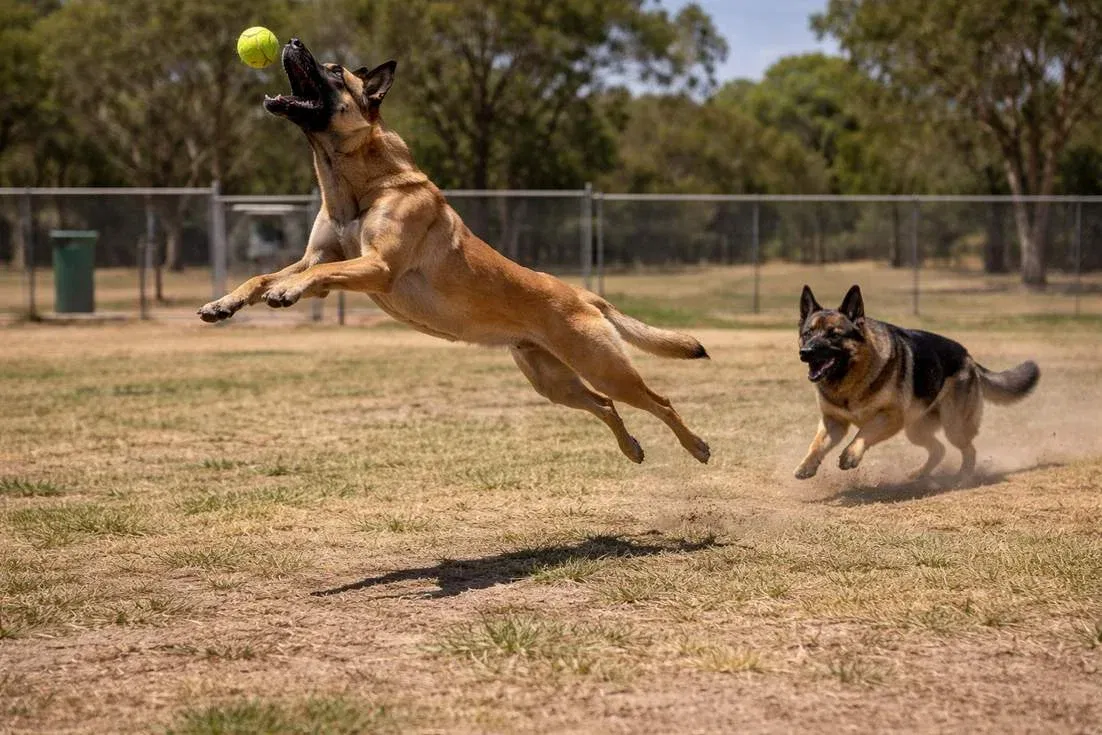
Exercise — How Active Are They Really?
Both breeds need serious daily exercise, but the Malinois operates at a different level entirely. This is not a “two walks a day” dog. A Malinois needs high-intensity physical and mental work — think structured training sessions, agility, scent work, or long runs — for a minimum of 2 hours per day, and many working-line Malinois need closer to 3–4 hours. A bored Malinois doesn’t get lazy; it gets creative. And a creative Malinois will dismantle your house, jump your fence (they can clear 1.8 metres from a standstill), and find things to herd that you didn’t know could be herded.
The German Shepherd needs 1–2 hours of exercise daily, split between walks, structured play, and training. They’re happy with long hikes, fetch sessions, and obedience work. Crucially, a well-exercised German Shepherd can settle indoors. They have a genuine off-switch that the Malinois mostly lacks.
Exercise Comparison Table
| Exercise Factor | Belgian Malinois | German Shepherd |
|---|---|---|
| Daily Exercise Needed | 2–4 hours (high intensity) | 1–2 hours |
| Exercise Type | Running, agility, scent work, bite sports, structured training | Walks, hiking, fetch, obedience, tracking |
| Off-Leash Reliability | Moderate — high prey drive, excellent recall if trained | Good — naturally handler-oriented |
| Heat Tolerance (Aus summers) | Moderate — leaner build helps | Low to moderate — thick coat is a liability |
| Swimming Ability | Good — most enjoy water | Good — many enjoy water |
| If Under-Exercised… | Fence jumping, destructive chewing, obsessive behaviours, house demolition | Barking, digging, restlessness, attention-seeking, mild destruction |
Australian Climate Warning
Both breeds struggle in peak Australian summer heat, but the German Shepherd is at higher risk due to its thicker double coat. On days above 30°C, exercise both breeds only in early morning or late evening. The Malinois’s lighter coat gives it a slight advantage in heat, but it will still push itself beyond safe limits if you let it. Always carry water, watch for heavy panting and drooling, and never leave either breed in a car — even for 5 minutes.
Image: Breed exercising outdoors. Alt text: “Belgian Malinois running at off-leash dog park in Australia”
Which one Easier to Train?
The German Shepherd is easier to train for most people. They’re intelligent, motivated by food and praise, and more tolerant of handler mistakes. A novice owner with commitment can successfully train a German Shepherd using positive reinforcement methods and a good local obedience club. They respond well to structure but won’t fall apart if the routine changes slightly.
The Belgian Malinois is one of the most trainable breeds in existence — in the right hands. They learn at lightning speed, respond to the subtlest body language cues, and can perform complex multi-step commands with ease. But that extreme trainability comes with extreme sensitivity. A harsh correction, a raised voice, or inconsistent timing can create anxiety, reactivity, or shut-down behaviour. Malinois need a handler who is calm, precise, and experienced with high-drive working breeds. They’re not a breed you can wing it with.
For both breeds, early socialisation (8–16 weeks) is critical. Expose them to different people, dogs, environments, surfaces, and sounds. The most common training mistake with German Shepherds is inconsistency. The most common mistake with Malinois is not providing enough mental stimulation — they need their brains worked as hard as their bodies, or training becomes boring and behaviour problems follow.
Which Costs More in Australia?
The German Shepherd has a higher upfront purchase price from registered breeders, but the Malinois can cost more over its lifetime due to higher training and exercise-related expenses. The Malinois also lives longer, adding years of ownership costs.
| Cost Category | Belgian Malinois (AUD) | German Shepherd (AUD) |
|---|---|---|
| Puppy (Registered Breeder) | $1,500 – $3,500 | $2,000 – $4,500 |
| Working-Line Puppy | $3,000 – $5,000+ | $3,000 – $6,000+ |
| Rescue/Adoption | $300 – $600 | $300 – $600 |
| First-Year Setup | $2,000 – $3,500 | $2,000 – $3,000 |
| Annual Ongoing Costs | $2,000 – $3,500 (higher training costs) | $1,800 – $3,000 |
| Pet Insurance (Monthly) | $50 – $130 | $60 – $150 |
| Lifetime Cost (Est.) | $35,000 – $55,000 (longer lifespan) | $25,000 – $40,000 |
The hidden cost with a Malinois is training. Most Malinois owners end up investing in professional training, sport classes (IPO/IGP, agility, or scent work), and equipment that a German Shepherd family might not need. Budget at least $1,000–$2,000 AUD per year for structured training if you go the Malinois route.
Which one for Australian Owners
Neither breed is affected by breed-specific legislation in any Australian state or territory. Both are fully legal to own, breed, and sell. Both are ANKC-registered under Group 5 (Working Dogs). Standard council registration fees apply.
Both breeds handle Australian winters easily but struggle in summer heat. The German Shepherd’s thicker coat makes it more vulnerable to heat stress on 35°C+ days. The Malinois’s shorter coat gives it better heat dissipation, but its drive to keep working in any temperature means you need to enforce rest breaks. Air conditioning, shade, and early/late exercise schedules are non-negotiable for both breeds in an Australian summer.
German Shepherds face breed discrimination in some rental applications — they’re listed as “large guard breeds” by some landlords and strata committees. The Malinois is less commonly recognised by landlords (many don’t know the breed), which can work in your favour or against you depending on the landlord’s reaction to its appearance. For both breeds, having obedience training certificates, references, and ANKC registration helps with rental applications.
Both breeds do well at off-leash parks when properly trained and socialised. The Malinois requires more caution due to its high prey drive — a poorly socialised Malinois at an off-leash park can be a liability. Strong recall training is essential before attempting off-leash exercise. Most major Australian cities have excellent off-leash parks and bush walking trails that suit both breeds.
Both breeds are curious, bold, and inclined to investigate wildlife — which puts them at risk for paralysis tick encounters (east coast) and snake bites. Their larger size means higher treatment costs: antivenom and ICU stays for a 30–40 kg dog can run $5,000–$12,000 AUD. Year-round tick and flea prevention is essential in tick-prone areas.
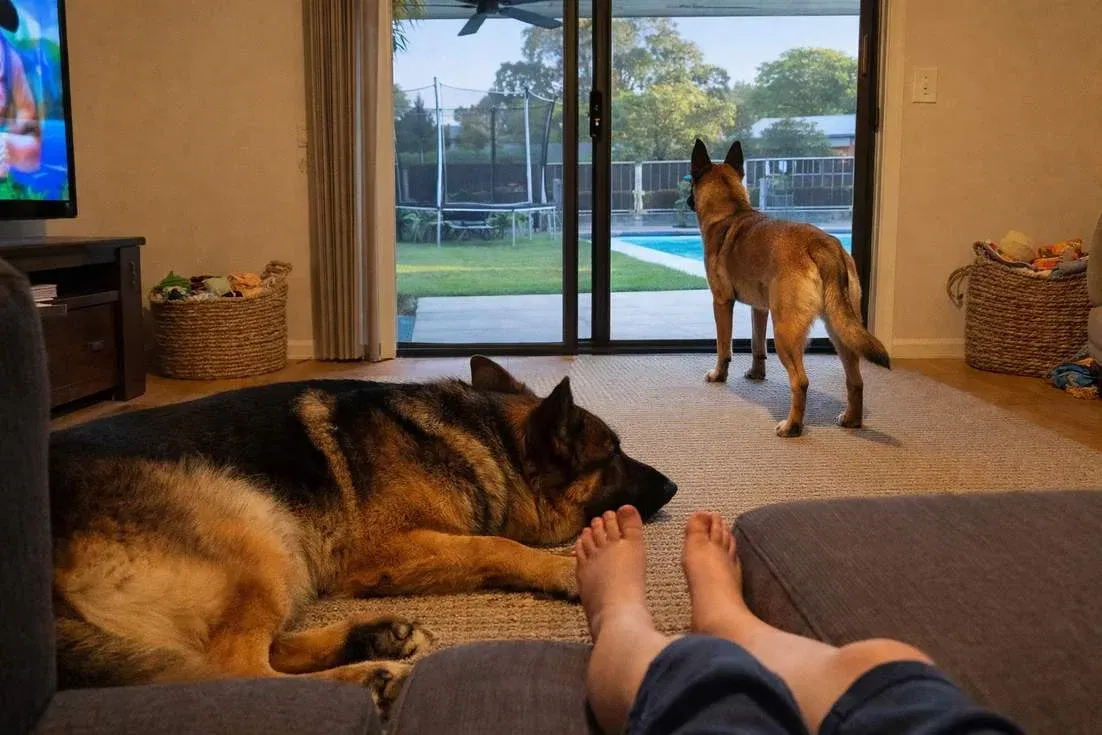
So, Which Should You Get?
- You have previous experience with high-drive working breeds and understand what “intensity” actually means in daily life
- You’re active enough to provide 2–4 hours of physical and mental exercise every single day, including structured training
- You want a dog for sport (IPO/IGP, agility, scent work, protection training) and have access to a club or professional trainer
- You’re a single person or couple without young children, or you have older kids who understand how to interact with working dogs
- You want a loyal, protective family dog that can transition from a morning run to an evening on the couch
- You’re a first-time working-breed owner who’s committed to training and socialisation but wants a more forgiving breed
- You have kids and want a dog that’s naturally tolerant of household chaos while still being alert and watchful
- You want a breed with a massive support network in Australia — GSD clubs, breeders, and trainers are everywhere
- You work long hours and the dog will be home alone for 8+ hours — both breeds develop separation anxiety and destructive behaviours
- You’re not prepared to commit to ongoing training beyond basic puppy school — these are working breeds that need mental stimulation for life
- You live in a small apartment with no yard and limited access to off-leash exercise areas
- You want a low-maintenance, easy-going dog — neither of these breeds fits that description, not even close
- Both breeds are intelligent, loyal working dogs, but the Malinois operates at a higher intensity level that most first-time owners underestimate — it needs a handler, not just an owner.
- The German Shepherd is the better choice for Australian families who want a protective, trainable companion that can balance work and rest. It’s more popular for good reason.
- If you’re drawn to the Malinois, be honest about your lifestyle: can you provide 2–4 hours of structured exercise and training daily, every day, for the next 14–16 years? If the answer is anything other than “absolutely”, the German Shepherd is your dog. Check ANKC affiliate breeders in your state, or contact the German Shepherd Dog Council of Australia (GSDCA) or the Belgian Shepherd Dog Club of your state.
Frequently Asked Questions
Is a Belgian Malinois or German Shepherd better for families with young children?
The German Shepherd is the better choice for families with young children. They’re more tolerant of unpredictable movement and noise, and they bond with the whole family rather than fixating on one handler. A Malinois can live with children, but it requires very careful management and experienced ownership to prevent herding or nipping behaviours.
Which breed is more aggressive — Belgian Malinois or German Shepherd?
Neither breed is inherently aggressive toward people. Both are naturally alert and protective, which can look like aggression to strangers but is actually guarding behaviour. The Malinois has a higher prey drive and can be more reactive to fast-moving stimuli (bikes, joggers, cats), while the German Shepherd is generally calmer in everyday situations. Proper socialisation from puppyhood prevents reactivity in both breeds.
Which breed is cheaper to own in Australia?
The German Shepherd is cheaper overall despite a higher puppy price from top breeders. The Malinois’s longer lifespan (12–16 years vs 9–13 years) and higher training/exercise costs mean lifetime ownership costs run $35,000–$55,000 AUD compared to $25,000–$40,000 AUD for a German Shepherd.
Can you keep a Belgian Malinois in an apartment in Australia?
It’s strongly discouraged. Malinois need space to move, a secure yard, and multiple hours of daily exercise. An under-exercised Malinois in an apartment will destroy it. German Shepherds can technically adapt to apartment living with very committed exercise routines, but they’re also not ideal.
What’s the difference between a Belgian Malinois and a German Shepherd?
The main differences are intensity and lifespan. The Malinois is leaner, lives longer (12–16 years vs 9–13 years), and has significantly higher energy and work drive. The German Shepherd is heavier, calmer, more adaptable to family life, and more forgiving of handler mistakes. Both are intelligent working breeds in ANKC Group 5.
Do Belgian Malinois and German Shepherds get along with each other?
They can, especially if raised together or introduced carefully. Both breeds can be dog-selective, so neutral-ground introductions and supervision are important. The Malinois’s higher energy can overwhelm a calmer German Shepherd, so matching energy levels matters.
Which breed sheds more — Belgian Malinois or German Shepherd?
The German Shepherd sheds significantly more. Its thicker double coat produces heavy year-round shedding with extreme blowouts in spring and autumn. The Malinois sheds moderately with a shorter coat that’s easier to maintain. If dog hair bothers you, the Malinois is the better choice (though neither breed is low-shedding).
What is a Belgian Malinois–German Shepherd mix called?
A Belgian Malinois–German Shepherd cross is commonly called a Malinois Shepherd or Shepinois. It’s a popular working-line cross used in some police and military programs, combining the Malinois’s intensity with the GSD’s broader structure. These crossbreeds are not ANKC-registered and can be unpredictable in temperament — you might get the Malinois’s drive in a German Shepherd’s body, which is a serious commitment.
1. ANKC — Belgian Shepherd Dog (Malinois) Breed Standard — https://ankc.org.au/breed/belgian-shepherd-dog-malinois/
2. ANKC — German Shepherd Dog Breed Standard — https://ankc.org.au/breed/german-shepherd-dog/
3. German Shepherd Dog Council of Australia (GSDCA) — https://www.gsdcouncilaustralia.org/
4. American Kennel Club — GSD vs Belgian Malinois: Similarities and Differences — https://www.akc.org/expert-advice/dog-breeds/german-shepherd-dog-vs-belgian-malinois/
5. Canstar — Dog Insurance Premiums by Breed (2025) — https://www.canstar.com.au/pet-insurance/dog-insurance-premiums/
6. DogzOnline — Belgian Shepherd Dog (Malinois) Breeders Australia — https://www.dogzonline.com.au/breeds/puppies/belgian-shepherd-dog-malinois.asp
7. DogzOnline — German Shepherd Dog Breeders Australia — https://www.dogzonline.com.au/breeds/puppies/german-shepherd-dog.asp
8. PetPlace — German Shepherd vs Belgian Malinois: Which Working Dog Is Right for You? — https://www.petplace.com/article/dogs/pet-care/german-shepherd-vs-belgian-malinois