
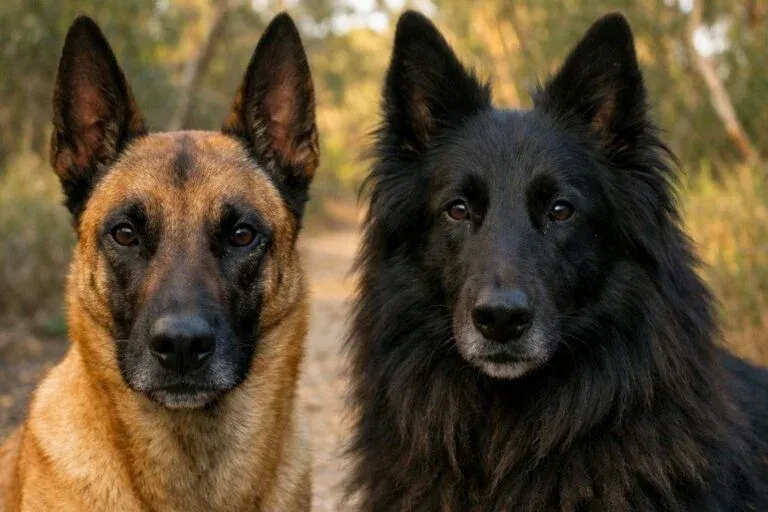
Here’s the thing that catches most people off guard: the Belgian Malinois and the Belgian Shepherd (Groenendael) are technically the same breed. Under ANKC rules in Australia, they’re registered as four varieties of the Belgian Shepherd Dog, separated only by coat type and colour. But anyone who’s actually lived with both will tell you that a Malinois and a Groenendael are about as similar as a sports car and a touring sedan — they share a chassis, but the driving experience is completely different. The short version: the Malinois is the high-octane working athlete that police forces fight over, while the Groenendael is the elegant, sensitive all-rounder that bonds to you like glue. Here’s what that means for your life, your wallet, and your fence line.
What You’ll Learn
- Breed traits & temperament
- Health concerns to know
- True cost in Australia
- Training & exercise needs
- Is this breed right for you?
Quick Facts at a Glance
| Trait | Belgian Malinois | Belgian Shepherd (Groenendael) |
|---|---|---|
| Origin | Belgium (Malines region) | Belgium (Groenendael region) |
| Size (Height) | 56–66 cm | 56–66 cm |
| Weight | 25–34 kg | 20–30 kg |
| Lifespan | 12–14 years | 12–14 years |
| Coat Type | Short, dense, weather-resistant | Long, straight, abundant with ruff |
| Shedding Level | Moderate | High |
| Energy Level | Very High | High |
| Trainability | Easy (with experienced handler) | Easy (with consistent handler) |
| Barking Level | Moderate to High | Moderate to High |
| Good With Kids | With supervision | With supervision |
| Good With Other Dogs | With supervision | With supervision |
| Apartment Friendly | No | Not ideal |
| Puppy Price (AUD) | $1,500 – $3,500 | $1,500 – $3,000 |
| ANKC Group | Working Dogs | Working Dogs |
| Australian Popularity | Rising fast (military/police demand) | Uncommon (dedicated breed community) |
Where Did they Come From?
Both varieties trace back to the same root. In 1891, Professor Adolphe Reul of the Cureghem Veterinary School in Belgium gathered 117 shepherd-type dogs and began the process of standardising them into distinct varieties based on coat type, length, and colour. By 1901, the Belgian Kennel Club formally registered all four varieties as one breed. The Malinois variety, named after the city of Malines (Mechelen), was said to be the first to breed true to type. It was so dominant in the early years that the other varieties were collectively referred to as “other-than-Malinois.” Over the 20th century, the Malinois became the go-to dog for military and law enforcement, favoured for its explosive drive and lighter, more agile build.
The Groenendael variety was established around 1885 by Nicholas Rose at his Château de Groenendael near Brussels. He selectively bred long-haired black Belgian Shepherds, producing what many consider the most visually striking variety. During World War I, Groenendaels served the Belgian Army as messenger dogs and stretcher bearers. They later gained popularity in the United States, where the American Kennel Club registers them separately as the “Belgian Sheepdog.”
The practical takeaway: the Malinois has been selectively bred for intensity and working drive for over a century, while the Groenendael has maintained a broader breeding focus that balances working ability with temperament and conformation. That breeding divergence is the single biggest reason they feel like different dogs to own, despite sharing the same breed standard skeleton.
How to Tell Them Apart
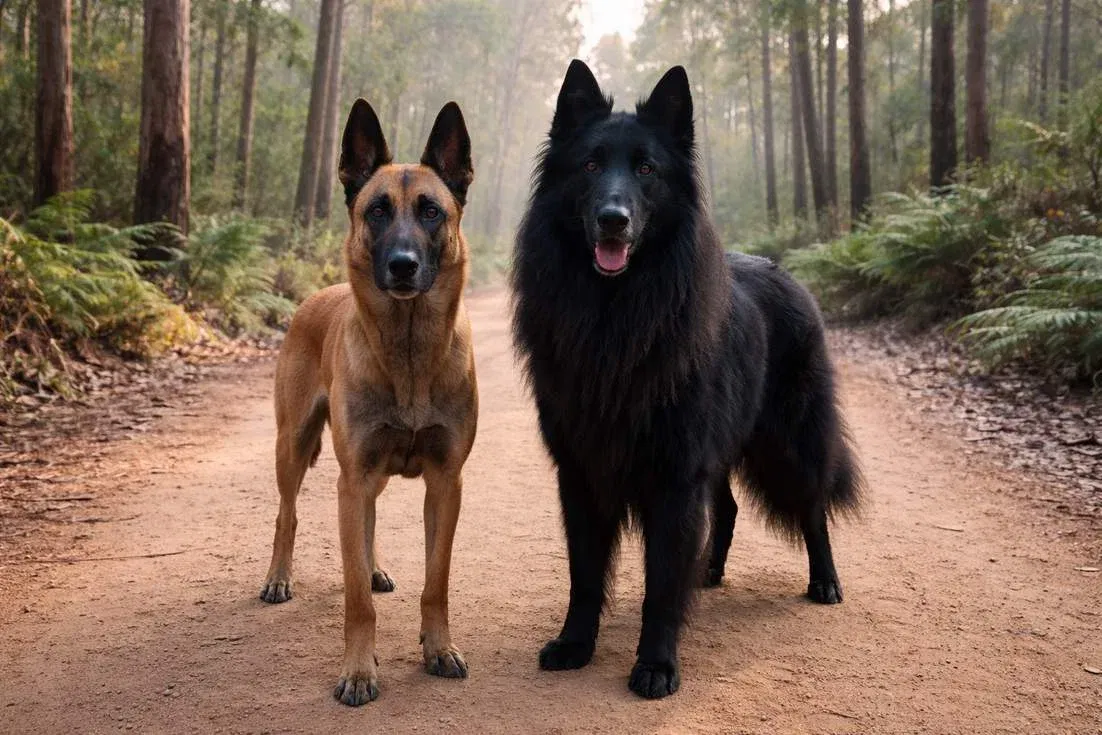
If you can’t tell these two apart at a distance, don’t worry — the body shape is nearly identical. Both are medium-sized, square-built dogs standing 56–66 cm tall with erect triangular ears, a proud head carriage, and an alert expression. The difference is almost entirely in the coat.
The Malinois has a short, dense, weather-resistant coat in fawn to mahogany with a black mask and black ear tips. It looks lean, athletic, and “ready to deploy.” The Groenendael has a long, straight, abundant black coat with a distinctive mane or ruff around the neck and feathering on the legs and tail. It looks elegant and almost regal by comparison. In terms of build, the Malinois tends to be slightly lighter and leaner — particularly working-line dogs, which are bred for explosive speed and agility rather than conformation aesthetics. The Groenendael is typically a touch heavier through the chest and carries more coat, which makes it appear larger even though the height range is identical.
A common mistake: people sometimes confuse dark sable Malinois with Groenendaels. If the dog has a short coat, it’s a Malinois regardless of how dark the overlay is. Coat length, not colour intensity, is what separates these two varieties.
Physical Comparison at a Glance
| Physical Trait | Belgian Malinois | Belgian Shepherd (Groenendael) |
|---|---|---|
| Build / Frame | Lean, athletic, square | Slightly heavier, elegant, square |
| Head Shape | Chiselled, moderate stop | Chiselled, moderate stop |
| Ear Type | Triangular, erect, set high | Triangular, erect, set high |
| Tail | Medium length, carried low at rest | Long, feathered, carried low at rest |
| Coat Length | Short | Long |
| Colour Options | Fawn to mahogany with black mask | Black (small white markings allowed) |
What Are They Actually Like to Live With?
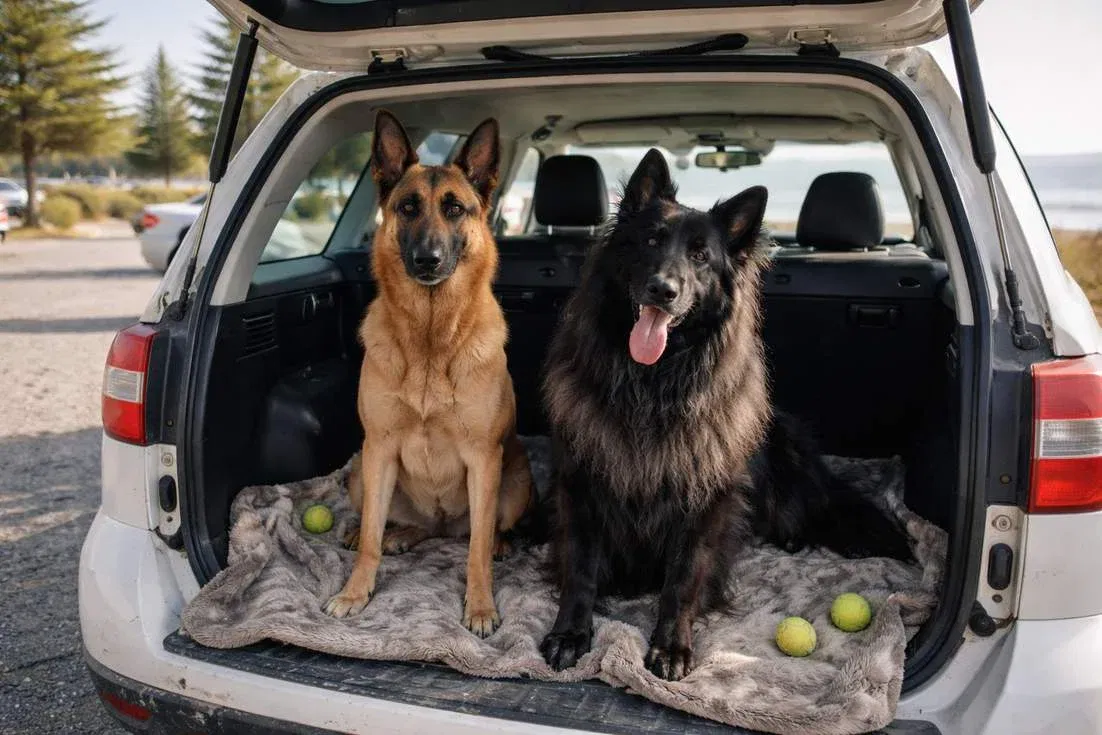
This is where the conversation gets real, because on paper these two look similar — both intelligent, both loyal, both protective. But the day-to-day experience of owning each one is dramatically different.
The Malinois doesn’t just want exercise — it needs a job. This is a dog bred to chase suspects, detect explosives, and clear buildings at 3am. If you think a daily walk and a game of fetch will cut it, your couch cushions will pay the price. The Groenendael is also high-energy by any normal standard, but its drive is more manageable. A solid 90-minute session of mixed activity (walks, training, play) will generally satisfy a Groenendael. A Malinois might need double that, plus structured mental work.
Both varieties bond intensely to their people, but they express it differently. The Groenendael is the classic velcro dog — it wants to be touching you, watching you, reading your emotions. Owners regularly describe them as “almost too perceptive.” The Malinois is also handler-focused, but its affection tends to look more like “I’m ready to work for you” than “I need to cuddle.” Working-line Malinois in particular can be so task-oriented that they seem aloof to people unfamiliar with the breed.
Neither variety is a natural nanny dog, and both require supervision around young children. The Malinois has a very high prey drive and a tendency to nip at heels (herding instinct on overdrive), which can be frightening for toddlers. The Groenendael can be sensitive and reactive to chaotic toddler energy, but generally has a softer mouth and lower impulse intensity. For families with kids over 10 who can participate in training, both varieties can work — but the Groenendael is the safer pick for most family setups.
The Groenendael handles alone time worse. Its deep emotional bond means it can spiral into destructive behaviour, excessive barking, or self-harm if left alone for more than 4–5 hours regularly. The Malinois also hates being left alone, but its distress tends to manifest as property destruction rather than emotional shutdown — think chewed door frames and shredded blinds. Neither breed belongs in a home where everyone works 9–5 with no midday break.
Both varieties have a strong prey drive. The Malinois’s is typically higher and faster to trigger, making it a riskier proposition with cats, small dogs, or pocket pets. Groenendaels can coexist with cats if raised together from puppyhood, but introductions to small animals should always be managed carefully. Multi-dog households work for both varieties, but same-sex aggression can be an issue, particularly in Malinois.
Health Issues
Both varieties are generally robust dogs with fewer breed-specific problems than many popular breeds. However, they share some common genetic vulnerabilities and each has its own risk profile.
Shared health risks
Hip dysplasia, elbow dysplasia, progressive retinal atrophy (PRA), cataracts, epilepsy, and anesthetic sensitivity affect both varieties. Australian breeders registered with Dogs Australia are increasingly DNA testing for conditions like degenerative myelopathy, spongy degeneration with cerebellar ataxia (SDCA1 and SDCA2), and MDR1 (multi-drug sensitivity).
Malinois-specific risks
The Malinois has a slightly higher incidence of bloat (gastric dilatation-volvulus) due to its deep chest and tendency to eat fast after intense exercise. Hemangiosarcoma (an aggressive blood vessel cancer) has also been flagged as a breed concern. Working-line Malinois bred for extreme drive can occasionally present with compulsive behaviours such as tail chasing or shadow fixation.
Groenendael-specific risks
The Groenendael has a notably higher epilepsy prevalence. A Danish epidemiological study found that epilepsy rates in Groenendael and Tervueren populations were significantly higher than the general dog population, with a heritability estimated at 0.77. Gastric carcinoma (stomach cancer) has also been identified as a breed concern in European Belgian Shepherd populations, particularly in the Groenendael and Tervueren varieties. Lymphoma occurs at a higher rate in Groenendaels compared to most breeds.
Common Health Costs Comparison
| Health Concern | Belgian Malinois Risk | Groenendael Risk |
|---|---|---|
| Hip Dysplasia | Low (5.4% OFA) | $6,000–$10,000 AUD surgery | Low–Moderate | $6,000–$10,000 AUD surgery |
| Elbow Dysplasia | Low | $3,000–$6,000 AUD surgery | Low | $3,000–$6,000 AUD surgery |
| Epilepsy | Moderate | $500–$2,500 AUD/year (medication) | Higher | $500–$2,500 AUD/year (medication) |
| Progressive Retinal Atrophy | Moderate | No cure; $300–$600 AUD (diagnosis) | Moderate | No cure; $300–$600 AUD (diagnosis) |
| Bloat (GDV) | Moderate | $5,000–$10,000 AUD emergency surgery | Low | $5,000–$10,000 AUD emergency surgery |
| Lymphoma | Low | $5,000–$15,000 AUD (chemotherapy) | Moderate–Higher | $5,000–$15,000 AUD (chemo) |
| Est. Annual Vet Costs | $800 – $1,500 AUD | $800 – $1,800 AUD |
The Malinois is arguably the hardier of the two varieties in terms of overall cancer risk, but the Groenendael’s higher epilepsy rate and lymphoma predisposition mean its lifetime veterinary bill can skew higher. Always confirm that your breeder has completed hip and elbow scoring, eye certification (ACES), and DNA panel testing before purchasing a puppy of either variety.
Grooming — Which Is More Work?
This one isn’t close. The Groenendael’s long, abundant coat requires 3–4 brushing sessions per week to prevent matting, with daily brushing during the twice-yearly coat blow. Professional grooming every 6–8 weeks is recommended, running $80–$120 AUD per session. The Malinois, by contrast, has a wash-and-wear coat that needs a weekly brush and a bath when it gets muddy. Professional grooming is rarely needed beyond nail trims and the occasional deshed treatment ($50–$80 AUD).
Both varieties shed. The Malinois sheds steadily year-round with two heavier seasonal blows. The Groenendael’s shedding is less constant but far more dramatic during coat blow — expect tumbleweeds of black fur on every surface in your house for 2–3 weeks, twice a year.
| Grooming Task | Belgian Malinois | Belgian Shepherd (Groenendael) |
|---|---|---|
| Brushing Frequency | 1–2 times/week | 3–4 times/week (daily in coat blow) |
| Professional Grooming | Rarely needed | $50–$80 AUD | Every 6–8 weeks | $80–$120 AUD |
| Shedding Season | Year-round moderate, 2x heavy | Moderate with 2x dramatic coat blow |
| Nail Trimming | Every 2–3 weeks | Every 2–3 weeks |
| Ear Cleaning | Weekly | Weekly |
How Active Are They Really?
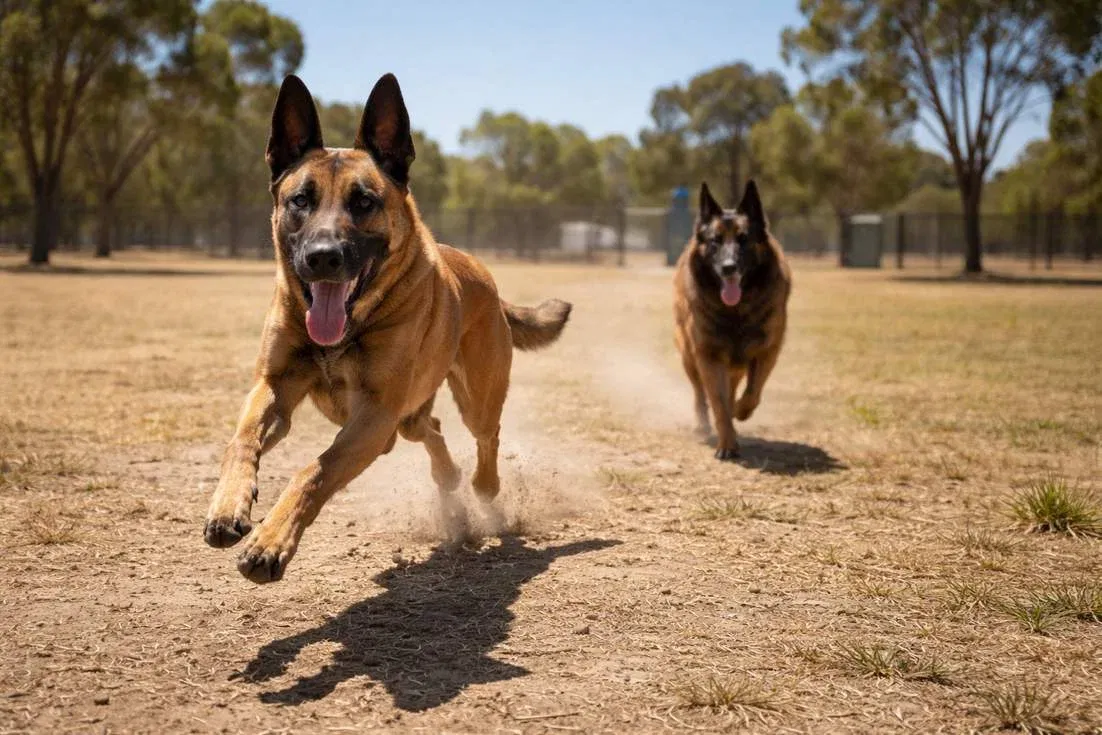
Both of these dogs were built to work all day in Belgian pastures, and that genetic heritage hasn’t softened. But there’s a meaningful gap in intensity.
The Malinois needs 2+ hours of vigorous daily activity that includes structured work — obedience drills, agility, scent work, protection sport, or similar. A bored Malinois doesn’t just get restless; it becomes destructive, neurotic, and sometimes aggressive. This is the number one reason Malinois end up in rescue. The Groenendael is also a high-energy breed by any standard, but 1–1.5 hours of mixed exercise (walking, off-leash running, training games) is generally enough to keep it balanced. Under-exercised Groenendaels tend to become clingy, anxious, and vocal rather than destructive.
| Exercise Factor | Belgian Malinois | Belgian Shepherd (Groenendael) |
|---|---|---|
| Daily Exercise Needed | 2+ hours (including structured work) | 1–1.5 hours |
| Exercise Type | Agility, protection sport, scent work, running | Long walks, hiking, obedience, herding |
| Off-Leash Reliability | Poor–Moderate (high prey drive) | Moderate (better recall if bonded) |
| Heat Tolerance (Aus summers) | Low–Moderate | Low (black coat absorbs heat) |
| Swimming Ability | Natural (many love water) | Trainable (not instinctive) |
| If Under-Exercised… | Destructive, neurotic, mouthy, escapes yards | Clingy, anxious, excessive barking, shadow-following |
Australian Climate Warning
Neither variety handles extreme Australian heat well. The Groenendael’s black coat absorbs significantly more heat than the Malinois’s lighter coat, putting it at higher risk of overheating on 35°C+ days. Both breeds should only be exercised in early morning (before 8am) or late evening (after 6pm) during summer. Watch for excessive panting, drooling, glazed eyes, or stumbling — signs of heatstroke that require immediate veterinary attention. Always check footpath temperature with the back of your hand before walking, and carry water for both you and your dog.
which one Easier to Train?
The Malinois is easier to train in the sense that it is extraordinarily responsive to rewards and has an almost unmatched desire to work. Professional trainers consistently rank the Malinois among the top 3 most trainable breeds alive. But — and this is a significant “but” — the Malinois is easier to train badly. Its intensity means that mistakes in timing, correction, or handling escalate fast. An overtrained Malinois can become reactive, handler-aggressive, or compulsively wired. It is not a forgiving breed for novice trainers.
The Groenendael is also highly trainable and keen to please, but it’s more emotionally sensitive. Harsh corrections shut a Groenendael down fast; it responds far better to positive reinforcement and patience. Where the Malinois thrives under pressure-based training systems (like protection sport), the Groenendael excels in obedience, agility, and herding trials where the handler-dog relationship is built on trust rather than intensity. For a first-time Belgian owner, the Groenendael is the more forgiving choice.
Common training mistakes with the Malinois include not starting impulse control early, using too much physical correction, and failing to teach an “off switch.” With the Groenendael, common errors include inconsistent boundaries (because they’re so sweet you let things slide), underestimating how much mental stimulation they need, and socialising them too late — Groenendaels that miss the critical socialisation window can become fearful and reactive.
Which Costs More in Australia?
Working-line Malinois puppies from high-drive imported bloodlines can command prices above $3,500 AUD and occasionally into the $5,000+ range for exceptional pedigrees. Show and companion Malinois from ANKC-registered breeders generally fall in the $1,500–$3,500 AUD range. Groenendaels are slightly less expensive on average ($1,500–$3,000 AUD) due to lower demand, but fewer breeders in Australia means waitlists can be long.
| Cost Category | Belgian Malinois (AUD) | Groenendael (AUD) |
|---|---|---|
| Puppy (Registered Breeder) | $1,500 – $3,500 | $1,500 – $3,000 |
| Rescue/Adoption | $350 – $800 | $350 – $800 |
| First-Year Setup | $2,500 – $4,000 | $2,500 – $4,000 |
| Annual Ongoing Costs | $2,500 – $4,000 | $2,800 – $4,500 |
| Pet Insurance (Monthly) | $60 – $110 | $65 – $120 |
| Lifetime Cost (Est.) | $35,000 – $55,000 | $38,000 – $60,000 |
The Groenendael’s higher lifetime cost estimate reflects increased grooming expenses ($600–$1,200 AUD/year vs. $200–$400 for the Malinois) and potentially higher veterinary bills due to epilepsy and cancer predispositions. The Malinois can be cheaper to maintain physically but more expensive in hidden costs: professional training ($1,500–$4,000 AUD for a solid foundation course), property damage from under-stimulation, and higher fencing requirements.
For registered breeders, check Dogs Australia (ANKC) state affiliate directories. For rescue, contact Belgian Shepherd rescue organisations in your state or Rescue a Belgian.
which one for Australian Owners
Neither variety was designed for 40°C days. The Groenendael’s heavy black coat makes it especially vulnerable to Australian summers, particularly in Queensland, Northern Territory, and inland regions. Air-conditioned indoor time is non-negotiable during extreme heat. The Malinois copes slightly better with its shorter coat but still needs careful heat management. Both varieties suit cooler southern states (Victoria, Tasmania, southern NSW) better than tropical and subtropical regions.
Neither the Belgian Malinois nor the Groenendael is subject to BSL in any Australian state or territory. However, the Malinois’s increasing popularity in protection and guard dog circles means some councils and strata bodies are starting to ask questions about the breed, particularly in rental applications. It’s not a restricted breed, but it’s gaining a reputation that can create headaches.
Both varieties are registered as Belgian Shepherd Dog (Malinois) and Belgian Shepherd Dog (Groenendael) under ANKC rules. Council registration costs vary by state: roughly $30–$80 AUD/year for desexed dogs and $150–$300 AUD/year for entire dogs, depending on your local government area.
The Malinois is increasingly being listed alongside breeds that landlords hesitate to approve, even though it’s not legally restricted. Its guard dog reputation and muscular appearance work against it in rental applications. The Groenendael, looking more like a fluffy show dog, tends to have an easier time gaining landlord approval — though size restrictions in strata buildings can still be a barrier for both.
Both varieties are curious, high-drive dogs that will investigate movement in long grass or bush. In tick-prone coastal areas (particularly the eastern seaboard from North Queensland to the Illawarra), paralysis tick prevention is critical. The Groenendael’s long coat makes tick checks harder and more time-consuming — budget extra time for daily coat inspections during tick season. The Malinois’s short coat makes ticks easier to spot. Both breeds’ high prey drive means snake encounters are a genuine risk in rural and semi-rural Australia. Snake avoidance training is recommended for both varieties.
Both varieties are classified as medium-to-large working dogs by Australian insurers, which puts them in a mid-to-high premium bracket. The Groenendael may attract slightly higher premiums due to its cancer and epilepsy predispositions. Expect $60–$120 AUD/month for comprehensive accident and illness cover. Shop around — premiums vary significantly between providers.
So, Should You Get a Belgian Malinois or a Belgian Shepherd (Groenendael)?
IMAGE (optional): Infographic summarising this section. Alt text: “Infographic comparing Belgian Malinois and Belgian Shepherd Groenendael for different lifestyles”
- You have prior experience with high-drive working breeds and want a dog for sport, protection work, or an active working role.
- You can commit to 2+ hours of structured daily activity including formal training, not just walks.
- You want a dog with explosive athleticism and an unmatched work ethic.
- You have a securely fenced property (1.8m minimum) and someone home for most of the day.
- You want a deeply bonded, emotionally perceptive companion that still has working capability.
- You’re an active household (1–1.5 hours of daily exercise) but don’t need a dog bred to clear buildings.
- You’re drawn to a striking appearance and don’t mind the grooming commitment.
- You have older children (10+) and want a family dog with a protective instinct but softer edges.
- You’ve never owned a working breed before. These are not starter dogs. Start with something less intense and work your way up.
- You work full-time with no capacity for midday breaks, doggy daycare, or a dog walker. Both breeds deteriorate mentally when left alone for 8+ hours.
- You live in a small apartment with no yard and limited access to off-leash exercise areas.
- You have toddlers or very young children and no prior experience managing high-drive dogs around kids.
- You’re not prepared to invest $1,500–$4,000 AUD in professional training as a baseline.
- These two varieties share DNA, a breed standard, and a Belgian postcode — but the Malinois is an F1 car and the Groenendael is a high-performance touring sedan. Choose based on your lifestyle, not your Instagram feed.
- The Groenendael will cost you more at the groomer and potentially more at the vet; the Malinois will cost you more in professional training and replacement furniture.
- In Australia, both varieties are available through ANKC-registered breeders and breed-specific rescue — check Dogs Australia state affiliates and the Belgian Shepherd Dog clubs in your state first.
Frequently Asked Questions
Is a Belgian Malinois or Belgian Shepherd (Groenendael) better for families with young children?
The Groenendael is generally the better choice for families with children over 10, as it has a softer temperament and lower impulse intensity than the Malinois. Neither variety is recommended for households with toddlers unless the owner has significant experience with working breeds. Both require supervision around children at all times.
Are Belgian Malinois more aggressive than Belgian Shepherd Groenendaels?
Neither variety is inherently aggressive. The Malinois has higher bite drive and prey drive due to decades of selective breeding for police and military work, which can look like aggression in an untrained or under-socialised dog. The Groenendael can be reactive if poorly socialised. Aggression in either variety is almost always a training and management failure, not a breed trait.
Which breed is cheaper to own in Australia?
The Malinois has lower grooming costs ($200–$400 AUD/year vs. $600–$1,200 for the Groenendael) but often requires more investment in professional training ($1,500–$4,000 AUD). Lifetime costs are broadly similar at $35,000–$60,000 AUD depending on health and lifestyle.
Can you keep a Belgian Malinois or Groenendael in an apartment in Australia?
Not recommended for either variety. Both need a securely fenced yard and regular access to open exercise spaces. The Malinois in particular can become destructive and vocal in small living spaces. If you’re in an apartment, look at lower-energy breeds.
What’s the difference between a Belgian Malinois and a Belgian Shepherd?
In Australia, the Belgian Malinois IS a Belgian Shepherd — it’s one of four varieties (Malinois, Groenendael, Tervueren, Laekenois) registered under the single Belgian Shepherd Dog breed by ANKC. The main difference between the Malinois and the Groenendael variety is coat (short fawn vs. long black) and working drive intensity, with the Malinois being the higher-drive variety.
Do Belgian Malinois and Groenendaels get along with each other?
Generally yes, especially if raised together or introduced properly. They share the same breed temperament foundation. However, same-sex pairings (particularly two males) can lead to resource guarding and dominance issues. Opposite-sex pairings tend to work better. Always supervise introductions and be prepared to manage the dynamic.
Which breed sheds more — Belgian Malinois or Groenendael?
The Malinois sheds more consistently throughout the year. The Groenendael sheds less day-to-day but produces a far more dramatic coat blow twice a year, where large volumes of undercoat come out over 2–3 weeks. Overall hair volume from the Groenendael is higher due to its longer coat. Invest in a quality undercoat rake regardless of which variety you choose.
Can you interbreed a Malinois and a Groenendael?
Under ANKC rules in Australia, intervariety breeding is permitted following FCI breeding recommendations. The accepted combination for these two would be Malinois × Tervueren or Groenendael × Tervueren — direct Malinois × Groenendael crosses are not among the traditionally recommended pairings, as FCI advises avoiding breeding long-coated to short-coated varieties directly. Each puppy from an intervariety litter is registered according to its individual coat type.
1. Dogs Australia (ANKC) — Belgian Shepherd Dog (Malinois) Breed Standard — https://dogsaustralia.org.au/BrowseBreed/browse-a-breed/223/Belgian-Shepherd-Dog-(Malinois)/
2. Dogs Australia (ANKC) — Belgian Shepherd Dog (Groenendael) Breed Standard — https://dogsaustralia.org.au/members/breeds/breed-standards/Belgian-Shepherd-Dog-(Groenendael,-Tervueren,-Laekenois,-Malinois)
3. PetMD — Belgian Sheepdog (Groenendael) Health and Care — https://www.petmd.com/dog/breeds/belgian-sheepdog
4. Dogster — 7 Belgian Malinois Health Issues (Vet Answer) — https://www.dogster.com/ask-the-vet/belgian-malinois-health-issues-vet-answer
5. Berendt et al. (2008) — Prevalence and characteristics of epilepsy in the Belgian Shepherd Groenendael and Tervueren — PMC: https://pmc.ncbi.nlm.nih.gov/articles/PMC2633289/
6. Orthopedic Foundation for Animals (OFA) — Belgian Malinois hip dysplasia statistics — https://ofa.org
7. American Belgian Malinois Club — ABMC Health Statement — https://cdn.akc.org/Marketplace/Health-Statement/Belgian-Malinois.pdf
8. Belgian Shepherd Dog Club of Queensland — Intervariety Breeding Regulations — https://www.bsdcq.com/intervariety.html
9. IPFD DogWellNet — Belgian Shepherd Breed Health Report — https://dogwellnet.com/content/health-and-breeding/breeds/breed-specific-health-reports/get-a-grihp-on-belgian-shepherds-r766/