
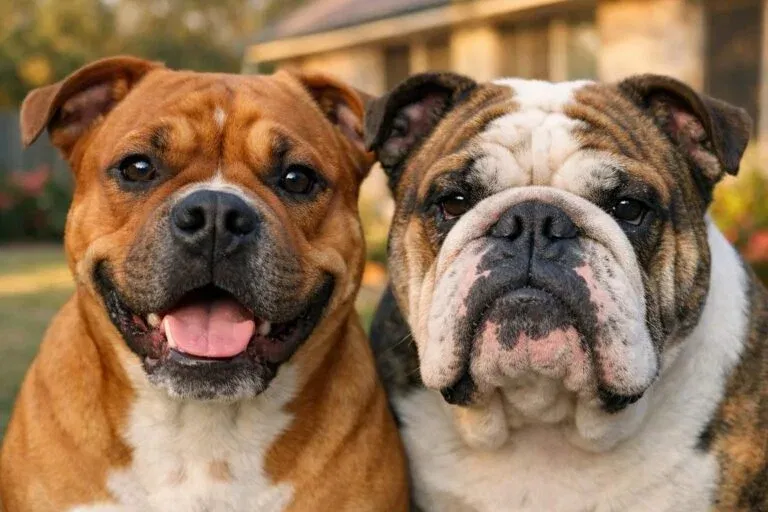
The Australian Bulldog exists for one reason: because the English Bulldog is broken. That’s not an insult — it’s the founding philosophy of the breed. In the 1990s, Australian breeders led by Pip Nobes in Queensland looked at the English Bulldog’s devastating list of health problems — the breathing struggles, the heatstroke risk, the caesarean births, the 8-year lifespan — and decided to build a better version for Australian conditions.
Three decades later, the Australian Bulldog has earned a loyal following and a reputation as the “healthier bulldog.” But is it actually healthier? Is it the same dog with a longer nose, or a genuinely different breed? And most importantly — which one is the right choice for an Aussie household?
Here’s the comparison, including some uncomfortable truths about both breeds.
What You’ll Learn
- Breed origins & history
- Physical & temperament differences
- Health comparison & vet costs
- Grooming, exercise & training needs
- Costs in Australia & breeder advice
- Which breed is right for you?
Australian Bulldog vs English Bulldog at a Glance
| Trait | Australian Bulldog | English Bulldog |
|---|---|---|
| Origin | Queensland, Australia (1990s) | England, UK (13th century) |
| Kennel Club Status | NOT ANKC registered; ABCA registered | ANKC registered (Group 7 — Non-Sporting) |
| Size (Height) | 45-50 cm | 31-36 cm |
| Weight | 25-35 kg | 18-25 kg |
| Lifespan | 10-12 years | 8-10 years |
| Coat Type | Short, smooth | Short, smooth, fine |
| Shedding Level | Low to Moderate | Low to Moderate |
| Energy Level | Moderate | Low |
| Trainability | Moderate — intelligent but stubborn | Low to Moderate — stubborn and slow to learn |
| Barking Level | Low to Moderate | Low |
| Good With Kids | Excellent — bred as a family companion | Good — gentle but fragile themselves |
| Good With Other Dogs | Generally good with socialisation | Can be dog-selective; same-sex aggression possible |
| Apartment Friendly | Yes | Yes — ideal apartment dog |
| Puppy Price (AUD) | $2,500-$4,000 (ABCA registered) | $3,500-$5,500 (ANKC registered) |
| BOAS Risk | Low to Moderate — longer muzzle | Very High — up to 80% affected |
| Caesarean Birth Rate | Lower — wider hips aid natural whelping | Over 80% require caesarean delivery |
History & Origins
The English Bulldog’s history stretches back to 13th-century England, where these dogs were bred for bull-baiting — a blood sport where dogs attacked tethered bulls. When bull-baiting was banned in 1835, the breed’s purpose disappeared overnight. Breeders pivoted from function to form, gradually reshaping the Bulldog into a companion animal.
Over the next 150 years, selective breeding for increasingly exaggerated features — flatter faces, wider shoulders, more wrinkles, shorter legs — produced the English Bulldog we know today. The result is a dog that looks nothing like its athletic bull-baiting ancestors and suffers from a catalogue of structural health problems as a direct consequence of its conformation.
In Australia, the English Bulldog (registered as the “British Bulldog” by the ANKC) is part of Group 7 (Non-Sporting) and has a dedicated breeder community through the National British Bulldog Council of Australia.
The Australian Bulldog’s origin story is refreshingly honest. In the 1990s, Queensland breeder Pip Nobes crossed English Bulldogs with Boxers, English Bull Terriers and Bullmastiffs to produce a dog that kept the Bulldog’s beloved personality — the loyalty, the clownish affection, the family devotion — while fixing its devastating health issues.
The goals were specific: a longer muzzle for better breathing, wider hips for natural whelping, longer legs for mobility, fewer wrinkles to reduce skin infections, and improved heat tolerance for the Australian climate. Noel and Tina Green coined the breed name “Australian Bulldog” and the breed was featured on Burke’s Backyard in 1998, sparking national interest.
In 2003, Pip Nobes founded the United Aussie Bulldog Association (UABA). The Aussie Bulldog Club of Australia (ABCA) now serves as the primary breed registry. The breed is not recognised by the ANKC, which means Australian Bulldogs cannot compete in ANKC conformation shows — but for most pet buyers, this distinction is irrelevant. The ABCA maintains its own breed standard, breeder ethics code and health testing requirements.
How They Look Side by Side
Place these two dogs next to each other and you’ll immediately see the family resemblance — and the deliberate differences.
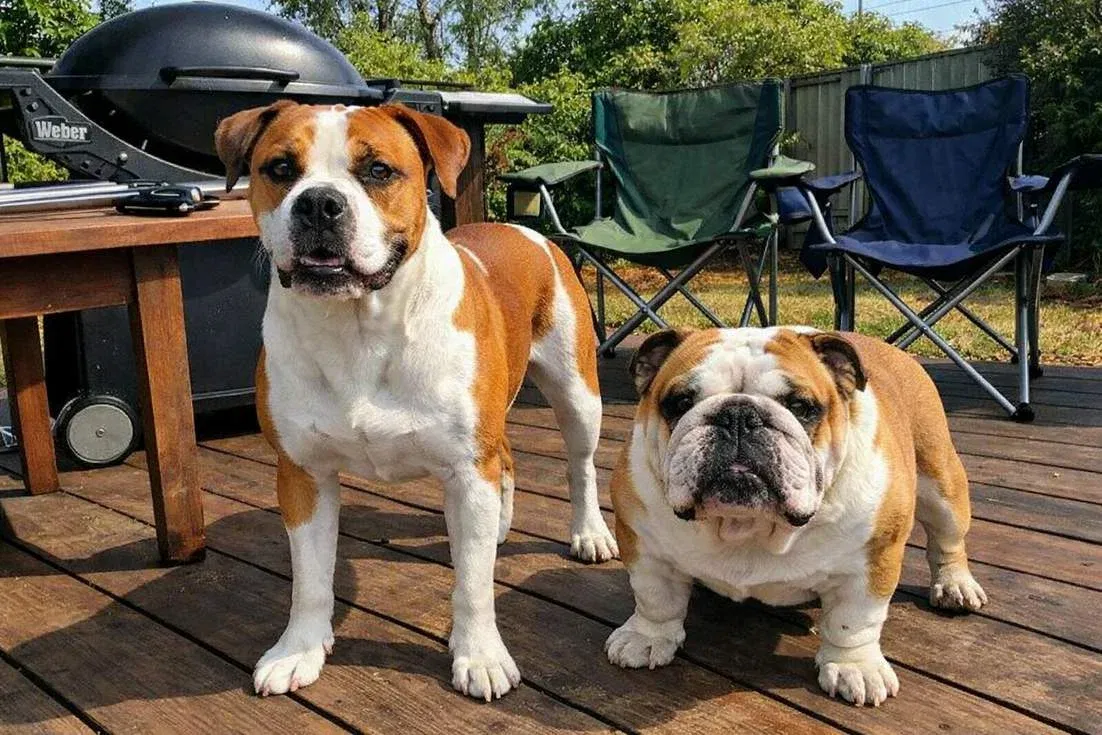
The most obvious difference is size. The Australian Bulldog is a noticeably bigger dog: 45-50 cm at the shoulder and 25-35 kg, compared to the English Bulldog’s compact 31-36 cm and 18-25 kg. The Aussie has longer legs, a more athletic frame, and a body built for movement rather than stationary posing.
The face tells the real story. The Australian Bulldog has a longer muzzle — not as long as a Boxer’s, but significantly longer than the English Bulldog’s severely compressed face. Where the English Bulldog might have six or more deep facial wrinkles, the Aussie typically has one to three folds across the nose. This seemingly small difference is the single biggest health improvement: more muzzle length means more airway space, which means the dog can breathe.
Hips are another critical difference. The English Bulldog’s narrow pelvis (relative to its massive shoulders) is why over 80% of litters require caesarean delivery. The Australian Bulldog was deliberately bred with wider hips, making natural birth significantly more achievable.
Physical Comparison at a Glance
| Physical Trait | Australian Bulldog | English Bulldog |
|---|---|---|
| Height | 45-50 cm | 31-36 cm |
| Weight | 25-35 kg | 18-25 kg |
| Build | Athletic, solid, compact but mobile | Stocky, heavy-boned, wide chest, low to ground |
| Muzzle Length | Moderate — noticeably longer than English | Very short — severely brachycephalic |
| Facial Wrinkles | 1-3 folds across nose | Heavy wrinkling across face, nose and forehead |
| Hip Width | Wider — allows natural whelping | Narrow relative to shoulders — caesarean common |
| Leg Length | Medium — proportional to body | Short — can impede movement |
| Tail | Short, straight or slightly curved | Short, can be screwed (linked to spinal issues) |
| Coat Colours | Red/white, fawn/white, brindle/white, apricot, and more | Red, fawn, white, brindle, piebald, and more |
| Underbite | Mild or absent | Pronounced — jaw is undershot |
Personality — Which Is the Better Family Dog?
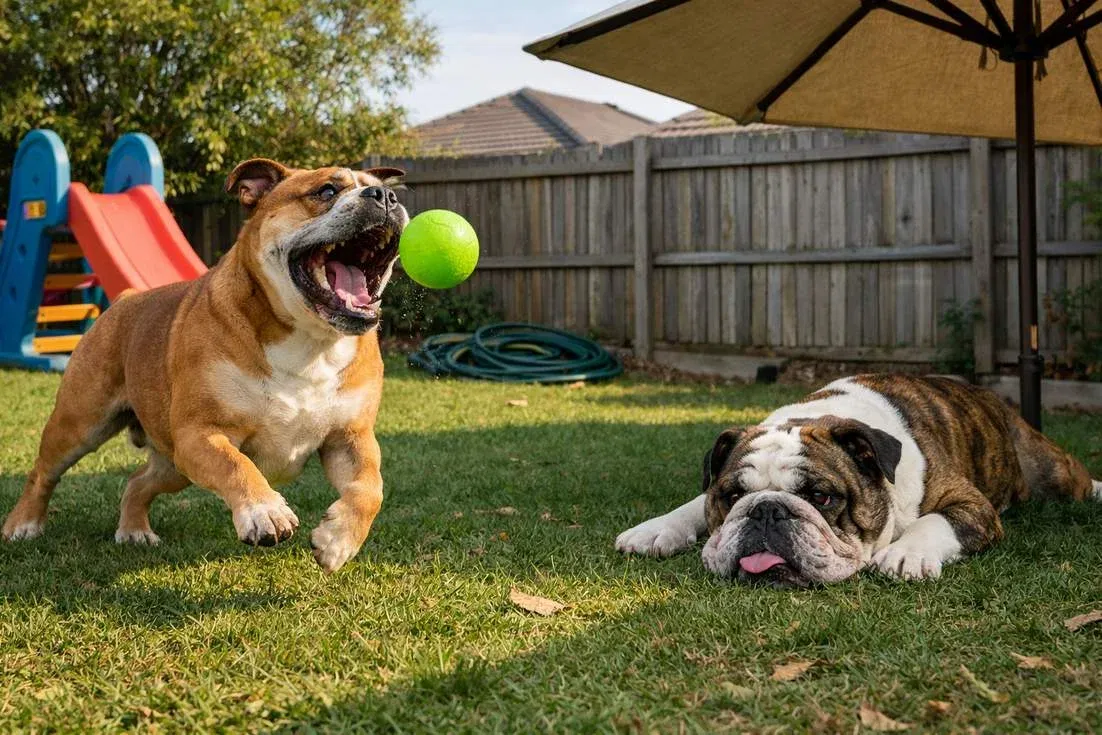
This is where the two breeds are most alike. Both inherited the Bulldog’s signature temperament: affectionate, loyal, goofy, people-obsessed and utterly devoted to their family. Both make outstanding family companions. The differences are in the details.
The Australian Bulldog is the more active dog. Not by much — we’re not talking Border Collie energy here — but the Aussie Bulldog actually wants to go for walks, play in the yard and keep up with an active family. A 30-45 minute walk plus some play is ideal. The English Bulldog is famously low-energy. They’re happy with a short stroll and will spend the rest of the day claiming your couch. This isn’t laziness — it’s partly because their compromised airways make sustained exercise physically difficult and sometimes dangerous.
Both breeds are champion cuddlers. The English Bulldog is a lap dog in a 20+ kg body — they want to be on you, not just near you. The Aussie Bulldog is similarly affectionate but slightly more independent. Both breeds suffer from separation anxiety if left alone for long periods. These are not dogs you can leave in the backyard all day — they need to be with their people.
Both breeds are excellent with children. The English Bulldog’s gentle, patient nature has made it one of the world’s most popular family dogs. The Australian Bulldog matches this — it was specifically bred as a family companion — but its slightly larger size and higher energy level mean it’s better suited to active families with older kids who want a dog that can actually keep up with them.
Both breeds generally coexist well with other animals when socialised early. The English Bulldog can show same-sex aggression toward other dogs, particularly intact males. The Aussie Bulldog, with its Bull Terrier and Boxer ancestry, can have a slightly higher prey drive — early socialisation with cats and smaller animals is important.
Neither breed is a guard dog. The English Bulldog looks intimidating but is typically friendly with strangers — its deterrent value is mostly visual. The Australian Bulldog has slightly more watchdog instinct (thanks to the Bullmastiff and Bull Terrier genetics) and will alert bark, but it’s still fundamentally a companion breed, not a protection dog.
Both breeds are legendarily stubborn. Training requires patience, consistency and a good supply of treats. The Aussie Bulldog is slightly more trainable thanks to the Boxer influence — Boxers are eager-to-please dogs — but “slightly” is doing heavy lifting in that sentence. Both breeds will look you dead in the eye and decide whether your command is worth obeying. Positive reinforcement only — neither breed responds to harsh correction.
Health — This Is Where It Gets Serious
This section is the reason the Australian Bulldog exists. The English Bulldog’s health profile is, by any objective measure, among the worst of any dog breed. The Australian Bulldog was created specifically to address these issues. How well it succeeds is the central question of this comparison.
English Bulldog: The Hard Truth
The English Bulldog suffers from a devastating range of structural health problems that are the direct result of breeding for exaggerated physical features. Brachycephalic Obstructive Airway Syndrome (BOAS) affects up to 80% of the breed to some degree. BOAS means the dog’s airways are physically too small for adequate breathing — every snort, wheeze and snore is a sign of oxygen restriction. BOAS surgery in Australia costs $4,000-$10,000 and doesn’t cure the condition — it merely improves airflow.
Beyond breathing, English Bulldogs commonly suffer from skin fold dermatitis (infections in their deep wrinkles), cherry eye, entropion, hip and elbow dysplasia, luxating patella, allergies, spinal issues linked to the screw tail, dental overcrowding due to the shortened jaw, and obesity. Over 80% of litters require caesarean delivery due to the mismatch between the puppies’ large heads and the mother’s narrow pelvis — making breeding an inherently surgical process. The RSPCA and Australian Veterinary Association have both raised concerns about the welfare implications of breeding brachycephalic dogs.
Australian Bulldog: Better, but Not Problem-Free
The Aussie Bulldog’s longer muzzle, fewer wrinkles and wider hips genuinely reduce many of the English Bulldog’s worst problems. BOAS severity is significantly lower — most Aussie Bulldogs breathe more comfortably than their English counterparts. Natural whelping is more common, though caesareans still occur. Skin fold infections are less frequent due to fewer wrinkles.
However, the Australian Bulldog is still a bulldog. It shares susceptibility to cherry eye, dry eye, entropion, hip dysplasia, allergies and joint issues. Because the breed is young (only 30 years old) and the gene pool is relatively small, long-term health data is limited. Some individual Aussie Bulldogs still have shorter muzzles than ideal — quality varies between breeders, and not all breeders prioritise health over appearance.
Health and Vet Cost Comparison
| Health Concern | Australian Bulldog | English Bulldog |
|---|---|---|
| BOAS (Breathing) | Low-Moderate risk | Surgery if needed: $4,000-$10,000 | Very High (up to 80%) | Surgery: $4,000-$10,000 |
| Skin Fold Infections | Lower risk (fewer wrinkles) | $200-$800/yr management | High risk | $500-$2,000/yr ongoing treatment |
| Cherry Eye | Moderate risk | $1,000-$2,500 surgery per eye | High risk | $1,000-$2,500 surgery per eye |
| Hip Dysplasia | Moderate risk | $4,000-$8,000 surgery | High risk | $4,000-$8,000 surgery |
| Allergies/Dermatitis | Moderate | $500-$2,000/yr | High | $1,000-$3,000/yr |
| Caesarean Delivery | Less common | $2,000-$5,000 per litter | Over 80% of litters | $2,000-$5,000 per litter |
| Heatstroke Risk | Lower — better airway, bred for Aus climate | Very High — can be fatal; exercise restriction needed |
| Est. Annual Vet Costs | $800-$1,800 AUD | $1,500-$4,000+ AUD |
The annual vet cost difference is not a typo. English Bulldogs are among the most expensive breeds to maintain medically in Australia. Between breathing management, skin care, allergy treatment, eye issues and orthopaedic problems, many English Bulldog owners report spending $3,000-$5,000 per year on veterinary care. Pet insurance is virtually non-negotiable for both breeds, but especially the English Bulldog.
Grooming
Both breeds have short, smooth coats that require minimal traditional grooming. The real grooming workload with bulldogs isn’t about the coat — it’s about the skin. The English Bulldog’s deep facial wrinkles need daily cleaning to prevent moisture, bacteria and yeast building up in the folds. Skip a few days and you’re looking at a vet visit for skin fold dermatitis.
The Australian Bulldog’s reduced wrinkles make this significantly less demanding — weekly checks are usually sufficient. Both breeds need regular nail trimming, ear cleaning and dental care. The English Bulldog’s tail pocket (the fold of skin around the screw tail) needs special attention and regular cleaning.
| Grooming Task | Australian Bulldog | English Bulldog |
|---|---|---|
| Coat Brushing | Once/week | Once/week |
| Wrinkle Cleaning | Weekly — fewer folds | DAILY — deep folds trap moisture/bacteria |
| Tail Pocket Cleaning | Usually not needed | 2-3 times/week — critical for screw tails |
| Bathing | Every 4-6 weeks | Every 2-4 weeks (skin issues may require medicated baths) |
| Professional Grooming | Minimal — $50-$80 occasional | Minimal — $50-$80 occasional |
| Ear Cleaning | Fortnightly | Weekly — prone to ear infections |
| Dental Care | Regular brushing + annual clean | Regular brushing + annual clean (overcrowded teeth) |
Exercise— How Much Do They Actually Need?
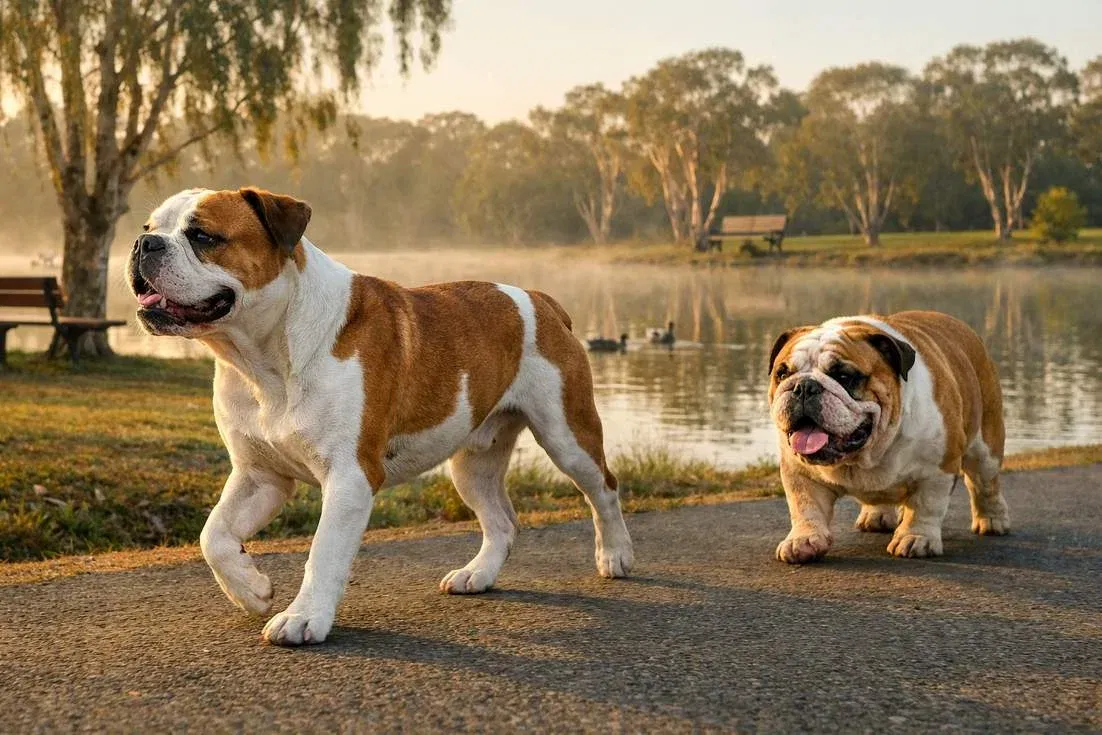
This is another area where the two breeds diverge significantly — and where the English Bulldog’s health problems have the most visible daily impact.
| Exercise Factor | Australian Bulldog | English Bulldog |
|---|---|---|
| Daily Exercise Needed | 30-45 minutes | 15-20 minutes (often limited by breathing) |
| Exercise Type | Walks, play sessions, backyard games | Short walks only; avoid overexertion |
| Heat Tolerance | Moderate — bred for Australian climate | VERY POOR — heatstroke risk above 25-28 degrees |
| Swimming Ability | Poor — heavy chest, can drown | VERY POOR — heavy chest, front-heavy; never leave near water unsupervised |
| Off-Leash Reliability | Moderate — stubborn but not a bolter | Moderate — too lazy to run far |
| If Under-Exercised… | Weight gain, mild destructiveness | Obesity (extremely common), joint stress, shortened lifespan |
Heat and Australian Summers: A Critical Difference
This is where the Australian Bulldog’s breeding purpose becomes most apparent. The English Bulldog is genuinely dangerous to own in Australian heat. Because their compromised airways can’t pant effectively, they cannot regulate body temperature normally. An English Bulldog exercising on a 30-degree day can go into heatstroke — a veterinary emergency that can be fatal. SASH Vets in Sydney reported seeing 25 critical brachycephalic emergencies during a single hot weekend in summer 2023, with some dogs dying.
The Australian Bulldog handles heat significantly better thanks to its longer muzzle and more efficient airways. It still needs shade, water and common sense in high temperatures, but it can participate in normal family life — walks before 9am and after 5pm, backyard play, trips to the park — in ways that are genuinely risky for an English Bulldog during an Australian summer.
For both breeds: never exercise in the heat of the day, always provide fresh water and shade, never leave in a parked car (even briefly), and be alert for heavy panting, drooling or disorientation — signs of heatstroke requiring immediate veterinary attention.
Training: Which one Easier to Train?
The Australian Bulldog is the easier dog to train — but “easier” still means “requires more patience than most breeds.” Both bulldogs are intelligent dogs that understand exactly what you’re asking; the question is whether they feel like complying.
The Aussie Bulldog’s Boxer heritage gives it a slightly more eager-to-please attitude. Boxers are known for their responsiveness and playfulness, and this shines through in many Aussie Bulldogs. They respond well to food rewards, play-based training and short, fun sessions. They can learn obedience basics, tricks and even some agility — something most English Bulldogs physically cannot do.
The English Bulldog’s training challenge is twofold: stubbornness plus physical limitation. Training sessions need to be very short (5-10 minutes) because the dog may tire or overheat quickly. High-energy recall training or agility work is out of the question for most English Bulldogs. Leash training is important — English Bulldogs should always wear a harness, never a collar, to avoid putting pressure on their already compromised airways.
For both breeds: start socialisation early (8-12 weeks), use positive reinforcement exclusively, keep sessions short and rewarding, and be consistent. A puppy kindergarten class is highly recommended. Both breeds can develop same-sex aggression if not socialised with other dogs early — this is more common in males.
Which Costs More in Australia?
The English Bulldog costs more to buy AND more to own. The purchase price is higher because ANKC-registered English Bulldogs from reputable breeders (who health-test, DNA-test and provide pedigree papers) command a premium. But the real cost difference is in ongoing veterinary care.
| Cost Category | Australian Bulldog (AUD) | English Bulldog (AUD) |
|---|---|---|
| Puppy (Registered Breeder) | $2,500-$4,000 (ABCA) | $3,500-$5,500 (ANKC) |
| Rescue / Adoption | $300-$600 | $400-$800 |
| First-Year Setup | $1,500-$2,500 | $2,000-$3,500 (incl. potential BOAS assessment) |
| Annual Vet Costs | $800-$1,800 | $1,500-$4,000+ |
| Pet Insurance (Monthly) | $50-$100 | $80-$150 (higher premiums due to breed risk) |
| Food (Monthly) | $80-$140 (25-35 kg dog) | $70-$120 (18-25 kg dog) |
| BOAS Surgery (if needed) | $4,000-$10,000 | $4,000-$10,000 (far more likely to need it) |
| Lifetime Cost (Est.) | $25,000-$40,000 | $35,000-$60,000+ |
The lifetime cost gap — potentially $20,000+ — reflects the English Bulldog’s significantly higher veterinary expenses. Multiple BOAS-related surgeries, ongoing skin care, allergy management, potential orthopaedic surgeries and higher insurance premiums compound over a lifetime. This isn’t a reason not to own an English Bulldog if you love the breed — but it is a financial reality that every prospective owner must understand before committing.
For English Bulldogs, take out pet insurance before the puppy is 3 months old. BOAS symptoms that present before insurance is activated become “pre-existing conditions” and won’t be covered. For Australian Bulldogs, insurance is still strongly recommended given the breed’s bulldog health tendencies, but premiums are generally lower.
Where to Find Reputable Breeders
English Bulldog: ANKC-registered breeders through Dogs NSW, Dogs Victoria, Dogs QLD, Dogs WA, Dogs SA, Dogs TAS, or the National British Bulldog Council of Australia. Always request BOAS grading, hip/elbow scores and DNA health panel results.
Australian Bulldog: ABCA (Aussie Bulldog Club of Australia) registered breeders — the club maintains breeder directories for each state. Look for breeders who health-test parent dogs and can show clearance certificates. Avoid Gumtree, Facebook Marketplace or any seller without breed club registration — unregistered “Aussie Bulldog” puppies may be poorly bred crossbreeds with none of the health improvements the breed was designed to achieve.
Australian Bulldog vs English Bulldog for Australian Owners
The Australian Bulldog was literally bred for the Australian climate — this is its single biggest advantage. It handles heat better than the English Bulldog, can exercise in moderate warmth and doesn’t carry the same heatstroke risk. The English Bulldog is genuinely dangerous in Australian summers. Air conditioning isn’t a luxury for English Bulldog owners — it’s a medical necessity. If your home doesn’t have reliable cooling, the English Bulldog is not a safe choice.
Neither breed is affected by breed-specific legislation in any Australian state or territory. However, the Australian Bulldog’s Bull Terrier and Bullmastiff ancestry means some councils may ask questions about the breed’s composition. Having ABCA registration paperwork that clearly identifies the dog as an “Australian Bulldog” helps avoid any confusion with restricted breeds.
Standard council registration applies. Both breeds are well under the “large dog” weight thresholds that trigger additional requirements in most councils. Council rego: $30-$100/year desexed, $100-$300/year entire.
Both breeds are excellent apartment dogs — one of the few areas where bulldogs genuinely excel. They’re low-energy indoors, don’t need a backyard, and are generally quiet. The Aussie Bulldog needs slightly more space due to its larger size, but a standard apartment with daily walks is perfectly suitable for either breed. Both breeds are well under typical strata weight limits (usually 10-20 kg restrictions, though some allow up to 30 kg — check your building rules, as the Aussie Bulldog at 25-35 kg may be borderline).
Both breeds are generally acceptable to landlords due to their calm, non-destructive nature and moderate size. The English Bulldog’s reputation as a gentle companion works in its favour. The Aussie Bulldog may raise questions from landlords unfamiliar with the breed — having ABCA papers helps. Neither breed is a barker or known for property damage, which are the main landlord concerns.
Both breeds are covered by major Australian pet insurers (Bow Wow Meow, PetSure, RSPCA Pet Insurance, Petplan). The English Bulldog will attract higher premiums due to its brachycephalic classification and known breed-specific conditions. Some insurers may exclude BOAS-related claims as “breed-related conditions” — read your PDS carefully. The Australian Bulldog’s insurance status varies by insurer — some list it as a recognised breed, others may classify it under “crossbreed” which can actually result in lower premiums.
The English Bulldog is ANKC-registered. The Australian Bulldog is not. For pet owners, this distinction is largely irrelevant — you can’t show an Aussie Bulldog at an ANKC event, but you can register it with the ABCA, insure it, get council registration, and live your life normally. Where the ANKC gap matters is breeding: without ANKC oversight, the quality of Australian Bulldog breeders varies more widely. The ABCA fills this gap with its own standards, but buyers need to do more due diligence to ensure they’re buying from a responsible breeder, not a backyard operation.
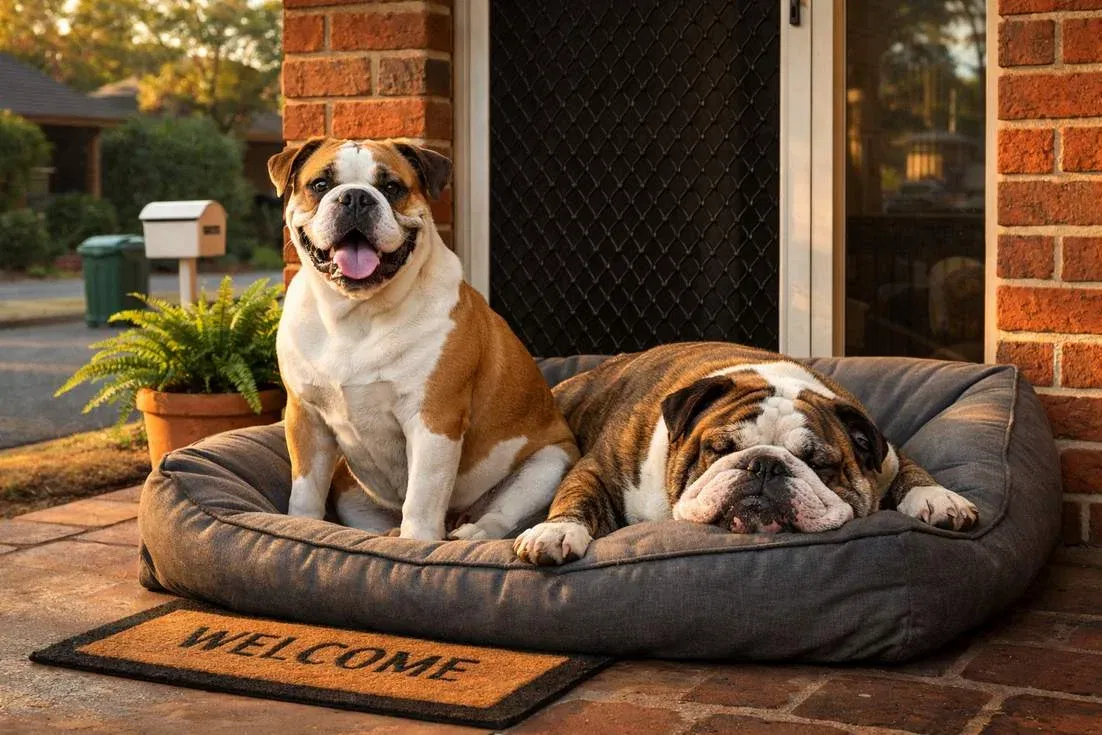
So, Should You Get an Australian or English Bulldog?
You want the Bulldog personality — the loyalty, the goofiness, the family devotion — in a healthier package. You live in a warm climate (anywhere in Australia, frankly) and need a dog that can handle summer without medical emergencies. You want a slightly more active companion that can join you on walks and play sessions. You’re comfortable buying from a breed club registry (ABCA) rather than the ANKC. You want a lower lifetime vet bill.
You specifically love the English Bulldog’s iconic look and compact size. You want an ANKC-registered purebred with established pedigree lines. You’re prepared — financially and emotionally — for the breed’s significant health challenges. You have reliable air conditioning and are willing to restrict exercise during warm weather. You understand that vet bills will likely be substantially higher than average. You want a truly low-energy dog that’s happy with minimal exercise.
You can’t afford unexpected vet bills of $4,000-$10,000 — both breeds carry bulldog health risks, even if the Aussie’s are reduced. You’re away from home more than 6-8 hours a day — both breeds develop separation anxiety. You want a jogging partner, hiking companion or high-energy dog. You live in a home without air conditioning or reliable cooling. You aren’t willing to commit to daily wrinkle/skin maintenance (English) or regular health monitoring (both). You want to buy the cheapest puppy you can find — budget bulldogs from unregistered breeders are a false economy that will cost you far more in vet bills.
[IMAGE: Optional infographic. Alt text: “Infographic comparing Australian Bulldog and English Bulldog for different lifestyles”]
The Australian Bulldog was built to be a better bulldog for Australian life — and by most measures, it succeeds. It breathes better, lives longer, handles heat better, costs less at the vet and can participate in normal family activities that would be risky for an English Bulldog. If you love the Bulldog personality but want a dog that can actually live a full, comfortable life in an Australian climate, the Aussie Bulldog is the smarter choice.
The English Bulldog remains one of the world’s most beloved companion breeds for a reason — their personality is genuinely extraordinary. But loving the breed means being honest about its health. If you choose an English Bulldog, buy from a breeder who health-tests obsessively (ask for BOAS grading specifically), insure immediately, budget for high vet bills and provide air-conditioned living.
Whichever breed you choose, buy from a registered, health-testing breeder. The difference between a well-bred bulldog and a poorly bred one isn’t just paperwork — it’s years of life and thousands of dollars in vet bills.
Frequently Asked Questions
Is the Australian Bulldog recognised by the ANKC?
No. The Australian Bulldog is not recognised by the ANKC (Dogs Australia). It is registered through the Aussie Bulldog Club of Australia (ABCA), which maintains its own breed standard, breeder code of ethics and registration system. The ABCA’s long-term goal is to achieve ANKC recognition, but this hasn’t happened yet. For pet owners, this means you can’t show an Aussie Bulldog at ANKC events, but it doesn’t affect insurance, council registration or everyday ownership.
Are Australian Bulldogs actually healthier than English Bulldogs?
Generally, yes — but with caveats. The Aussie Bulldog’s longer muzzle significantly reduces BOAS severity, its wider hips improve whelping, and its fewer wrinkles reduce skin infections. However, the breed is only 30 years old and long-term health data is limited. Individual Aussie Bulldogs can still develop cherry eye, hip dysplasia, allergies and other bulldog-typical conditions. Quality varies between breeders — always choose a breeder who health-tests parent dogs.
Can English Bulldogs cope with Australian summers?
Poorly. English Bulldogs are at genuine heatstroke risk in Australian temperatures above 25-28 degrees. They cannot pant effectively due to their compressed airways, which means they can’t cool themselves normally. Air conditioning is essential, exercise must be restricted to cool hours, and owners must be vigilant for heatstroke signs. Australian veterinary hospitals see brachycephalic emergencies every summer — some fatal. This is the single strongest argument for the Australian Bulldog over the English Bulldog for Australian households.
How much does an Australian Bulldog cost in Australia?
Expect to pay $2,500-$4,000 AUD for an ABCA-registered Australian Bulldog puppy. Prices vary by breeder, bloodlines, colour and location. English Bulldogs from ANKC breeders cost $3,500-$5,500 AUD, with show-quality puppies or those from imported lines reaching $6,000+. Avoid unregistered puppies sold cheaply on Gumtree or Facebook — these often lack the health improvements that make the Australian Bulldog worth choosing.
What breeds make up the Australian Bulldog?
The Australian Bulldog was developed by crossing English Bulldogs primarily with Boxers and English Bull Terriers, with some Bullmastiff influence. The goal was to retain the English Bulldog’s companion temperament while improving its physical structure — longer muzzle, wider hips, longer legs and better heat tolerance. The breed has been bred within its own population for over two decades now, with the ABCA maintaining the studbook.
Do English Bulldogs really need caesarean births?
The vast majority do. Estimates suggest over 80% of English Bulldog litters are delivered by caesarean section due to the puppies’ large heads relative to the mother’s narrow pelvis. This makes English Bulldog breeding inherently expensive (each caesarean costs $2,000-$5,000 AUD) and raises ethical questions about breeding dogs that cannot reproduce naturally. The Australian Bulldog’s wider hips were specifically designed to address this issue, though caesareans still occur in the breed.
Which breed is better for apartment living?
Both are excellent apartment dogs. The English Bulldog is marginally better suited due to its smaller size (18-25 kg vs 25-35 kg) and lower energy level. However, the Australian Bulldog’s size is still apartment-manageable with daily walks. The English Bulldog’s advantage disappears in apartments without air conditioning — in that scenario, the Australian Bulldog is safer because it handles heat better.
Can I get pet insurance for an Australian Bulldog in Australia?
Yes. Most major Australian pet insurers cover Australian Bulldogs. Some list them as a recognised breed; others may classify them under “mixed breed” or “crossbreed.” Either way, you can insure them. Read the Product Disclosure Statement carefully for any brachycephalic breed exclusions — some policies limit coverage for conditions common to flat-faced breeds. Taking out insurance before 3 months of age, before any health conditions are documented, gives the best coverage.
Primary Sources:
- Aussie Bulldog Club of Australia (ABCA) — Breed Standard & Breeder Directory: https://www.aussiebulldogclub.com/
- Burke’s Backyard — Aussie Bulldog Feature: https://www.burkesbackyard.com.au/fact-sheets/pets/pet-road-tests/aussie-bulldog/
- National British Bulldog Council of Australia — via ANKC: https://ankc.org.au/
- RSPCA Australia — Brachycephalic Breeds: https://www.rspca.org.au/
- Australian Veterinary Association — Love is Blind Campaign: https://www.vetvoice.com.au/ec/pet-ownership/brachycephalic-pets/
- CHOICE Australia — Flat-Faced Dog Breeds and Vet Bills: https://www.choice.com.au/outdoor/pets/pet-health/articles/flat-faced-dog-breeds-pugs-frenchies-british-bulldogs-vet-bills
- SASH Vets NSW — BOAS Surgery Information: https://sashvets.com/fixed-price-boas-surgery/
- Bow Wow Meow Insurance — Australian Bulldog Breed Profile: https://bowwowinsurance.com.au/dogs/dog-breeds/australian-bulldog/
- PetSecure — Australian Bulldog: https://www.petsecure.com.au/pet-care/dog-breeds/australian-bulldog/
- DogzOnline — British Bulldog Breeders and Puppies Australia: https://www.dogzonline.com.au/breeds/puppies/british-bulldog.asp