
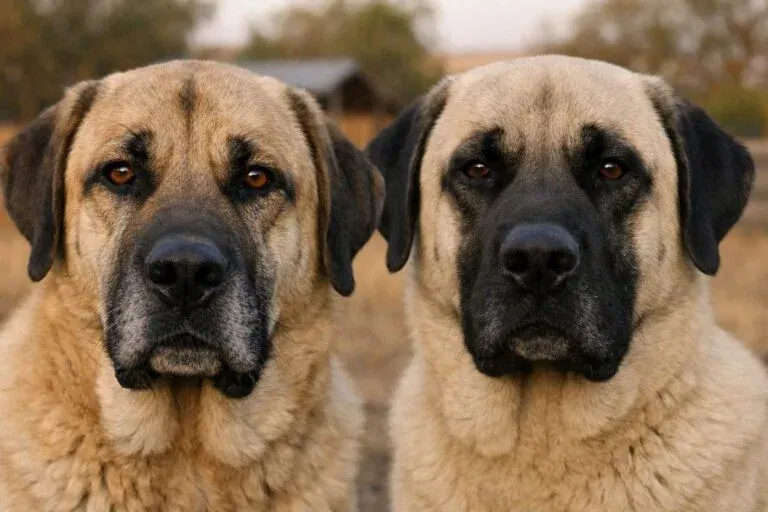
If you’ve been googling “Anatolian Shepherd vs Kangal” and come away more confused than when you started, welcome to the most polarising breed debate in the dog world. Depending on which kennel club you ask, these two are either the exact same dog with different paperwork, or two distinct breeds with centuries of separate heritage. The short version: in Australia, they’re registered under one name (Anatolian Shepherd Dog), but the Kangal Shepherd Dog now also has its own ANKC listing — and the breeders on either side of the fence have strong opinions.
Here’s what actually matters if you’re trying to decide which one belongs on your Aussie farm, acreage, or (brave choice) suburban property.
What You’ll Learn
- Breed traits & temperament
- Health concerns to know
- True cost in Australia
- Training & exercise needs
- Is this breed right for you?
Breed Quick Facts Table
| Trait | Anatolian Shepherd | Kangal Dog |
|---|---|---|
| Origin | Anatolia region, Turkey | Kangal District, Sivas Province, Turkey |
| Kennel Club Status | AKC recognised; ANKC registered | FCI recognised (Standard 331); ANKC registered separately since 2018 |
| Size (Height) | 68–76 cm (males), 63–71 cm (females) | 72–80 cm (males), 65–73 cm (females) |
| Weight | 40–65 kg | 48–70 kg |
| Lifespan | 11–13 years | 12–15 years |
| Coat Type | Short to medium double coat; slightly longer at neck | Short, dense double coat; coarse outer, soft undercoat |
| Shedding Level | High (seasonal blow) | High (seasonal blow) |
| Energy Level | Moderate | Moderate |
| Trainability | Challenging — fiercely independent | Moderate — independent but more responsive |
| Barking Level | Moderate to High (deep, authoritative bark) | Moderate (barks with purpose, not excessively) |
| Good With Kids | Yes — gentle with family children | Yes — notably gentle with children and vulnerable family members |
| Good With Other Dogs | With supervision — can be dominant | With supervision — same-sex aggression possible |
| Apartment Friendly | No — needs acreage or large property | No — needs acreage or large property |
| Puppy Price (AUD) | $1,800–$4,000 | $2,500–$5,000+ (rarer, some imported at $15,000–$20,000) |
| ANKC Group | Group 6 (Utility) | Group 6 (Utility) |
| Australian Popularity | Uncommon — small but dedicated breeder community | Very rare — limited registered Kangal-specific breeders |
Where Did they Come From?
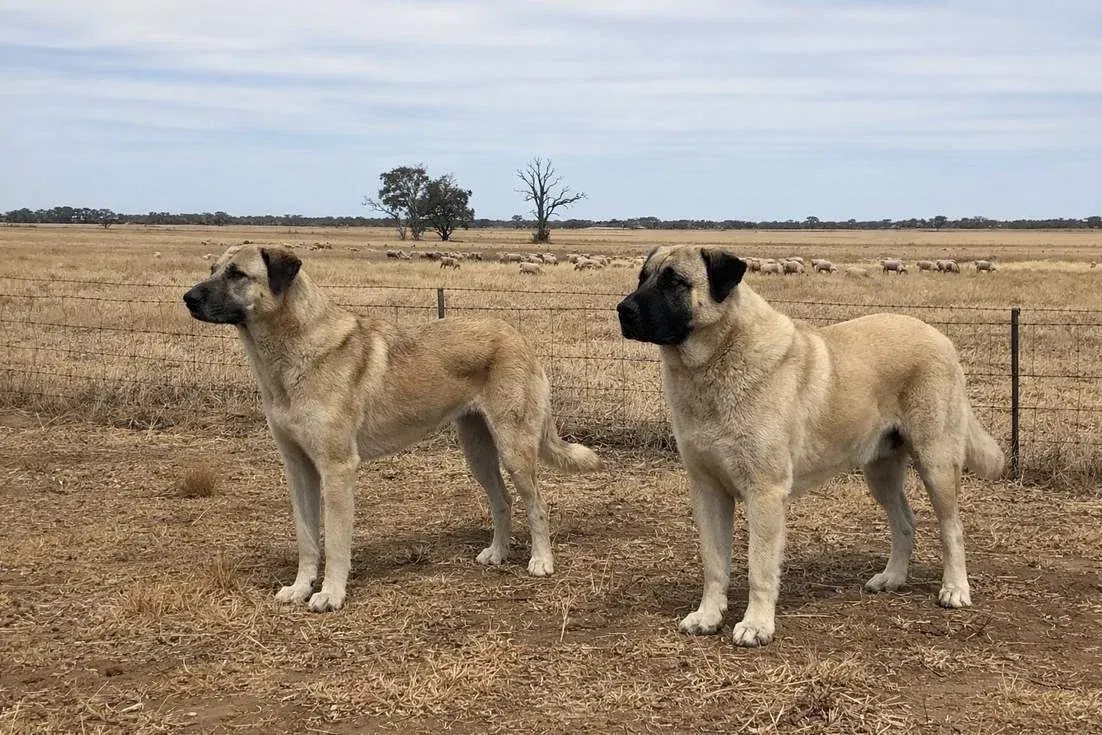
Both breeds trace their roots to the same place: Turkey’s Anatolian Plateau, where livestock guardian dogs have worked alongside shepherds for over 6,000 years. Assyrian stone carvings dating to 2,000 BC show large, powerful dogs that resemble today’s Turkish shepherd breeds — making these among the oldest working dog lineages in the world.
The Anatolian Shepherd Dog is the broader Western classification for Turkey’s regional guardian dogs. The name was coined when these dogs were first exported from Turkey in the mid-20th century. They were brought to Australia in the 1980s and quickly earned a reputation as outstanding livestock protectors for sheep, goats, alpacas and poultry on Australian farms.
The Kangal Dog is named specifically after the Kangal District in Turkey’s Sivas Province, where locals consider it a distinct, purer line of guardian dog. In Turkey, the Kangal is a national treasure — featured on postage stamps and protected by export restrictions. Turkish breeders argue the Kangal is not a generic Anatolian shepherd but a specific, standardised breed with a uniform fawn coat and black mask.
The politics matter because they affect what you can actually buy in Australia. The ANKC originally registered everything as Anatolian Shepherd Dog. From 1998 to 2011, they briefly split the breeds, then merged them back. Now, following the FCI’s 2018 decision, both breed names exist in the Australian registry — but the gene pool is small, intertwined, and finding a “pure Kangal” outside Turkey is difficult and expensive.
How to Tell Them Apart
At a distance, you probably can’t. Up close, there are subtle but real differences if you know what to look for.
Size is the first clue. The Kangal is generally the bigger dog — males routinely hit 70+ kg and stand up to 80 cm at the shoulder. Anatolian Shepherds are slightly lighter and leaner, with more variation in build. Both are giant breeds, but a big male Kangal is genuinely imposing.
Coat colour is the most reliable visual difference. The Kangal comes in one colour: fawn (ranging from pale cream to steel grey-fawn) with a distinctive black mask and black ears. No exceptions in the breed standard. The Anatolian Shepherd can appear in fawn, brindle, white, pinto, red and various other colour combinations — with or without a mask. If the dog is white, brindle or multicoloured, it’s classified as an Anatolian, not a Kangal.
Head shape differs subtly. The Kangal has a broader, more powerful skull with a more pronounced stop (the angle between forehead and muzzle). The Anatolian tends toward a slightly narrower, more angular head. The Kangal’s ears sit closer to the cheeks, while the Anatolian’s may be set slightly higher.
The tail is another tell. Kangals carry a long tail with a characteristic tight curl when alert, held high over the back. The Anatolian’s tail is also long and may curl, but it’s typically carried lower and with less dramatic curl.
Physical Comparison at a Glance
| Physical Trait | Anatolian Shepherd | Kangal Dog |
|---|---|---|
| Build / Frame | Large, rugged, moderately muscular | Larger, heavier-boned, powerful and athletic |
| Head Shape | Broad but slightly narrower, moderate stop | Very broad skull, pronounced stop, powerful jaw |
| Ear Type | Pendant, triangular, set medium-high | Pendant, triangular, set lower, close to cheeks |
| Tail | Long, low-set, moderate curl | Long, high-set, tight curl over back when alert |
| Coat Length | Short to medium; longer at neck/mane | Short; slightly longer at neck only |
| Coat Texture | Consistent throughout | Coarse outer coat, soft dense undercoat |
| Colour Options | Fawn, brindle, white, pinto, red — all accepted | Fawn with black mask only — no exceptions |
| Bite Force | Strong (~508 PSI estimated) | Strongest of all domestic dogs (~743 PSI) |
What Are They Actually Like to Live With?
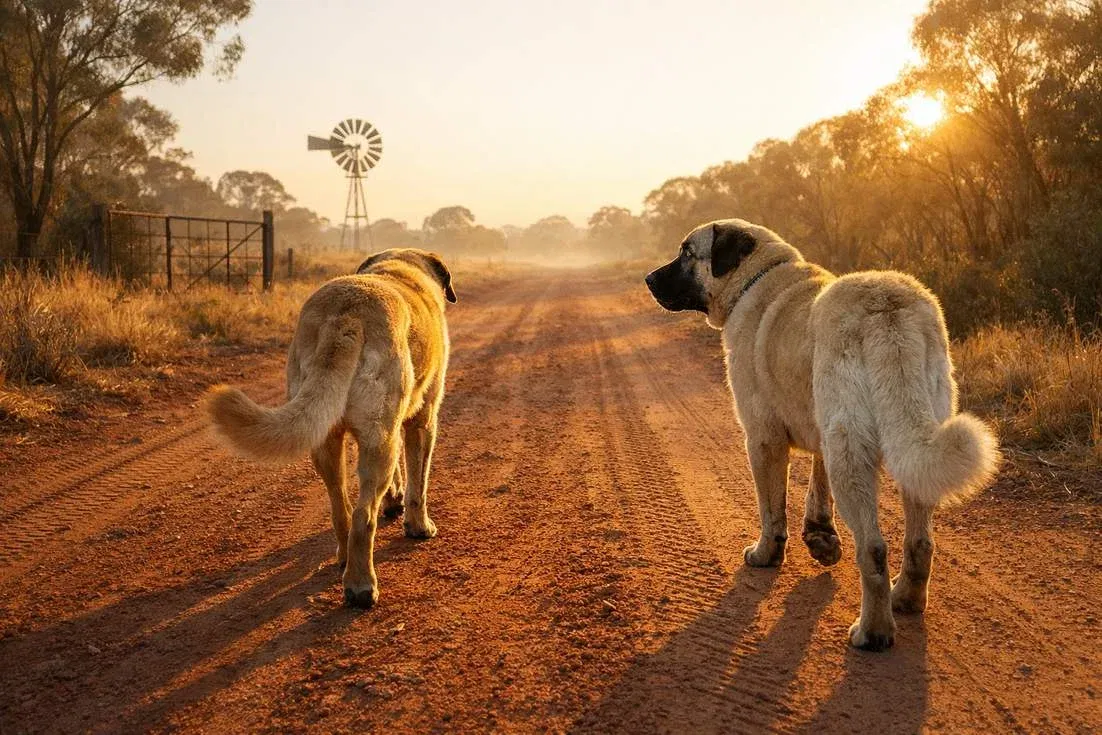
Both of these dogs were bred to make life-or-death decisions about predators without waiting for a human to tell them what to do. That independence is their defining trait — and the reason most pet owners are out of their depth with either breed.
Neither breed is hyperactive. These are not Huskies bouncing off walls. Both the Anatolian and Kangal are calm, watchful dogs that conserve energy for when it matters. They need 45–60 minutes of daily exercise — long walks or free roaming on a property — but they’re not interested in fetch or agility. Under-exercised, they become restless and start patrolling obsessively, barking at everything, or digging escape routes.
This is the biggest temperament difference between the two. The Kangal is surprisingly affectionate with its family — they bond deeply, are notably gentle with children, and actively seek out their people. Kangal owners often describe them as “gentle giants” who lean against you on the couch. The Anatolian Shepherd is more reserved and independent. They love their family but on their own terms — they’re more likely to station themselves at the edge of the room, watching over everyone, than to cuddle up. Both breeds are deeply loyal, but the Kangal wears it on its sleeve.
Both breeds are naturally suspicious of unfamiliar people. This isn’t aggression — it’s their job. A well-socialised Anatolian or Kangal will assess a stranger calmly but won’t invite pats. A poorly socialised one can become genuinely problematic. Early, consistent socialisation from puppyhood is non-negotiable with both breeds. The Anatolian tends to be more aloof; the Kangal is more alert and may position itself between its family and the perceived threat.
Both breeds are gentle with children they know. The Kangal in particular has a centuries-old reputation for being remarkably soft with small children, lambs and other vulnerable members of the “flock.” However, at 50–70 kg, they can knock a toddler over without meaning to. Supervise all interactions. These dogs see your kids as members of the flock to be protected — which is wonderful until they decide the neighbour’s child visiting for a playdate is an intruder.
Both breeds excel at coexisting with livestock — that’s their purpose. Chickens, sheep, goats and horses are typically safe. However, same-sex aggression with other dogs is common, particularly with the Anatolian. Both breeds have a moderate to strong prey drive toward cats and small animals unless raised alongside them from puppyhood. Two intact males of either breed in the same household is asking for trouble.
This is not trainable — it’s hardwired. Both breeds will patrol your boundaries, bark at anything unusual at 3am, and physically position themselves between your family and perceived danger. The Kangal is known for engaging predators more directly (wolf-fighting was literally part of the job description in Turkey), while the Anatolian tends to intimidate and warn first. Neither breed needs guard dog training — you need management training for yourself.
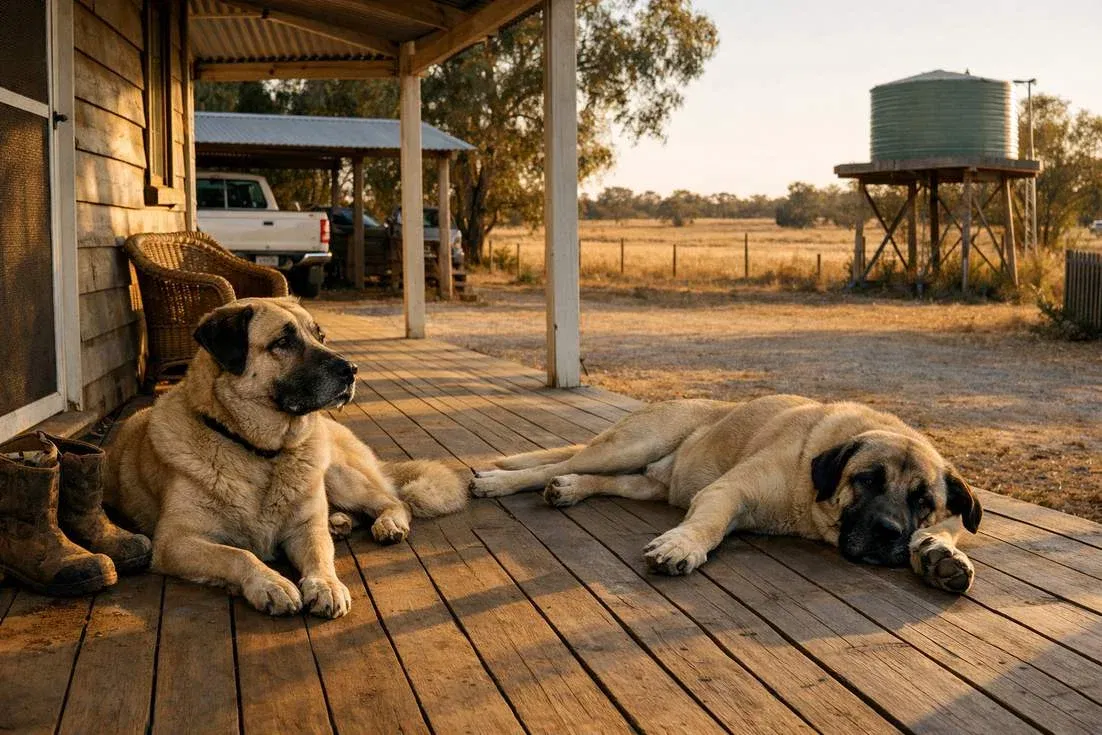
[IMAGE: Lifestyle action shot. Alt text: “Anatolian Shepherd Dog guarding livestock on Australian farm”]
Health Issues: Anatolian Shepherd vs Kangal
For giant breeds, both the Anatolian and Kangal are remarkably healthy — a testament to thousands of years of natural selection on the Anatolian Plateau where only the hardiest dogs survived. That said, they’re not bulletproof.
Shared Health Risks
Both breeds share susceptibility to hip dysplasia, which is the primary orthopaedic concern. Elbow dysplasia, entropion (eyelid rolling inward) and hypothyroidism also appear in both populations. Both breeds are at risk of bloat (gastric dilatation-volvulus), a life-threatening emergency more common in deep-chested giant breeds.
Anatolian Shepherd-Specific Risks
The Anatolian’s wider genetic pool introduces slightly more variety in health conditions. They’re prone to hip and elbow dysplasia (estimated 12% affected), hypothyroidism, von Willebrand’s disease (a bleeding disorder) and certain cancers — hemangiosarcoma and osteosarcoma typically present at middle age (6–8 years). Lymphoma can appear earlier, between 2 and 4 years. Sensitivity to anaesthesia is a known concern in this breed — always inform your vet.
Kangal-Specific Risks
The Kangal’s hip dysplasia rate is slightly higher (estimated 18–19%), likely due to their heavier frame. Entropion affects 13–17% of Kangals before age three. Bloat carries an 8–11% lifetime risk. Skin allergies affect roughly 16% of Kangals. Degenerative myelopathy has been identified in 20–24% of Kangals as carriers, though not all will develop clinical signs.
Common Health Costs Comparison
| Health Concern | Anatolian Shepherd | Kangal Dog |
|---|---|---|
| Hip Dysplasia | Moderate (12%) | $4,000–$8,000 surgery | Moderate–High (18–19%) | $4,000–$8,000 surgery |
| Entropion (Eye) | Low–Moderate | $1,000–$2,500 surgery | Moderate (13–17%) | $1,000–$2,500 surgery |
| Bloat / GDV (Emergency) | Moderate risk | $3,000–$8,000 | Moderate risk (8–11%) | $3,000–$8,000 |
| Hypothyroidism (Ongoing) | Moderate | $300–$800/yr | Low–Moderate | $300–$800/yr |
| Cancer (Hemangio/Osteo) | Moderate risk | $5,000–$15,000+ | Lower risk | Variable |
| Est. Annual Vet Costs | $1,000–$2,000 AUD | $1,000–$2,200 AUD |
Both breeds benefit significantly from buying from breeders who hip and elbow score parent dogs. In Australia, the ANKC breed club recommends hip and elbow X-rays as minimum health screening. The Kangal’s slightly higher hip dysplasia rate makes this non-negotiable. Preventive gastropexy (stomach tacking during desexing) is worth discussing with your vet for either breed given the bloat risk.
Grooming — Which Is More Work?
Good news: neither breed is high-maintenance in the grooming department. These are working dogs that evolved to be self-sufficient, and their coats reflect that. Both have a dense double coat that sheds heavily twice a year (“blowing coat”) and moderately the rest of the time. The Anatolian’s coat is slightly longer, particularly around the neck and mane area, which means marginally more brushing. The Kangal’s coat is shorter and coarser, requiring less grooming effort between seasonal blows.
Neither breed needs professional grooming in the way a Poodle or Shih Tzu does. A thorough brush once a week (daily during blowing season) and a bath every 2–3 months is sufficient. Budget $60–$100 AUD for occasional professional grooming, though most owners handle it themselves.
| Grooming Task | Anatolian Shepherd | Kangal Dog |
|---|---|---|
| Brushing Frequency | 1–2 times/week (daily when blowing) | Once/week (daily when blowing) |
| Professional Grooming | Every 10–12 weeks | $70–$120 | Every 10–12 weeks | $70–$120 |
| Shedding Season | Heavy blow 2x/year; moderate year-round | Heavy blow 2x/year (spring); moderate year-round |
| Nail Trimming | Every 3–4 weeks | Every 3–4 weeks |
| Ear Cleaning | Fortnightly (pendant ears trap moisture) | Fortnightly (pendant ears trap moisture) |
Exercise — How Active Are They Really?
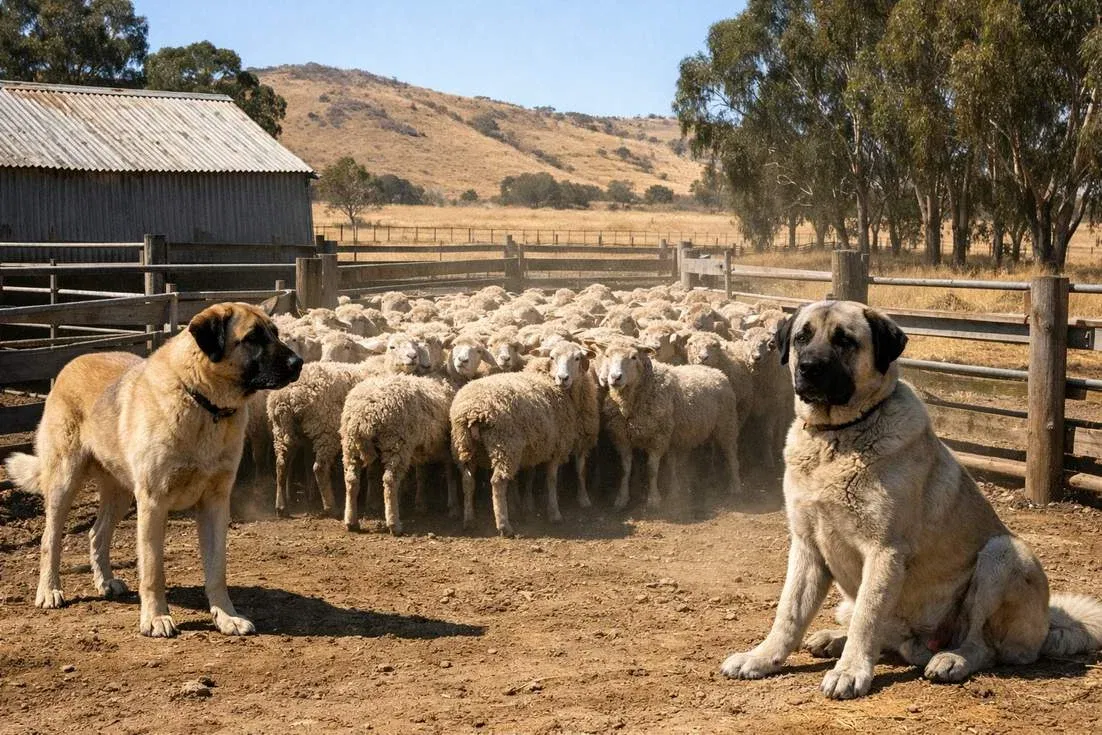
Neither breed needs the intense exercise regime of a Husky or Border Collie — and over-exercising young dogs of either breed is actually dangerous for their developing joints. These are marathon endurance dogs, not sprinters. They’re built to patrol vast paddocks at a steady pace, not to run laps at the dog park.
| Exercise Factor | Anatolian Shepherd | Kangal Dog |
|---|---|---|
| Daily Exercise Needed | 45–60 minutes | 45–75 minutes |
| Exercise Type | Long walks, property patrol, free roaming | Long walks, property patrol, hiking with weight |
| Off-Leash Reliability | Poor — independent, may choose not to return | Moderate — slightly better recall, still independent |
| Heat Tolerance (Aus summers) | Moderate — bred for hot Turkish summers | Moderate to Good — adapted to extreme Turkish plateau heat |
| Swimming Ability | Variable — some enjoy it, not natural swimmers | Variable — not bred for water |
| If Under-Exercised… | Excessive barking, patrolling, fence-line pacing, digging | Restlessness, territorial aggression, destructive behaviour |
Australian Climate Considerations
Here’s some genuinely good news for Aussie owners: both breeds are better suited to Australian heat than most giant breeds. The Anatolian Plateau — where both breeds originated — experiences scorching summers (35–40+ degrees) as well as freezing winters. Their coats are adapted for temperature regulation in both extremes. That said, they still need shade, constant fresh water, and exercise limited to early morning and late evening during summer. The Kangal’s shorter coat gives it a slight edge in heat management. Both breeds handle the Australian climate better than northern European giant breeds like the Bernese Mountain Dog or Saint Bernard.
[IMAGE: Breed exercising outdoors. Alt text: “Kangal Dog patrolling farmland in rural Australia”]
which one Is Easier to Train?
The Kangal is generally easier to train — but “easier” still means significantly harder than most breeds. Both dogs were bred to think for themselves in the field, and they’ll apply that same independence to your training sessions.
The Kangal tends to be more responsive to its handler and more willing to cooperate when it understands the purpose of a command. Kangal owners report a dog that watches them intently and seems to genuinely want to work with its person — as long as the person earns respect through calm, consistent leadership. The Kangal’s slightly stronger bond with its family translates into slightly better trainability.
The Anatolian Shepherd is the more independent thinker of the two. They’re highly intelligent — they’ll learn a command in three repetitions — but they reserve the right to decide whether obeying is worthwhile in any given moment. Experienced Anatolian owners describe it as training a colleague, not an employee. You’re negotiating, not commanding.
Critical training rules for both breeds: start socialisation at 8 weeks, not 8 months. Use positive reinforcement — these dogs will shut down completely under harsh correction. Expose them to visitors, other animals, vehicles and novel environments constantly during the 8–16 week critical window. Obedience classes are strongly recommended, but choose a trainer experienced with livestock guardian breeds. A trainer who expects Border Collie responsiveness will fail with both of these breeds.
Neither breed will ever be reliably off-leash in unfenced areas. Accept this. Their independent judgment and protective instincts mean they will always prioritise their own assessment of a situation over your recall command. Secure, high fencing (1.8m minimum, 2m preferred) is a requirement for ownership.
Which Costs More in Australia?
The Kangal is more expensive to acquire — but once you’ve got either breed home, ongoing costs are virtually identical. The Kangal’s higher purchase price reflects its rarity in Australia and the extraordinary cost of importing dogs or semen from Turkey (upwards of $15,000–$20,000 per import).
| Cost Category | Anatolian Shepherd (AUD) | Kangal Dog (AUD) |
|---|---|---|
| Puppy (ANKC Breeder) | $1,800–$4,000 | $2,500–$5,000+ (imported lines significantly more) |
| Rescue / Adoption | $400–$800 | Extremely rare in rescue |
| First-Year Setup | $2,000–$3,500 | $2,000–$3,500 |
| Annual Ongoing Costs | $2,500–$4,000 | $2,500–$4,500 |
| Pet Insurance (Monthly) | $60–$120 | $65–$130 |
| Food (Monthly) | $120–$200 (40–65 kg dog) | $140–$220 (48–70 kg dog) |
| Lifetime Cost (Est.) | $35,000–$55,000 | $38,000–$60,000 |
Both breeds eat less than you’d expect for their size — they evolved on frugal diets and are not overeaters. Overfeeding is actually a bigger risk than underfeeding, as excess weight compounds the hip dysplasia risk. Budget for premium large-breed dog food ($80–$150/month for kibble) and avoid grain-free diets unless veterinary-directed, due to the emerging link between grain-free diets and dilated cardiomyopathy in large breeds.
For ANKC-registered Anatolian Shepherd breeders, contact Dogs NSW, Dogs Victoria, Dogs QLD, or visit the Anatolian Shepherd Dog Club of Victoria. For Kangal Shepherd Dogs, the breeder pool is much smaller — Dogs NSW lists registered Kangal breeders and imported lines are available through a handful of dedicated kennels nationally.
Which one for Australian Owners
Both breeds are genuinely well-suited to the Australian climate — a significant advantage over many other giant breeds. They originated on Turkey’s high plateau where summer temperatures regularly exceed 35 degrees. Their double coat insulates in both heat and cold. Both breeds handle Australian summers better than Bernese Mountain Dogs, Saint Bernards, or Newfoundlands. Standard precautions still apply: shade, fresh water, and avoiding exercise during the heat of the day.
Neither the Anatolian Shepherd nor the Kangal is affected by breed-specific legislation in any Australian state or territory. However, both breeds are large, powerful dogs with strong guarding instincts. Responsible ownership — secure fencing, socialisation, and supervision — is critical for avoiding any dangerous dog declaration from local council.
Standard council registration rates apply: $30–$100/year for desexed dogs, $100–$300/year for entire dogs, depending on your council. Some councils classify dogs over 40 kg as “large” and may require additional containment standards (1.8m fencing, self-closing gates). Check your specific council requirements before bringing either breed home.
This is where both breeds truly shine. Anatolian Shepherds and Kangals are among Australia’s most effective livestock guardian dogs, actively used to protect sheep, goats, alpacas, poultry and horses from foxes, wild dogs, wedge-tailed eagles and even feral pigs. The Anatolian Shepherd Dog Club of Victoria actively promotes the breed for working farm use. Many Australian farmers rate these dogs as more effective than Maremmas for larger properties due to their size, speed and assertiveness.
Neither breed is realistic for rental properties. At 40–70+ kg, both exceed most strata and landlord size restrictions. Both breeds bark — deeply and loudly — at perceived threats, which creates neighbour issues in close-quarter living. These dogs need rural or semi-rural properties with significant land. A suburban backyard can work if it’s large and securely fenced, but apartments and townhouses are out of the question.
Both breeds’ size means higher-weight-bracket tick prevention costs ($25–$45/month for products like Bravecto or NexGard Spectra). Their thick coats make manual tick checks difficult — run your hands through the coat daily in tick-prone coastal areas. Both breeds may investigate snakes due to their guardian instinct. Snake avoidance training ($150–$300/session) is strongly recommended for rural properties.
Both breeds are covered by major Australian insurers (Bow Wow Meow, PetSure, RSPCA Pet Insurance). Premiums are in the higher bracket due to their giant size and associated orthopaedic risks. The Kangal may be listed under “Kangal Shepherd Dog” or “Anatolian Shepherd” depending on the insurer — confirm the breed name matches your ANKC registration. Pet insurance is especially valuable for these breeds given the $3,000–$8,000+ cost of bloat or hip surgery.
So, which one Should You Get?
You want a livestock guardian dog with the widest genetic diversity and the most available breeder network in Australia. You’re a farmer or rural property owner looking for a working dog to protect stock from foxes, wild dogs or other predators. You prefer a more independent dog that patrols and guards without needing much direction. You’re comfortable with a dog that’s loyal but not overly affectionate — more sentinel than cuddle buddy.
You want a livestock guardian dog with the strongest bite force and most focused guarding instinct of any domestic breed. You prefer a guardian that’s also genuinely affectionate with your family, especially children. You want a slightly more trainable and handler-responsive dog than the Anatolian. You’re willing to source from a very small breeder pool in Australia, accept potential waitlists, and pay a premium for the breed.
You’ve never owned a large, independent-thinking dog before. These breeds are not beginner dogs — they need experienced, confident owners. You live in a suburban house with a standard-height fence and close neighbours. You rent, or your property doesn’t have secure fencing of at least 1.8 metres. You want a dog that’s friendly with every stranger, off-leash reliable, or eager to please. You’re not prepared for the financial commitment of giant-breed vet bills, including potential $5,000–$8,000+ emergency surgeries. You want a dog park dog. These breeds are livestock guardians. They may not tolerate unknown dogs rushing up to them.
[IMAGE: Optional infographic. Alt text: “Infographic comparing Anatolian Shepherd and Kangal Dog for different lifestyles”]
For most Australian buyers, the Anatolian Shepherd is the practical choice — more breeders, more genetic diversity, a proven track record on Aussie farms, and a slightly lower price tag. It’s the workhorse of the two.
The Kangal is the specialist’s choice — a dog with the world’s strongest bite force, a deeper family bond, and a purer Turkish heritage, but with a price premium and extremely limited availability in Australia that makes sourcing one a genuine commitment.
Whether they’re the “same breed” or not depends entirely on which kennel club you follow. What’s not debatable: both dogs need experienced owners, massive properties, and a job to do. Give them that, and they’ll protect your family and livestock with a devotion that’s been 6,000 years in the making.
Read more: /anatolian-shepherd/ | /kangal-shepherd-dog/
Frequently Asked Questions
Are the Anatolian Shepherd and Kangal the same breed?
A: It depends on which kennel club you ask. The FCI (world’s largest federation) merged them into one breed under “Kangal Shepherd Dog” in 2018. The AKC lists them as Anatolian Shepherds. The UKC recognises them as two separate breeds. In Australia, the ANKC registers both names. Genetically, they share the same Turkish shepherd dog ancestry. The practical difference is the Kangal is held to a stricter physical standard (fawn with black mask only, generally larger) while the Anatolian Shepherd encompasses a wider range of colours and builds.
Is an Anatolian Shepherd or Kangal better for families with young children?
A: The Kangal is often considered the better family dog of the two, thanks to its more affectionate temperament and renowned gentleness with children. However, both breeds weigh 40–70+ kg and can accidentally injure small children through sheer size. Both need supervision with young kids. Neither breed is appropriate for a family without a large property and experience managing giant, independent-thinking dogs.
Are Anatolian Shepherds or Kangals aggressive?
A: Neither breed is inherently aggressive toward people. Both are naturally protective and reserved with strangers, which is their job as livestock guardians. Aggression in either breed is almost always the result of poor socialisation, inadequate training, or irresponsible ownership. That said, both breeds will defend their family and property if they perceive a genuine threat — this is hardwired, not trained. Early socialisation from 8 weeks is critical.
Which breed is cheaper to own in Australia?
A: The Anatolian Shepherd is cheaper to acquire ($1,800–$4,000 AUD versus $2,500–$5,000+ for a Kangal). Ongoing costs are virtually identical since both breeds are similar in size and health profile. Lifetime ownership costs for either breed range from $35,000 to $60,000 AUD depending on health, insurance, and food quality.
Can you keep an Anatolian Shepherd or Kangal in a suburban backyard?
A: Technically yes, if the yard is large (600m2+ of fenced space) with secure 1.8m+ fencing, and you provide daily exercise and mental stimulation. Realistically, both breeds perform best on rural or semi-rural properties where they have a purpose — livestock to guard, a perimeter to patrol. Their deep barking at perceived threats at any hour can cause serious neighbour issues in suburban settings.
What’s the difference between a Kangal and an Anatolian Karabash?
A: “Karabash” means “black head” in Turkish and refers to the fawn-with-black-mask colour pattern. An Anatolian Karabash is essentially an Anatolian Shepherd with Kangal colouring — fawn body and black mask. In Turkey, “Karabash” and “Kangal” are often used interchangeably. In international registries, the Karabash colour pattern is the Kangal breed standard. If someone is selling an “Anatolian Karabash” in Australia, they’re usually selling an Anatolian Shepherd with the classic fawn-and-mask colouring.
Do Anatolian Shepherds and Kangals get along with each other?
A: Generally, yes — they’re closely related and share similar temperaments. An opposite-sex pairing works best, as same-sex aggression is possible with both breeds. If running two livestock guardian dogs on the same property, many Australian farmers pair an Anatolian or Kangal with a Maremma Sheepdog for complementary guarding styles.
Which breed sheds more — the Anatolian Shepherd or Kangal?
A: The Anatolian Shepherd sheds slightly more due to its longer coat, particularly around the neck and shoulders. Both breeds blow their entire undercoat once or twice a year, creating several weeks of intense shedding. During blowing season, daily brushing with an undercoat rake is necessary for both. Outside of blowing season, the Kangal’s shorter coat requires less maintenance.
1. ANKC Breed Standard — Anatolian Shepherd Dog: https://ankc.org.au/breed-standard/group-6/anatolian-shepherd-dog/
2. ANKC / Dogs NSW — Kangal Shepherd Dog: https://www.dogsnsw.org.au/Breeds/browse-all-breeds/165/Kangal-Shepherd-Dog/
3. FCI Standard No. 331 — Kangal Shepherd Dog (renamed from Anatolian Shepherd Dog, 2018): https://www.fci.be/
4. Anatolian Shepherd Dog Club of Victoria (ASDCV): https://www.cobankopegi.org/
5. Takas Volkodav — Anatolian Shepherd and Kangal Breed Facts, Australian History: https://www.takasvolkodav.com/
6. AKC — Siberian Husky vs Alaskan Malamute / Anatolian Shepherd: https://www.akc.org/
7. Canine Journal — Anatolian Shepherd vs Kangal: https://www.caninejournal.com/anatolian-shepherd-vs-kangal/
8. Comarkaan Kennels — Kangal or Anatolian in Australia: https://www.comarkaan.com/kangal-or-anatolian/
9. Tribocie Anatolian Shepherd Dogs — Australian Breeding: https://www.tribocie.com.au/
10. PetsOnline — Alaskan Malamute Prices Australia (vet cost reference): https://petsonline.com.au/