

If you’re trying to work out whether you want an American Staffordshire Terrier or a Staffordshire Bull Terrier, you’re not the only one confused — even council officers struggle to tell them apart, and that’s a problem worth understanding before you sign any papers. These two breeds share ancestors, share the “Staffy” nickname, and share a reputation that doesn’t match reality. The short version: the AmStaff is the bigger, more athletic cousin; the English Staffy is the compact, people-obsessed tank. Both are softer than they look, and neither is a Pit Bull — though Australian BSL laws mean you’ll want to know the difference. Here’s what actually matters.
What You’ll Learn
- Key physical and temperament differences
- Health concerns and costs for each breed
- Exercise, training, and grooming needs
- Costs and availability in Australia
- BSL considerations for Australian owners
- Which breed might be right for your lifestyle
Breed Quick Facts Table
| Trait | American Staffy (AmStaff) | English Staffy (SBT) |
|---|---|---|
| Origin | United States | Staffordshire, England |
| Size (Height) | 43–48 cm | 36–41 cm |
| Weight | 20–32 kg | 11–17 kg |
| Lifespan | 12–16 years | 12–14 years |
| Coat Type | Short, smooth, stiff | Short, smooth, close-fitting |
| Shedding Level | Low to Moderate | Low to Moderate |
| Energy Level | Moderate to High | Moderate to High |
| Trainability | Moderate (needs experienced handler) | Moderate (stubborn but eager) |
| Barking Level | Moderate (can be vocal when alone) | Low |
| Good With Kids | Yes — with supervision | Yes — famous for loving children |
| Good With Other Dogs | With supervision — can be selective | With supervision — high prey drive possible |
| Apartment Friendly | Not ideal (needs space) | Yes — adapts well to smaller spaces |
| Puppy Price (AUD) | $2,500 – $5,000 | $2,000 – $5,000 |
| ANKC Group | Group 2 (Terriers) | Group 2 (Terriers) |
| Australian Popularity | Less common — niche breed | Extremely popular — one of Australia’s most owned breeds |

Where Did they Come From?
The Staffordshire Bull Terrier originated in the Staffordshire region of England in the early 19th century. Breeders crossed the old English Bulldog with various terrier breeds to create a compact, strong dog for bull-baiting and later dogfighting. When these cruel sports were outlawed, responsible breeders redirected the Staffy’s loyalty and courage toward becoming a family companion. The English Kennel Club recognised the breed in 1935, and the Staffy earned its famous reputation as the “nanny dog” for its natural gentleness with children.
The American Staffordshire Terrier developed in the United States when English Staffordshire Bull Terriers were brought over by immigrants in the late 1800s. American breeders selectively bred for a taller, more athletic dog, and the breed eventually diverged enough to be recognised separately by the AKC in 1936 (originally as the “Staffordshire Terrier,” renamed to “American Staffordshire Terrier” in 1972 to distinguish it from its English cousin).
What this means for you: the English Staffy was refined as a compact family companion. The AmStaff was bred for a more athletic, versatile role. Both breeds descend from fighting stock, but decades of responsible breeding have produced dogs whose defining trait is loyalty to their human family — not aggression.
How to Tell Them Apart
Size is the easiest giveaway. An English Staffy stands noticeably shorter and more compact — they’re built like a muscular barrel on short legs. An AmStaff is taller, leaner through the body, and has longer legs that give it a more athletic, rectangular silhouette. If you see a Staffy that looks like it could fit in a suitcase, it’s probably an English Staffy. If it looks like it’s been doing CrossFit, it’s probably an AmStaff.
Head shape differs subtly: English Staffies have a shorter, wider skull with famously pronounced cheek muscles and the iconic “Staffy smile.” AmStaffs have a medium-length, broader skull with a more proportional head-to-body ratio. Both breeds have short, smooth coats, but the AmStaff comes in a slightly wider variety of colour combinations, often with white markings.
Physical Comparison at a Glance
| Physical Trait | American Staffy (AmStaff) | English Staffy (SBT) |
|---|---|---|
| Build / Frame | Tall, athletic, rectangular | Short, compact, barrel-chested |
| Head Shape | Medium-length, broad skull | Short, wide skull, huge cheek muscles |
| Ear Type | Half-pricked or rose | Half-pricked or rose |
| Tail | Medium length, tapers to a point | Medium length, carried low |
| Coat Length | Short | Short |
| Colour Options | Wide range incl. brindle, blue, fawn, black, red + white markings | Black, blue, fawn, red, white, brindle + combinations |
What Are They Actually Like to Live With?
Both breeds are devoted, people-loving dogs — but the day-to-day feel of living with each one is genuinely different.
Energy and exercise: Both breeds need 45–90 minutes of daily exercise, but AmStaffs generally have more stamina and do better with intense activities like hiking, agility, and jogging. English Staffies are happy with a good walk and some garden playtime — they’re surprisingly couch-friendly for a muscular breed and are better suited to apartment living.
Affection style: English Staffies are legendary velcro dogs. They want to sit ON you, not next to you. They’re emotionally sensitive, attuned to your mood, and will follow you from room to room. AmStaffs are affectionate too but slightly more independent and confident — they’ll happily greet strangers and cope better with a busy household full of noise and visitors.
Kids and family: The English Staffy is famous for its love of children. The AKC describes them as having “a special feel for kids,” and this reputation is well-earned. AmStaffs are also good with children but are bigger and stronger, so supervision is more important with young kids simply due to their physical size. Neither breed is aggressive toward people.
Other dogs: This is a genuine difference. Both breeds can be selective with other dogs, but AmStaffs tend to be more tolerant and sociable in multi-dog settings. English Staffies can have a higher prey drive and may be dog-reactive if not socialised early and consistently. This is not aggression toward people — it’s a breed trait that needs management. Early socialisation and ongoing positive exposure to other dogs is non-negotiable for both breeds.
Barking: English Staffies are notably quiet dogs. AmStaffs can be more vocal, especially when left alone for long periods, and may develop compulsive barking without enough stimulation.
Health Issues
Both breeds are relatively robust for their size, but each has breed-specific health considerations.
English Staffies are prone to L2-HGA (a metabolic neurological disorder) and hereditary cataracts (HC) — both of which reputable breeders DNA-test for. Skin allergies (especially diet-related) are common, and hip dysplasia can occur though it’s less prevalent than in larger breeds. The good news: Staffies bred from health-tested parents have relatively few issues.
AmStaffs share some of the same risks (hip dysplasia, skin allergies) but are also prone to cerebellar ataxia, cardiac conditions, and thyroid issues. Their larger size puts slightly more stress on joints over time.
Common Health Costs Comparison (AUD)
| Health Concern | American Staffy Risk | English Staffy Risk |
|---|---|---|
| Hip Dysplasia | Moderate | $3,000–$8,000 AUD | Low–Moderate | $3,000–$8,000 AUD |
| Skin Allergies | Moderate | $500–$3,000 AUD/year | Moderate–High | $500–$3,000 AUD/year |
| L2-HGA | Low | DNA test available | Moderate (if not tested) | DNA test available |
| Hereditary Cataracts | Low | Moderate (if not tested) | $2,000–$5,000 AUD |
| Cardiac Conditions | Moderate | $2,000–$8,000 AUD | Low |
| Cruciate Ligament | Moderate | $3,000–$6,000 AUD | Low–Moderate | $3,000–$6,000 AUD |
| Est. Annual Vet Costs | $1,000 – $2,500 AUD | $800 – $2,000 AUD |
Both breeds are generally healthy when sourced from breeders who DNA-test for L2-HGA and HC. Always ask for proof of health testing before purchasing a puppy of either breed. English Staffies are slightly cheaper to maintain due to their smaller size (less food, lower anaesthetic costs, smaller medication doses).
Grooming — Which Is More Work?
Both breeds are low-maintenance groomers. Short, smooth coats mean no trips to the professional groomer and minimal brushing. A weekly brush with a rubber curry comb removes loose hair, and a bath every 4–6 weeks keeps them fresh. Neither breed has a strong doggy odour.
| Grooming Task | American Staffy | English Staffy |
|---|---|---|
| Brushing Frequency | Once a week | Once a week |
| Professional Grooming | Rarely needed | $40–$60 AUD | Rarely needed | $40–$60 AUD |
| Shedding Season | Mild year-round, slight increase in spring | Mild year-round, slight increase in spring |
| Nail Trimming | Every 2–3 weeks | Every 2–3 weeks |
| Ear Cleaning | Fortnightly | Fortnightly |
How Active Are They Really?
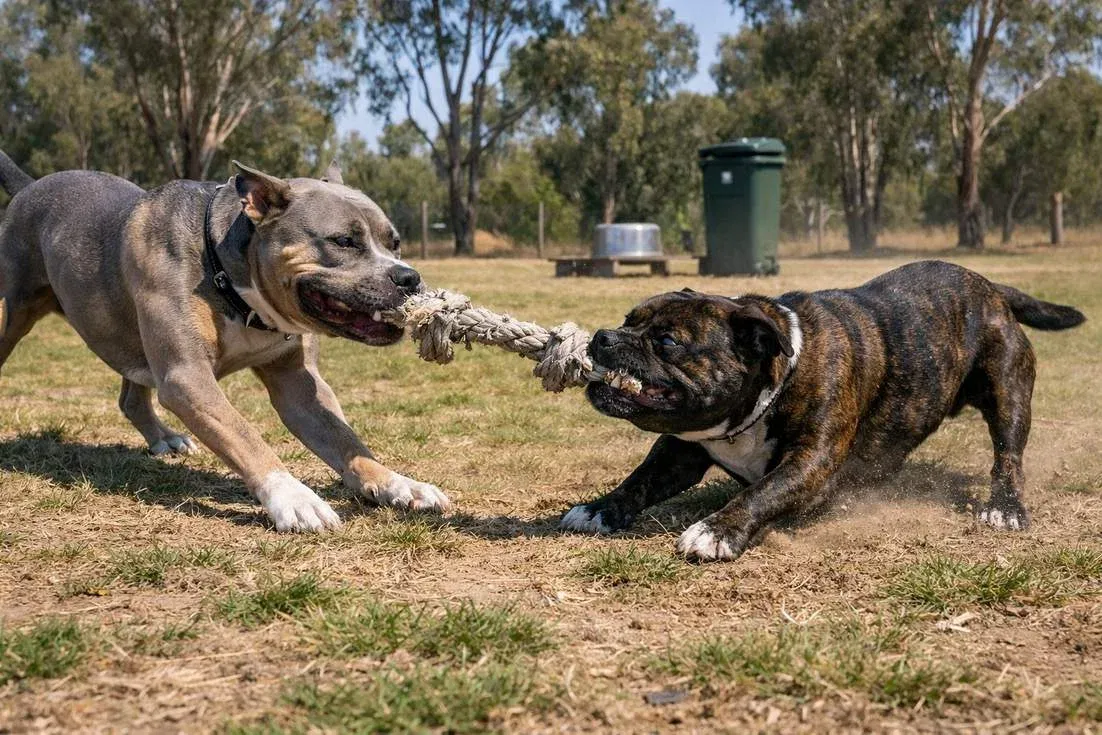
AmStaffs need more intense exercise than English Staffies. Think of the AmStaff as the endurance athlete and the English Staffy as the sprinter who then naps on the couch for three hours. Both breeds love play, fetch, and tug-of-war, but the AmStaff has more sustained energy.
| Exercise Factor | American Staffy | English Staffy |
|---|---|---|
| Daily Exercise Needed | 1–1.5 hours | 45 mins – 1 hour |
| Exercise Type | Hiking, jogging, agility, strength games | Walks, fetch, tug, garden play |
| Off-Leash Reliability | Moderate (needs solid recall training) | Moderate (prey drive can be an issue) |
| Heat Tolerance (Aus summers) | Moderate (short coat helps) | Moderate (short snout = monitor closely) |
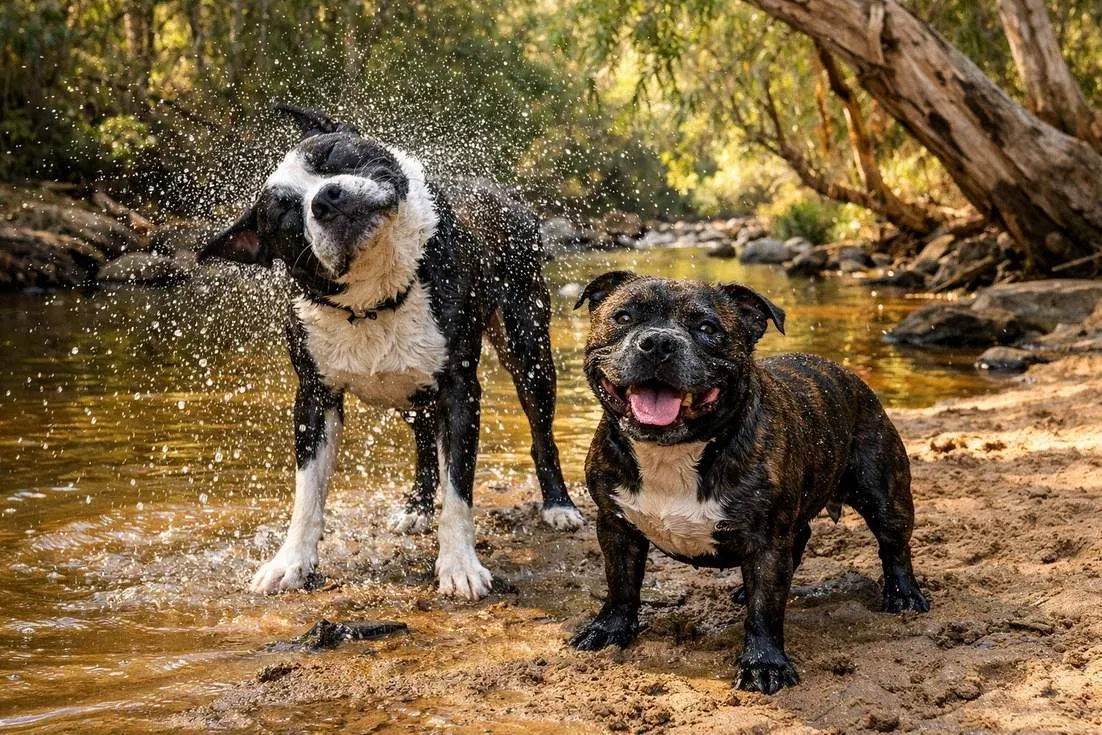
| Swimming Ability | Many enjoy it — varies individually | Many enjoy it — varies individually |
| If Under-Exercised… | Destructive chewing, digging, restlessness | Weight gain, boredom barking, chewing |
Australian Climate Warning
Both breeds have short coats that offer poor UV protection, so sunburn on exposed skin (belly, nose, ears) is a real risk in Australian summers. Light-coloured Staffies are especially vulnerable. Use pet-safe sunscreen on pink or exposed areas. Both breeds are brachycephalic-adjacent — the English Staffy in particular has a shorter muzzle that can make heat regulation harder. Exercise early morning or after sunset during summer, always provide shade and fresh water, and never leave either breed in a parked car.
which Is Easier to Train?
AmStaffs are generally easier to train in terms of picking up commands quickly. They’re intelligent, motivated, and respond well to structured, reward-based training. However, their size and strength mean that an experienced handler gets better results — an undertrained 30 kg AmStaff is harder to manage than an undertrained 15 kg English Staffy.
English Staffies are eager to please but can be stubborn and tenacious. They’ll test boundaries with a grin on their face. Short, fun training sessions work best — repetition bores them quickly. Both breeds respond well to positive reinforcement and poorly to harsh correction (which can damage trust and create fear-based reactivity).
Common training mistake for AmStaffs: not starting early enough with lead manners. A 30 kg AmStaff that pulls is a genuine safety hazard on footpaths. Common training mistake for English Staffies: underestimating their need for dog-socialisation. Staffies who aren’t exposed to other dogs regularly as puppies are far more likely to become dog-reactive as adults. Puppy school from 8–12 weeks is highly recommended for both breeds.
Which Costs More in Australia?
Costs are fairly similar, with AmStaffs slightly more expensive due to being rarer in Australia. English Staffies benefit from a massive breeding community across all states, which keeps prices competitive.
| Cost Category | American Staffy (AUD) | English Staffy (AUD) |
|---|---|---|
| Puppy (Registered Breeder) | $2,500 – $5,000 | $2,000 – $5,000 |
| Rescue/Adoption | $300 – $800 | $200 – $600 |
| First-Year Setup | $2,000 – $3,500 | $1,500 – $3,000 |
| Annual Ongoing Costs | $2,000 – $3,500 | $1,500 – $3,000 |
| Pet Insurance (Monthly) | $40 – $80 | $35 – $70 |
| Lifetime Cost (Est.) | $22,000 – $40,000 | $18,000 – $35,000 |
English Staffies are significantly cheaper to feed and medicate due to their smaller size. Both breeds are widely available through rescue organisations — in fact, Staffy-type dogs are among the most common breeds in Australian shelters, so adopting is a great option.
Which One right for Australian Owners
BSL (Breed-Specific Legislation) — THIS IS THE MOST IMPORTANT SECTION FOR AUSTRALIAN STAFFY OWNERS: Neither the Staffordshire Bull Terrier nor the American Staffordshire Terrier is a banned or restricted breed in Australia. However, the American Pit Bull Terrier IS restricted in all Australian states, and both Staffy breeds can be visually confused with Pit Bulls by council officers. In Victoria, ANKC pedigree papers provide a legal exemption for AmStaffs — a registered AmStaff with papers cannot be declared a restricted breed. An AmStaff WITHOUT papers is at risk of seizure. English Staffies face similar confusion. Bottom line: always keep your ANKC pedigree papers readily accessible, and microchip/register your dog promptly.
Climate suitability: Both breeds handle Australian weather reasonably well thanks to their short coats, but neither tolerates extreme heat. English Staffies, with their shorter muzzles, are at slightly higher risk of heat stress. Both are prone to sunburn on pink or lightly-coloured skin.
Council registration: Straightforward for both breeds in all states. Costs vary ($30–$80 AUD desexed, $150–$300+ entire). Desexing is required in most states for non-breeding pets.
Rental restrictions: This is where both breeds face real challenges. Many landlords and strata bodies have blanket bans on “bull breeds” or “Staffy-type dogs.” English Staffies face this more often due to their sheer popularity and public perception. Some landlords won’t differentiate between a Staffy and a Pit Bull. Getting pet references, completing a Canine Good Citizen certificate, and providing your ANKC papers can help.
Rescue availability: Both breeds are very well-represented in Australian shelters and rescue organisations. Staffy-type dogs make up a significant proportion of dogs available for adoption at the RSPCA and breed-specific rescues across the country.
So, which one Should You Get?
- You want a bigger, more athletic dog for hiking, jogging, and high-energy activities.
- You have experience with strong-willed breeds and can commit to consistent, structured training.
- You have a house with a yard — AmStaffs need more space than English Staffies.
- You’re prepared to keep ANKC pedigree papers on hand to avoid BSL confusion.
- You want a compact, couch-friendly companion that’s smaller and easier to manage physically.
- You have young children — English Staffies have one of the best reputations with kids of any breed.
- You live in an apartment or smaller home — the English Staffy adapts better to limited space.
- You’re a first-time Staffy owner — their smaller size makes training mistakes more forgiving.
- You’re not willing to invest in proper socialisation with other dogs from puppyhood.
- You leave your dog alone for 8+ hours daily — both breeds bond intensely and can develop separation anxiety.
- You’re unwilling to deal with potential rental or insurance discrimination against “bull breed” dogs.
- You want a guard dog. Both breeds are too friendly with strangers to be effective guards.
- Both breeds are loyal, people-loving dogs that look tougher than they act — the English Staffy will sit in your lap, and the AmStaff will lean against your legs until you topple over.
- The English Staffy is smaller, cheaper to maintain, and better suited to apartments. The AmStaff is bigger, more athletic, and needs more exercise and space.
- In Australia, always buy from an ANKC registered breeder and keep your pedigree papers accessible — BSL confusion is real and can have devastating consequences for unpapered dogs. Both breeds are readily available through rescue organisations if you’d prefer to adopt.
American Staffy vs English Staffy: Frequently Asked Questions
Is an American Staffy or English Staffy better for families with young children?
The English Staffy has one of the best reputations with children of any breed — the AKC and breed clubs describe them as having a “special feel for kids.” AmStaffs are also good with children but are significantly bigger and stronger, so supervision matters more with toddlers. Both breeds are affectionate and gentle with their family.
Are American Staffies or English Staffies aggressive?
No. Neither breed is aggressive toward people. Both breeds score well on temperament tests — the AmStaff passes the American Temperament Test Society evaluation at a rate above the all-breeds average. Their tough appearance is misleading. That said, both breeds can be dog-selective and need early, ongoing socialisation with other dogs.
Are Staffies banned in Australia?
No. Neither the Staffordshire Bull Terrier nor the American Staffordshire Terrier is banned or restricted in Australia. The American Pit Bull Terrier IS restricted. However, both Staffy breeds can be visually confused with Pit Bulls, so keeping ANKC pedigree papers is important — especially in Victoria, where papers provide a legal exemption from restricted breed declarations.
Which breed is cheaper to own in Australia?
English Staffies are cheaper overall. They eat less, cost less to medicate, and are more widely available from breeders, which keeps prices competitive. Expect to spend roughly $3,000–$5,000 AUD less over an English Staffy’s lifetime compared to an AmStaff.
Can you keep an American Staffy or English Staffy in an apartment?
English Staffies adapt well to apartment living thanks to their smaller size and moderate exercise needs. AmStaffs can manage in a larger apartment with sufficient daily exercise, but they’re better suited to a house with a yard. For either breed in an apartment, check strata rules about pet size and breed restrictions.
What’s the difference between an American Staffy and an English Staffy?
The main differences are size and build. AmStaffs are taller (43–48 cm vs 36–41 cm) and heavier (20–32 kg vs 11–17 kg) with a more athletic frame. English Staffies are compact and muscular with a wider skull and the famous “Staffy smile.” Temperamentally, English Staffies are slightly more emotionally sensitive and quieter; AmStaffs are more confident and outgoing.
Is an American Staffy the same as a Pit Bull?
No. The American Staffordshire Terrier and the American Pit Bull Terrier are separate breeds, despite sharing common ancestry. In Australia, the distinction matters legally — Pit Bulls are restricted, AmStaffs are not. ANKC pedigree papers are the best way to prove your AmStaff is not a restricted breed.
Do American Staffies and English Staffies get along with other dogs?
Both breeds can be dog-selective, meaning they may not get along with every dog they meet. Early and consistent socialisation from puppyhood is critical. With proper training and introduction, many Staffies live happily in multi-dog households. Off-leash dog parks require caution and good recall for both breeds.
Which breed sheds more?
Shedding is virtually identical — both breeds have short, smooth coats that shed lightly year-round with a mild increase in spring. A weekly brush with a rubber curry comb keeps shedding under control. If you’re comparing these breeds to Golden Retrievers or Labradors, both Staffies shed significantly less.
1. ANKC Breed Standard — Staffordshire Bull Terrier: https://ankc.org.au/breeds/breed-standard/?breedId=101
2. ANKC Breed Standard — American Staffordshire Terrier: https://ankc.org.au/breeds/breed-standard/?breedId=65
3. Victorian Government — Standard for Restricted Breed Dogs (AmStaff pedigree exemption): https://agriculture.vic.gov.au/livestock-and-animals/animal-welfare-victoria/dogs/restricted-breed-dogs
4. RSPCA Australia — Position on Breed-Specific Legislation: https://kb.rspca.org.au/knowledge-base/what-is-the-rspcas-view-on-breed-specific-legislation/
5. American Temperament Test Society — Breed Statistics: https://atts.org/breed-statistics/
6. Dogz Online — Staffordshire Bull Terrier pricing and breeders: https://www.dogzonline.com.au/breeds/puppies/staffordshire-bull-terrier.asp
7. American Staffordshire Terrier Club of Victoria — BSL Information: http://www.astcv.org/breed-specific-legislation.html
8. Staffordshire Bull Terrier Social & Support Group NSW — BSL Position: https://oz.dogs.net.au/staffordsocial/bsl–breed-specific-legislation.asp
Category Tags: Breeds | Breed Comparisons | Terriers