

If you’ve been researching Labrador puppies in Australia and stumbled across the terms “American Lab” and “English Lab,” you’re probably confused — and you should be. No kennel club on earth recognises these as separate breeds. The ANKC, AKC, and Kennel Club (UK) all register one breed: the Labrador Retriever. But decades of breeding for different purposes — the show ring versus the hunting field — have produced two dogs that look, act, and live so differently they might as well carry different names. If you’re choosing between them, the real question isn’t which breed you want. It’s which lifestyle you’re signing up for.
What You’ll Learn
- Breed traits & temperament
- Health concerns to know
- True cost in Australia
- Training & exercise needs
- Is this breed right for you?
Quick Facts at a Glance
| Trait | American Lab (Field Line) | English Lab (Show Line) |
|---|---|---|
| Official Breed | Labrador Retriever (ANKC) | Labrador Retriever (ANKC) |
| Breeding Purpose | Field trials, hunting, working roles | Conformation shows, companionship |
| Size (Height) | 54–62 cm | 54–57 cm |
| Weight | 25–36 kg | 25–38 kg |
| Lifespan | 10–14 years | 10–12 years |
| Coat Type | Short, dense, thinner double coat | Short, dense, thick double coat |
| Shedding Level | Moderate | High |
| Energy Level | Very High | Moderate to High |
| Trainability | Very High (needs experienced handler) | High (forgiving of mistakes) |
| Barking Level | Moderate to High (excitement-driven) | Low to Moderate |
| Good With Kids | Yes (better with older kids) | Yes (all ages) |
| Good With Other Dogs | Yes, with socialisation | Yes |
| Apartment Friendly | No | Not ideal (possible with commitment) |
| Puppy Price (AUD) | $2,500 – $4,500 | $2,500 – $4,500 |
| ANKC Group | Group 3 (Gundogs) | Group 3 (Gundogs) |
| Australian Availability | Limited — niche working breeders | Widely available — majority of ANKC breeders |
History & Origins
Both types trace back to the same ancestor: the St. John’s Water Dog from Newfoundland, Canada, brought to England in the early 1800s by fishermen and British aristocrats. The Kennel Club (UK) recognised the Labrador Retriever in 1903, and the breed arrived in Australia in 1929 with three black imports from England.
The split happened gradually over the mid-20th century. British and Australian breeders selecting for the show ring prioritised a stockier frame, broader skull, calm demeanour, and the thick “otter tail” described in the breed standard. Meanwhile, American and some British breeders selecting for field trials and hunting favoured speed, endurance, drive, and a leaner build that could work all day without tiring. Neither type is more “correct” — they’re the product of different selection pressures applied to the same gene pool for 80-plus years.
In Australia, the vast majority of ANKC-registered Labrador breeders work with show lines (English type). Working/field line breeders (American type) are a smaller community, concentrated around retriever trial clubs in NSW, Victoria, and Queensland. Some Australian breeders use a blend of both bloodlines, producing Labs that sit somewhere between the two extremes.
How to Tell Them Apart
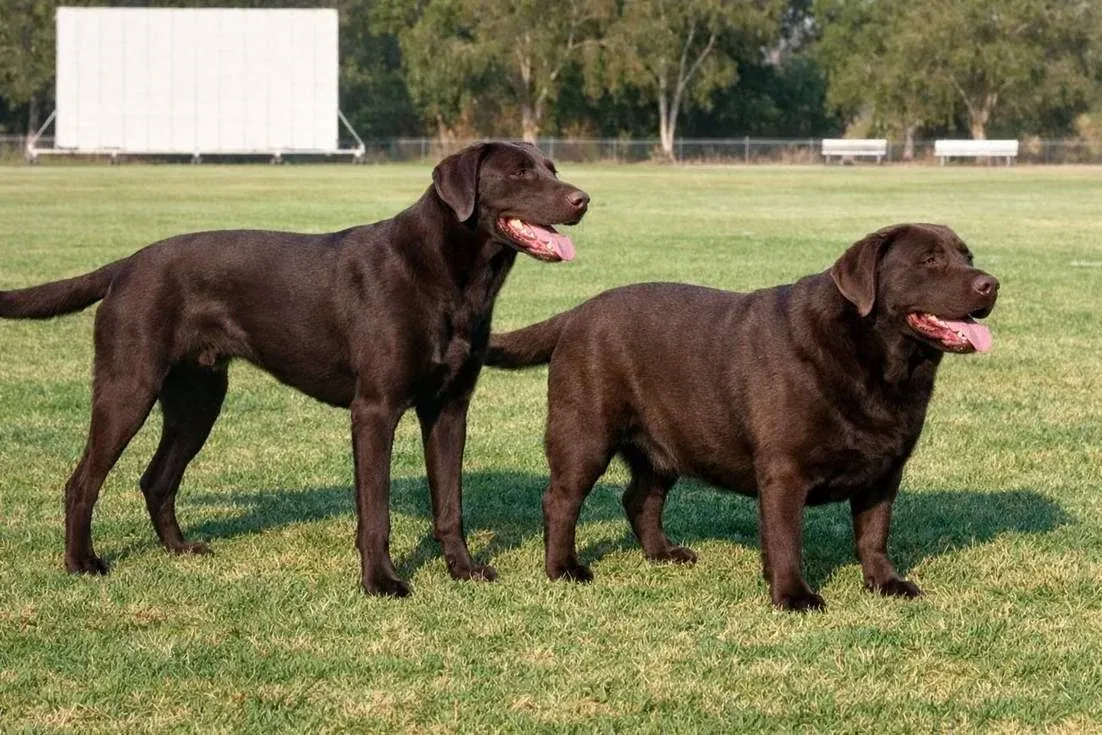
Put an American Lab and an English Lab side by side and you’d think they were different breeds. The English Lab looks like a teddy bear — wide head, thick neck, barrel chest, and that classic otter tail that’s thick at the base and tapers to a point. Their muzzle is shorter and their stop (the angle between forehead and nose) is more pronounced. They carry more weight through the ribs and hindquarters, giving them a solid, rounded silhouette.
The American Lab looks like an athlete. Taller, leaner, with longer legs, a narrower head, and a more streamlined body built for covering ground fast. Their tail is thinner (sometimes called “whippy” by show enthusiasts), their coat is often less dense, and their overall frame has more visible muscle definition. If the English Lab is a rugby forward, the American Lab is a centre — lighter, faster, and harder to catch.
Both types come in the same three ANKC-recognised colours: black, yellow (ranging from cream to fox red), and chocolate. Silver, charcoal, and champagne variants exist but are not recognised by the ANKC and are actively discouraged by the National Labrador Retriever Breed Council of Australia.
Physical Comparison at a Glance
| Physical Trait | American Lab (Field Line) | English Lab (Show Line) |
|---|---|---|
| Build / Frame | Lean, athletic, rangy | Stocky, broad, solid |
| Head Shape | Narrower skull, longer muzzle | Wider skull, shorter muzzle, pronounced stop |
| Ear Type | Set slightly higher, less heavy | Set lower, heavier, hang close to head |
| Tail | Thinner, can curve slightly | Thick otter tail, straight |
| Coat Density | Moderate double coat | Dense, plush double coat |
| Colour Options | Black, yellow, chocolate | Black, yellow, chocolate |
What Are They Actually Like to Live With?
This is where the two types diverge most sharply, and it’s the section that matters most if you’re choosing one to bring home.
English Labs are the dog most Australians picture when they think “Labrador.” They’re affable, steady, and happy to mooch around the house between walks. They bond with the whole family, tolerate toddlers pulling their ears, and genuinely switch off at the end of the day. If you come home and sit on the couch, an English Lab will lie at your feet within five minutes. They’re built for the rhythm of suburban family life — morning walk, afternoon nap, evening cuddle, repeat.
American Labs run on a different operating system. They’re wired for work, and their brains don’t have a reliable off-switch until they’ve been physically and mentally exhausted. If you come home and sit on the couch, an American Lab will bring you a ball. Then a shoe. Then a cushion. Then it’ll start redecorating the garden because you clearly aren’t getting the message. They bond deeply — often more intensely with one handler — and they thrive on structure, routine, and having a job to do every single day.
For families with young children, English Labs are generally the safer pick. Their calmer temperament means fewer accidental knockdowns, less mouthing, and more patience. American Labs can be outstanding family dogs too, but they suit homes with older kids (8+) who can participate in training, fetch sessions, and structured outdoor activities.
Separation anxiety appears in both types but manifests differently. An English Lab left alone too long might chew a shoe or raid the bin. An American Lab left alone too long might remove a door frame or dig through the back fence. The destruction potential scales with the energy level.
Health Issues
Because they’re the same breed, both types share the core Labrador health profile. Hip and elbow dysplasia affect Labs across all lines, which is why the ANKC mandates hip and elbow scoring for breeding stock through the AVA/ANKC CHEDS scheme. Exercise-Induced Collapse (EIC) is an inherited neuromuscular condition found in both show and field lines — DNA testing is available and should be confirmed before any mating. Progressive Retinal Atrophy (PRA) affects vision in both types and is also DNA-testable.
Where health risks diverge is largely a product of build and lifestyle. English Labs carry a well-documented tendency toward obesity. A landmark Cambridge University study found that most Labradors carry a mutation in the POMC gene, which regulates appetite and satiety. English Labs, being less active by nature, are particularly vulnerable. A 2022 PetSure Australia report flagged Labradors as one of the top five breeds for obesity-related insurance claims. Overweight Labs face compounding risks: worsened joint disease, diabetes, heart strain, and a lifespan shortened by up to two years.
American Labs face a different risk profile. Their extreme athleticism and high-drive behaviour lead to more soft-tissue injuries — cruciate ligament tears, sprains, and strains from hard stops, jumps, and sharp turns during fieldwork or intense fetch sessions. They’re also more likely to ingest foreign bodies (sticks, balls, socks) because their retrieving instinct is dialled to maximum.
Chocolate Labs of either type carry an additional concern. Research from the University of Sydney found that chocolate Labradors live roughly 10% shorter lives than their black and yellow counterparts and experience higher rates of ear infections and skin conditions. If you’re set on a chocolate, prioritise breeders who health-test thoroughly regardless of colour.
Common Health Costs Comparison (AUD)
| Health Concern | American Lab (Field Line) | English Lab (Show Line) |
|---|---|---|
| Hip Dysplasia | Moderate risk | $6,000–$12,000 AUD surgery | Moderate risk | $6,000–$12,000 AUD surgery |
| Elbow Dysplasia | Moderate risk | $3,000–$8,000 AUD | Moderate risk | $3,000–$8,000 AUD |
| Obesity-Related Illness | Low risk | Varies | High risk | $1,500–$5,000+ AUD (ongoing) |
| Cruciate Ligament Tear | Higher risk | $4,000–$8,000 AUD per knee | Moderate risk | $4,000–$8,000 AUD per knee |
| Exercise-Induced Collapse (EIC) | Present in both | DNA test $80–$150 | Present in both | DNA test $80–$150 |
| Progressive Retinal Atrophy | Present in both | DNA test $80–$150 | Present in both | DNA test $80–$150 |
| Ear Infections | Moderate | $150–$500 AUD per episode | Moderate–High | $150–$500 AUD per episode |
| Est. Annual Vet Costs | $800–$1,800 AUD | $800–$2,000 AUD |
Grooming — Which Is More Work?
Neither type requires professional grooming in the way a Poodle or Golden Retriever does, but they’re far from low-maintenance. Both types have a water-resistant double coat that sheds year-round and “blows” heavily twice a year during seasonal changes. English Labs typically have a denser, plusher coat that traps more loose fur and produces heavier moults. American Labs shed moderately by comparison, though “moderately” still means hair on every surface you own.
Both types are prone to ear infections thanks to their floppy ears trapping moisture — a particular concern in humid coastal regions of Australia like Far North Queensland, the NSW north coast, and Perth’s wet winters. Weekly ear checks and cleaning after swimming are non-negotiable for both.
Grooming Comparison
| Grooming Task | American Lab (Field Line) | English Lab (Show Line) |
|---|---|---|
| Brushing Frequency | 2–3 times per week | 3–4 times per week (heavier coat) |
| Professional Grooming | Optional | $50–$80 AUD | Optional | $50–$80 AUD |
| Shedding Season | Moderate blowout, twice yearly | Heavy blowout, twice yearly |
| Nail Trimming | Every 2–4 weeks | Every 2–4 weeks |
| Ear Cleaning | Weekly (required after swimming) | Weekly (essential after swimming) |
How Active Are They Really?
This is where the two types are furthest apart, and it’s the section most buyers underestimate.
An English Lab needs a solid 60–90 minutes of daily exercise — a long walk, a swim at the beach, a game of fetch in the park. They’ll happily do more if offered, but they won’t spiral into destruction if one day is quieter than usual. After a good session, they settle. They’re content to snooze on the back deck or lie near you while you work. This is the Lab that earns its reputation as the ideal family dog.
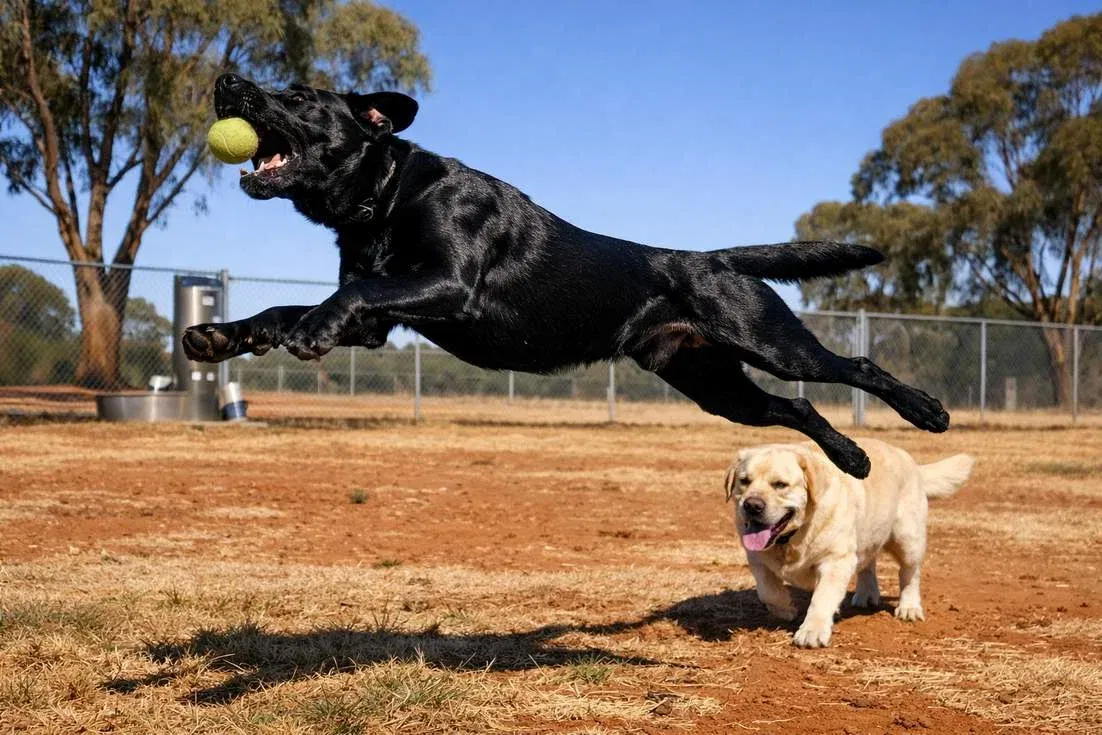
An American Lab needs 90 minutes to two-plus hours of structured, purposeful exercise every single day. A stroll around the block doesn’t count. They need running, swimming, retrieval drills, agility, scent work, or any activity that engages both their body and their brain simultaneously. These dogs were bred to work a full day in the field and still have energy left over. A bored American Lab doesn’t just chew — it excavates, shreds, and problem-solves its way through whatever barrier stands between it and stimulation.
Exercise Comparison
| Exercise Factor | American Lab (Field Line) | English Lab (Show Line) |
|---|---|---|
| Daily Exercise Needed | 1.5–2+ hours (structured) | 1–1.5 hours |
| Exercise Type | Running, swimming, retrieval drills, scent work | Walks, swimming, fetch, casual play |
| Off-Leash Reliability | Moderate (high prey drive) | Good (with training) |
| Heat Tolerance (Aus summers) | Moderate — won’t self-regulate | Moderate — heavier coat is a liability |
| Swimming Ability | Strong natural swimmer | Strong natural swimmer |
| If Under-Exercised… | Destructive digging, chewing, escape attempts, excessive barking | Weight gain, mild chewing, restlessness |
Australian Climate Warning
Labs of both types are at risk in Australian summers, but for different reasons. English Labs carry more insulation (denser coat, heavier build) and overheat faster during midday exercise. American Labs have better heat dissipation but refuse to self-regulate — they’ll keep retrieving until they collapse. Both types are at real risk of heatstroke above 30°C. Exercise early morning or after sunset from October through March. Always carry water on walks, avoid hot pavement (test with the back of your hand for five seconds), and watch for heavy panting, glazed eyes, or a dark red tongue — all signs of heat stress requiring immediate vet attention.
Which One Easier to Train?
Both types are among the most trainable dogs alive. Labradors as a breed are food-motivated, eager to please, and responsive to positive reinforcement. But the training experience differs sharply between the two types.
English Labs are more forgiving of beginner mistakes. They’re patient, slower to frustrate, and recover quickly from confused handling. If you use slightly unclear cues or inconsistent timing, an English Lab will generally figure out what you meant and comply anyway. They’re the breed most trainers recommend for first-time dog owners, and they’re widely used as therapy dogs, guide dogs, and assistance dogs in Australia for exactly this reason.
American Labs learn faster and retain more, but they demand precision. Their high drive means they’re always “on,” which makes them incredibly responsive to skilled handlers and incredibly frustrating for inexperienced ones. They need clear structure, consistent boundaries, and training sessions that challenge them mentally. Without this, they’ll find their own entertainment — and you won’t enjoy the results. Puppy classes are a minimum; serious ongoing training (obedience, retriever drills, nose work) is realistically a commitment for the life of the dog.
One common mistake with American Labs: relying solely on physical exercise to manage behaviour. A tired dog is a good dog, the saying goes — but an American Lab that’s physically exhausted without mental stimulation just becomes a fitter, faster problem. Brain work matters more than kilometres.
Which Costs More in Australia?
| Cost Category | American Lab (AUD) | English Lab (AUD) |
|---|---|---|
| Puppy (Registered Breeder) | $2,500 – $4,500 | $2,500 – $4,500 |
| Rescue/Adoption | $350 – $800 | $350 – $800 |
| First-Year Setup | $2,500 – $3,500 | $2,000 – $3,000 |
| Annual Ongoing Costs | $2,500 – $4,000 | $2,000 – $3,500 |
| Pet Insurance (Monthly) | $50 – $120 | $50 – $120 |
| Training (Lifetime) | $2,000 – $5,000+ (ongoing structured training) | $500 – $2,000 (puppy school + basics) |
| Lifetime Cost (Est.) | $30,000 – $55,000 | $25,000 – $45,000 |
The cost gap is driven primarily by training and exercise infrastructure. American Lab owners frequently invest in advanced obedience courses, retriever training clubs, agility equipment, and higher-quality interactive toys to keep their dogs mentally stimulated. English Lab owners spend more on weight management — prescription diet food, extra vet consultations for weight checks, and joint supplements as the dog ages.
Which one for Australian Owners
Because neither type is a distinct breed, there are no BSL or council registration differences between them. Both are registered as Labrador Retrievers with your local council, and neither faces breed-specific restrictions anywhere in Australia.
Climate is a factor. Australian summers push both types, but English Labs with their denser coat and heavier build are at higher risk during extended heat. In tropical regions (Darwin, Cairns, Townsville), English Labs will need air-conditioned indoor time during the hottest months. American Labs cope marginally better with heat but create different problems — they still need their two hours of daily exercise regardless of temperature, which means owners in hot climates must plan carefully around cooler parts of the day.
Rental restrictions affect both types equally. Labs are large dogs (25–38 kg), and many Australian landlords and strata bylaws restrict dogs over 10–15 kg. Neither type is singled out, but an American Lab’s potential for destructive behaviour in a confined rental can make it harder to maintain a lease. English Labs’ calmer indoor temperament gives them a practical edge in rental situations.
Paralysis ticks are a concern for both types, particularly along the eastern seaboard from Far North Queensland to the Victorian border. Labs love bushwalking and swimming in tick-heavy areas. Year-round tick prevention (NexGard, Bravecto, Simparica) is non-negotiable. Snake encounters are also common for both types in rural and semi-rural Australia. American Labs with high prey drive may be more likely to investigate — and harass — a snake rather than retreat.
Finding a breeder: English-type Labs dominate the ANKC registered breeder pool. If you want a working/field-line (American-type) Lab, search for breeders affiliated with retriever trial clubs in your state. The Retrieving Ability Test (RAT) and Retrieving Trial (RT) communities are the best starting points. Ask any breeder which lines they work with and whether their dogs are bred for show, field, or dual purpose.
So, which one Should You Get?
- You’re an active person or family who runs, hikes, swims, or hunts regularly and wants a dog that can keep up all day.
- You have experience training high-drive dogs and understand the difference between physical exercise and mental stimulation.
- You want a dog for a working role — retriever trials, scent detection, search and rescue, or competitive obedience.
- You have a large yard or acreage and a structured daily routine that includes dedicated training time.
- You want a reliable family dog that’s gentle with young children, settles indoors, and adapts to the rhythms of suburban life.
- You’re a first-time dog owner looking for a trainable, forgiving breed that doesn’t require advanced handling skills.
- You want a therapy dog, assistance dog, or emotional support animal — English Labs’ calm, steady temperament makes them the preferred choice for these roles.
- You have a moderately active lifestyle (daily walks, weekend beach trips) but don’t want a dog that demands two-plus hours of structured work every day.
- You live in a small apartment with no outdoor access and limited capacity for daily exercise. Labs of any line are 25–38 kg sporting dogs that need space and movement.
- You’re away from home for 8+ hours a day without dog-walking support. Labs are social dogs that deteriorate in isolation — American Labs with destruction, English Labs with weight gain and depression.
- You’re not prepared for shedding. Both types shed heavily. If dog hair on every surface you own isn’t acceptable, neither type is right for you.
- You have a tight budget for veterinary care. Both types carry genetic risks (hip/elbow dysplasia, EIC, PRA) that can generate bills of $5,000–$12,000+ AUD for a single condition.
- They’re the same breed on paper but different dogs in your house. The English Lab is the steady family companion most people picture when they say “Labrador.” The American Lab is the high-performance athlete that needs a handler, not just an owner.
- In Australia, English Labs are easier to find, easier to train, and easier to live with for the average household. American Labs are outstanding dogs for the right person — but that person needs to be honest about their lifestyle, time, and experience before committing.
- Whichever type you choose, insist on ANKC-registered breeders who hip and elbow score their breeding stock, DNA test for EIC and PRA, and can clearly tell you whether their dogs are show line, working line, or dual purpose. The term you use matters less than the breeder’s transparency about what they’re producing.
Frequently Asked Questions
Are American Labs and English Labs different breeds?
No. Both are Labrador Retrievers registered under the same ANKC breed standard. The terms “American” and “English” refer to breeding lines — field/working versus show/conformation — not separate breeds. A Labrador born in Melbourne from American field lines is still an ANKC-registered Labrador Retriever.
Which type is better for families with young children?
English Labs are generally the better fit for homes with young children. Their calmer energy, gentler mouth, and natural patience make them more predictable around toddlers and preschoolers. American Labs can be wonderful family dogs but their higher energy and bounciness suit families with children aged 8 and older.
Are American Labs harder to train?
Not harder, but different. American Labs learn extremely fast and are highly responsive — but they demand precision, consistency, and structured mental stimulation. English Labs are more forgiving of beginner errors. For a first-time dog owner, an English Lab is the more practical choice.
Can you keep an American Lab in a suburban backyard?
Technically yes, but only if you commit to 90 minutes to two-plus hours of structured daily exercise and mental enrichment. A bored American Lab in a suburban backyard will dig, bark, chew, and escape. If your lifestyle is more “morning walk plus evening play,” an English Lab is a far better match.
Which type sheds more?
English Labs typically shed more due to their denser, plusher double coat. Both types shed year-round and blow coat heavily twice a year during seasonal changes. Invest in a good deshedding tool (like a Furminator) regardless of which type you choose.
Do chocolate Labs really live shorter lives?
Research from the University of Sydney suggests chocolate Labradors live approximately 10% shorter lives than black or yellow Labs. This applies to both show and field lines. Chocolate Labs also showed higher rates of ear and skin conditions. Colour alone shouldn’t determine your choice, but it’s worth factoring into health expectations and breeder selection.
How do I find a working-line (American-type) Lab breeder in Australia?
Working/field-line Lab breeders are a smaller community in Australia. Start with your state’s retriever trial club — look for breeders competing in Retrieving Ability Tests (RAT) or Retrieving Trials (RT). Check DogzOnline for breeders who specifically mention working or field lines. Ask whether parents hold retrieving trial titles (Rt.Ch) rather than conformation titles (Aust.Ch).
What is a “dual-purpose” Labrador?
A dual-purpose Lab is bred from a combination of show and working bloodlines, aiming for a dog that has the physical type of a show Lab with some of the drive and trainability of a field Lab. Some Australian breeders specialise in this middle ground. These dogs can make excellent companions for active families who want more drive than a pure show line but less intensity than a pure field line.
1. ANKC / Dogs Australia — Labrador Retriever Breed Standard Extension (2018) — dogsaustralia.org.au
2. National Labrador Retriever Breed Council (Australia) — Breed Standard and Health Position Statements — nationallabradorretrieverbreedcouncilaustralia.com
3. Raffan et al. (2016) — “A Deletion in the Canine POMC Gene Is Associated with Weight and Appetite in Obesity-Prone Labrador Retriever Dogs” — Cell Metabolism, Cambridge University
4. McGreevy et al. (2018) — University of Sydney — Labrador Retriever Colour and Lifespan Study
5. AVA/ANKC Canine Hip and Elbow Dysplasia Scheme (CHEDS) — ava.com.au
6. PetSure Australia (2022) — Claims Data: Top Breeds for Obesity-Related Insurance Claims
7. DogzOnline — Labrador Retriever Breeder Directory and Puppy Listings — dogzonline.com.au
8. Labrador Breed Council (UK) — Health Committee Recommendations: EIC, CNM, PRA, Hip and Elbow Scoring — labradorbreedcouncil.co.uk