
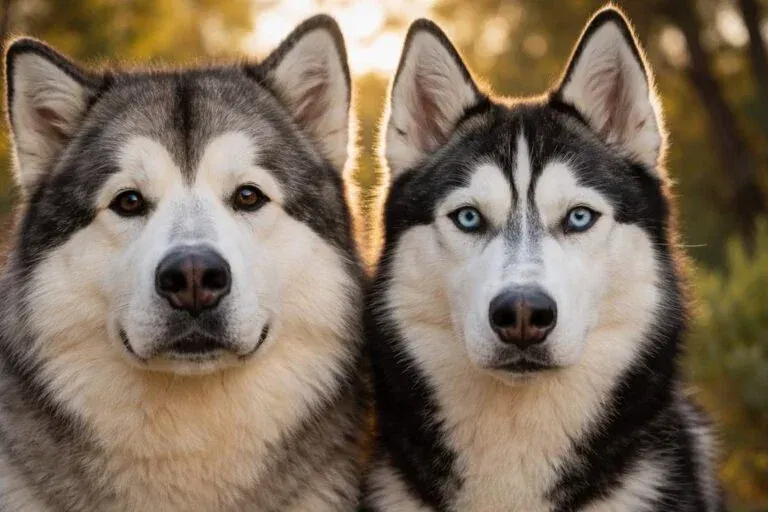
They both look like wolves. They both pull sleds. They both shed enough fur to build a second dog every spring. But the Alaskan Malamute and the Siberian Husky are genuinely different breeds built for very different jobs — and living with one versus the other is a completely different experience. Think of it this way: the Malamute is the weightlifter, built to haul heavy freight at a steady pace. The Husky is the marathon runner, built for speed and endurance over vast distances. That fundamental difference in purpose shapes everything from their size and energy levels to how they behave in your backyard on a 38°C Melbourne afternoon. Here’s what actually matters when choosing between these two Arctic breeds in Australia.
[IMAGE: Featured image — both breeds together or split-screen. Alt text: “Alaskan Malamute vs Siberian Husky comparison side by side”]
What You’ll Learn
- Breed traits & temperament
- Health concerns to know
- True cost in Australia
- Training & exercise needs
- Is this breed right for you?
Quick Facts at a Glance
| Trait | Alaskan Malamute | Siberian Husky |
|---|---|---|
| Origin | Alaska (Mahlemut Inuit people) | Siberia (Chukchi people) |
| Size (Height) | 58–63 cm (male) | 53–58 cm (female) | 53–60 cm (male) | 50–56 cm (female) |
| Weight | 34–45 kg (male) | 32–38 kg (female) | 20–27 kg (male) | 16–23 kg (female) |
| Lifespan | 10–14 years | 12–15 years |
| Coat Type | Thick, coarse double coat (longer) | Dense, smooth double coat (shorter) |
| Shedding Level | Extreme — heavy year-round + biannual coat blow | High — moderate year-round + biannual coat blow |
| Eye Colour | Brown only | Blue, brown, bi-eyed, or parti-coloured |
| Energy Level | High (strength-based) | Very High (endurance-based) |
| Trainability | Moderate — independent, strong-willed | Moderate — intelligent but stubborn |
| Barking / Vocalisation | Low — soft “woo-woos” | HIGH — howling, talking, dramatic vocalisations |
| Good With Kids | Yes — with supervision (large size) | Yes — with supervision |
| Good With Other Dogs | Same-sex aggression common | Generally good — pack mentality |
| Apartment Friendly | No — needs space | No — too energetic for confined spaces |
| Puppy Price (AUD) | $2,500 – $5,000 | $1,500 – $4,000 |
| ANKC Group | Group 6 (Utility) | Group 6 (Utility) |
Where Did the They Come From?
The Alaskan Malamute is one of the oldest Arctic sled dog breeds, developed by the Mahlemut Inuit people of northwestern Alaska over 4,000 years ago. These dogs were essential for survival — they hauled heavy loads of food, supplies, and equipment across vast frozen landscapes. The Malamute was bred for raw pulling power and endurance, not speed. They worked in teams but were also family companions, sleeping alongside children for warmth. The breed nearly disappeared during the Alaskan Gold Rush when they were crossbred with other dogs, but dedicated breeders preserved the original bloodlines.
The Siberian Husky was developed by the Chukchi people of northeastern Siberia over 3,000 years ago. Unlike the Malamute, the Husky was bred to pull lighter loads at faster speeds over enormous distances. Efficiency was everything — Huskies could run all day on minimal food, making them perfectly adapted to the nomadic Chukchi lifestyle. The breed gained worldwide fame during the 1925 serum run to Nome, Alaska, when relay teams of Huskies transported life-saving diphtheria antitoxin across 1,085 km in brutal conditions. The lead dog Balto became a national hero, with a statue erected in New York’s Central Park.
What this means for you: the Malamute was the slow, powerful freight truck. The Husky was the quick, efficient long-distance courier. These working origins explain why Malamutes are calmer and more powerful indoors but need strength-based activities, while Huskies are restless bundles of energy that need to run.
How to Tell Them Apart
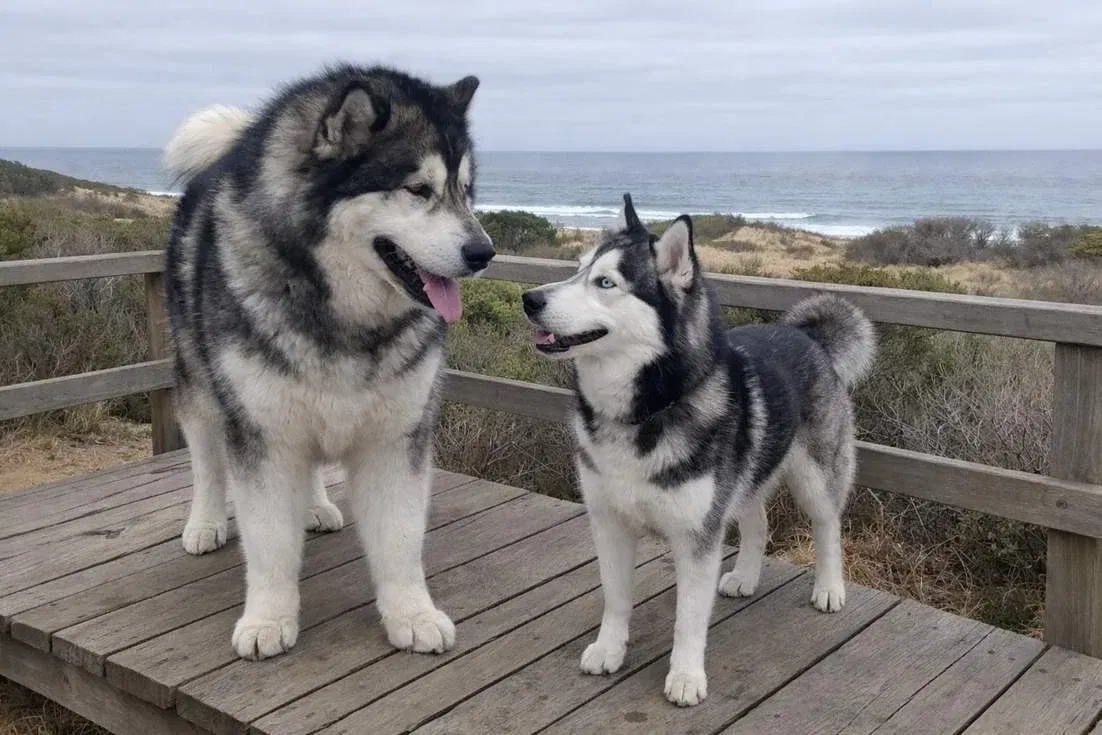
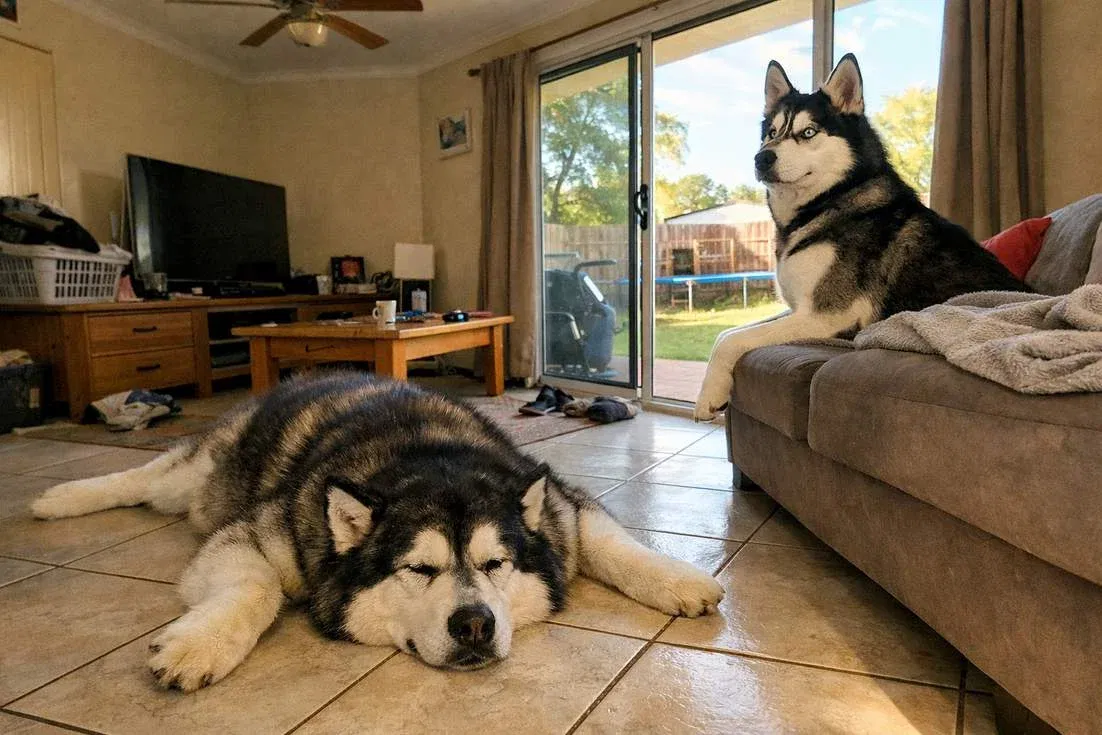
Size is the easiest tell. Stand them side by side and the difference is obvious: a male Malamute at 38–45 kg is nearly twice the weight of a male Husky at 20–27 kg. The Malamute has a broad, bear-like head, a heavy-boned frame, and a powerful chest built for hauling. The Husky is leaner, more compact, and built for agility and speed.
Eyes are the other dead giveaway. Malamutes always have brown eyes — blue eyes are a disqualification in the breed standard. Huskies are famous for their striking blue eyes, though they can also have brown eyes, one of each (bi-eyed), or even split-coloured eyes (parti-coloured). If you see a sled dog with blue eyes, it’s a Husky or a mix — not a Malamute.
Tails tell a story too. The Malamute carries its bushy, plumed tail curled over its back in a graceful arc. The Husky’s brush-like tail hangs down when relaxed and rises in a sickle curve when alert, but doesn’t curl as tightly as the Malamute’s.
Physical Comparison at a Glance
| Physical Trait | Alaskan Malamute | Siberian Husky |
|---|---|---|
| Build / Frame | Heavy-boned, broad, powerful | Lean, compact, athletic |
| Head Shape | Broad, bear-like, wide-set ears | Narrower, fox-like, ears set high |
| Eye Colour | Brown only (blue = disqualification) | Blue, brown, bi-eyed, parti-coloured |
| Tail | Plumed, curled over back | Brush-shaped, hangs down when relaxed |
| Coat Length | Longer, coarser outer coat | Shorter, smoother outer coat |
| Colour Options | Grey/white, black/white, red/white, sable, seal | Black/white, grey/white, red/white, agouti, pure white + more |
| Facial Markings | Open face or cap with bar/mask | White mask-like markings, forehead stripe common |
What Are They Actually Like to Live With?
Both breeds are friendly, affectionate, and absolutely useless as guard dogs. A Malamute will greet a burglar with a dignified tail wag; a Husky will show them where the treats are kept. But the daily experience of living with each breed is markedly different.
Energy and intensity: Huskies are relentless. They need 1–2 hours of vigorous exercise daily — running, biking, or mushing-style activities. Without enough output, a Husky will redesign your garden through excavation, remodel your furniture through chewing, and serenade your neighbours through howling. Malamutes need significant exercise too (1–1.5 hours daily), but they prefer strength-based activities like hiking with a pack, pulling a cart, or long structured walks. Malamutes are generally calmer indoors once exercised.
Vocalisation: This is a major practical difference. Huskies are among the most vocal dog breeds on the planet. They howl, “talk,” whine, and make dramatic vocalisations that sound eerily human. YouTube is full of Husky tantrum compilations for a reason. Malamutes are significantly quieter — they’ll “woo-woo” softly but rarely howl at the same volume or frequency. If you have close neighbours or live in a townhouse, the Husky’s vocal habits are a genuine consideration.
Independence: Malamutes are more independent and sometimes aloof. They bond deeply with their family but don’t need constant interaction. They can handle moderate alone time better than Huskies. Huskies are pack animals through and through — they want to be with their people (or other dogs) at all times and are more prone to separation anxiety and destructive behaviour when left alone.
Other dogs: This is where the breeds diverge significantly. Huskies generally get along well with other dogs thanks to their strong pack instinct. Malamutes, particularly males, can show same-sex aggression and may not tolerate other dogs of the same gender. The Alaskan Malamute Club of America explicitly recommends keeping Malamutes with dogs of the opposite sex. Both breeds have a strong prey drive and are unreliable around cats, rabbits, and other small animals.
Health Issues
Both breeds are generally healthy working dogs, but their size difference creates different health profiles.
Malamutes, as a larger breed, are more prone to hip and elbow dysplasia, bloat (gastric dilatation-volvulus, or GDV), hypothyroidism, and inherited polyneuropathy (a nerve condition that causes weakness in the limbs). They can also develop day blindness (cone degeneration) and bleeding disorders like von Willebrand’s disease. Responsible Australian breeders hip/elbow score and DNA test for polyneuropathy before breeding.
Huskies are a healthier breed overall with fewer structural issues due to their lighter build. Their main concerns are eye conditions — hereditary cataracts (which can appear as early as 6–12 months), corneal dystrophy, and progressive retinal atrophy (PRA). They can also develop hip dysplasia, though less frequently than Malamutes. Both breeds share a significant risk: zinc-responsive dermatosis (a skin condition common in Arctic breeds) and sensitivity to certain anaesthetic agents.
Lifespan: Huskies typically live longer (12–15 years) than Malamutes (10–14 years), which is consistent with the general trend that smaller dogs live longer.
Common Health Costs Comparison
| Health Concern | Alaskan Malamute Risk | Siberian Husky Risk |
|---|---|---|
| Hip/Elbow Dysplasia | HIGH | $4,000–$10,000+ AUD surgery | Moderate | $4,000–$10,000+ AUD surgery |
| Bloat (GDV) | HIGH | $3,000–$8,000 AUD emergency | Low–Moderate |
| Eye Conditions (Cataracts, PRA) | Moderate | $1,500–$4,000 AUD | HIGH | $1,500–$4,000 AUD |
| Hypothyroidism | HIGH | $50–$100 AUD/month medication | Low–Moderate |
| Polyneuropathy | Moderate (DNA test available) | Low |
| Zinc-Responsive Dermatosis | Moderate | $200–$1,000 AUD/year | Moderate | $200–$1,000 AUD/year |
| Heat Stress / Heatstroke | VERY HIGH in Australian climate | HIGH in Australian climate |
| Est. Annual Vet Costs | $1,000 – $3,000 AUD | $800 – $2,500 AUD |
The single biggest health risk for both breeds in Australia is heat. These are Arctic dogs wearing permanent fur coats in a country where summer temperatures regularly exceed 35°C. Heatstroke is a real and potentially fatal risk. See the Australian Considerations section below for essential heat management strategies.
Grooming — Which Is More Work?
If you’re allergic to dog hair, close this article now. Both breeds shed prodigiously year-round and then go nuclear twice a year during their biannual “coat blow,” when they shed their entire undercoat over 2–4 weeks. During coat blow season, you will find fur on your food, in your car, woven into your clothes, and in rooms the dog has never entered. This is not an exaggeration.
| Grooming Task | Alaskan Malamute | Siberian Husky |
|---|---|---|
| Brushing (Normal) | 2–3 times per week | 1–2 times per week |
| Brushing (Coat Blow) | Daily — heavy undercoat removal | Daily — moderate undercoat removal |
| Professional Grooming | Every 6–8 weeks (recommended) | Every 8–12 weeks (optional) |
| Shedding Volume | Extreme — fills bin bags | High — substantial but less than Mal |
| Bathing | Every 6–8 weeks (naturally clean) | Every 6–8 weeks (very clean, minimal odour) |
| Nail Trimming | Every 2–3 weeks | Every 2–3 weeks |
| Coat Blow Duration | 3–4 weeks, twice yearly | 2–3 weeks, twice yearly |
Critical rule for both breeds: NEVER shave a Malamute or Husky. Their double coat insulates against both cold and heat. Shaving removes UV protection, disrupts temperature regulation, and the coat may never grow back correctly. Use a quality undercoat rake and high-velocity dryer instead.
Malamutes are more grooming-intensive overall due to their longer, coarser coat. However, both breeds are famously clean dogs with minimal “doggy odour” — they groom themselves almost like cats.
How Active Are They Really?
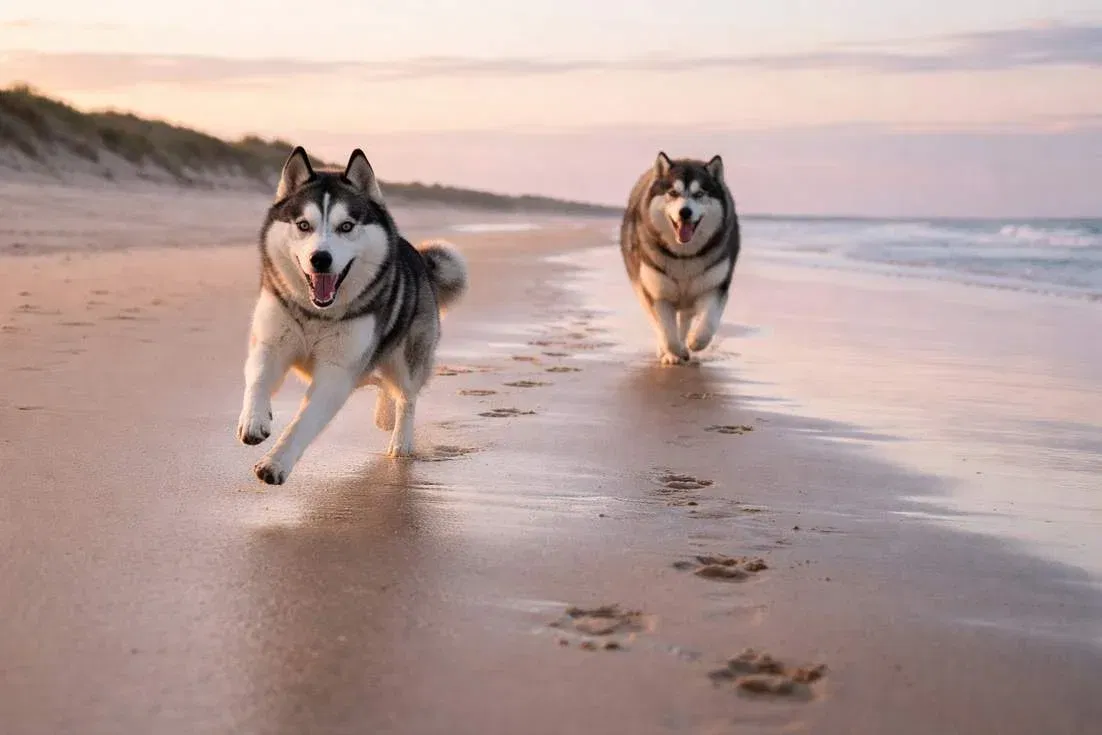
Both breeds need substantial daily exercise, but the type and intensity differ.
| Exercise Factor | Alaskan Malamute | Siberian Husky |
|---|---|---|
| Daily Exercise Needed | 1–1.5 hours (strength-based) | 1–2+ hours (endurance / running) |
| Preferred Activities | Hiking, weight pulling, cart pulling, backpacking | Running, bikejoring, mushing, agility, lure coursing |
| Off-Leash Reliability | Poor — high prey drive, independent | Very Poor — will run and never look back |
| Escape Artist Rating | Moderate — will dig under or push through fences | Extreme — climbs, jumps, digs, opens latches |
| If Under-Exercised… | Digging, chewing, stubbornness | Howling, destruction, escape attempts, digging |
| Suited to Running Partner | No — overheats, prefers walking/hiking pace | Yes — built for sustained running (cooler weather only) |
Fencing is absolutely critical for both breeds. You need minimum 1.8-metre solid fencing with anti-dig barriers (buried chicken wire or concrete footings). Huskies are legendary escape artists — they’ll climb chain-link fences, squeeze through gaps, unlatch gates, and dig tunnels. Malamutes use brute strength to push through or under fences. Neither breed should ever be trusted off-leash in an unfenced area. Their prey drive and desire to run override all training.
Training – Easier to Train?
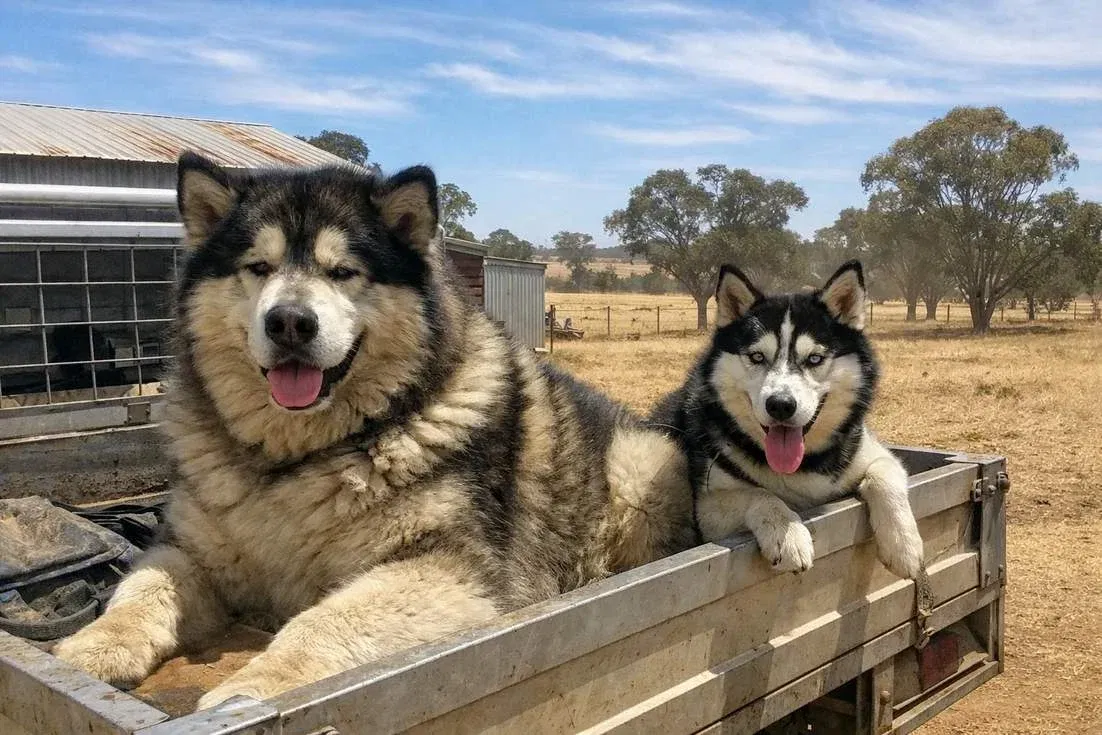
Neither breed is easy to train. Both are intelligent, independent working breeds that were developed to make decisions autonomously in harsh conditions — not to sit and stay on command. If you want a dog that lives to please you, get a Labrador. If you want a dog that respects you as a partner, an Arctic breed might work.
Huskies are intelligent but easily bored. Training sessions need to be short, varied, and engaging. They respond well to positive reinforcement but will tune out repetitive drills. Their biggest training challenges are recall (non-existent when prey drive activates), pulling on leash (it’s literally what they were bred to do), and containing their vocal outbursts.
Malamutes are strong-willed and will test boundaries constantly. They respect consistent leadership but not harsh correction. Because of their size and power, a 40+ kg Malamute that hasn’t learned leash manners is genuinely dangerous to walk. Early socialisation with other dogs is essential to manage their same-sex aggression tendencies.
Neither breed is recommended for first-time dog owners. Both need owners who understand pack dynamics, can provide firm and consistent (not harsh) leadership, and won’t be intimidated by a dog that regularly decides its own priorities. Puppy school and ongoing obedience training are non-negotiable for both breeds.
Which Costs More in Australia?
Malamutes cost more across the board — more expensive to buy, more expensive to feed (they eat roughly twice as much as a Husky), and more expensive in potential vet bills due to their size. Both breeds are expensive dogs to maintain compared to average breeds.
| Cost Category | Alaskan Malamute (AUD) | Siberian Husky (AUD) |
|---|---|---|
| Puppy (Registered Breeder) | $2,500 – $5,000 | $1,500 – $4,000 |
| Rescue/Adoption | $400 – $800 | $400 – $900 |
| First-Year Setup | $2,000 – $4,000 | $1,500 – $3,000 |
| Monthly Food Cost | $120 – $300 | $80 – $180 |
| Annual Ongoing Costs | $2,500 – $5,000 | $2,000 – $4,000 |
| Pet Insurance (Monthly) | $50 – $120 | $40 – $90 |
| Lifetime Cost (Est.) | $35,000 – $65,000 | $25,000 – $50,000 |
Annual Ongoing Costs:
Food costs are a significant ongoing difference. A 40 kg Malamute eating premium kibble will cost $120–$300 AUD per month. A 25 kg Husky will cost roughly half that. Pet insurance is strongly recommended for both breeds — a single hip dysplasia surgery or GDV emergency can easily exceed $8,000 AUD.
Which one for Australian Owners
This cannot be overstated: both breeds were engineered for sub-zero Arctic conditions. Keeping them in Australia requires active, daily heat management. These are not dogs you can leave in a backyard during an Australian summer. Without proper heat management, heatstroke is a real and potentially fatal risk.
Essential heat management strategies: always provide multiple fresh water stations, air-conditioned indoor spaces during hot days, exercise only in the early morning or after sunset (before 7 AM or after 7 PM in summer), provide cooling mats and/or paddling pools, never leave either breed in a car — even for minutes, consider cooling vests for outdoor exercise, and monitor for signs of heat stress (excessive panting, drooling, lethargy, bright red gums). Malamutes are at higher risk than Huskies due to their larger body mass and thicker coat. Both breeds do best in cooler southern states (Victoria, Tasmania, southern NSW, ACT, SA). Owners in Queensland, the Northern Territory, and tropical regions should think very carefully before acquiring an Arctic breed.
Neither the Alaskan Malamute nor the Siberian Husky is affected by BSL in any Australian state or territory. No restrictions apply.
Both breeds are large (or medium-large) and energetic, which can create challenges with landlords and strata rules. Many rental properties have size limits that exclude Malamutes. Their shedding can also be a concern for landlords. Huskies are slightly easier to rent with due to their smaller size but their vocal habits may cause noise complaints. Council registration is standard for both breeds.
Australia has a surprisingly active sled dog community, with dryland mushing (wheeled sleds, scooters, and bikejoring) popular during cooler months. State-based clubs include the Sled Dog Club of Victoria, NSW Sled Dog Sports, and the Australian Siberian Husky Club. Both breeds can participate in weight pulling, backpacking, canicross, and dryland mushing events. These activities are excellent outlets for their working drives and a great way to bond with your dog.
Both breeds’ thick double coats make it harder to spot paralysis ticks. Year-round tick prevention is essential in tick-prone areas. Keep fur trimmed short around the neck and chest to improve tick visibility. Both breeds’ prey drive also puts them at risk of snake encounters — supervise outdoor time in rural and semi-rural areas, particularly during warmer months.
So, Which one Should You Get?
- You want a calm, powerful, dignified companion that’s quieter indoors.
- You prefer hiking, bushwalking, and strength-based activities over running.
- You have experience with large, strong-willed breeds and can handle a 40+ kg dog.
- You have a single-dog household or can pair with a dog of the opposite sex.
- You live in a cooler Australian climate with a large, securely fenced yard.
- You’re active and want a running, cycling, or mushing partner.
- You don’t mind vocal dogs and can manage howling/talking (and your neighbours can tolerate it).
- You want a multi-dog household — Huskies are generally better with other dogs.
- You want a dog that’s more outgoing, playful, and socially engaging.
- You have previous dog experience but not necessarily with giant breeds.
- You’re a first-time dog owner. Both breeds require experienced handling.
- You live in tropical or subtropical Australia without reliable air conditioning.
- You don’t have secure, high fencing (1.8 m minimum) with anti-dig barriers.
- You can’t commit to 1–2 hours of daily exercise, every single day, in all weather.
- You want a low-shedding dog. These breeds are the polar opposite of hypoallergenic.
- You want a reliable off-leash dog. Neither breed can be trusted off-leash outside secure areas.
- The Malamute is the gentle giant — powerful, quiet, independent, and magnificent. It’s the right choice for experienced owners who want a hiking companion and don’t mind the extra size, food bill, and grooming.
- The Husky is the spirited athlete — vocal, social, mischievous, and tireless. It’s the right choice for active owners who want an engaging, entertaining partner and can handle the energy, noise, and escape artistry.
- In Australia, both breeds require significant heat management commitment. Neither is a “leave in the backyard” dog. They need air conditioning, early-morning exercise, and owners who take the heat seriously. Both breeds are available through rescue organisations — Arctic Rescue Victoria, Siberian Husky Rescue Australia, and state-based sled dog clubs often have dogs looking for experienced homes.
Frequently Asked Questions
Is an Alaskan Malamute bigger than a Siberian Husky?
Yes, significantly. Male Malamutes weigh 38–45 kg and stand 58–63 cm tall. Male Huskies weigh 20–27 kg and stand 53–60 cm tall. The Malamute is nearly twice the weight of a Husky, with a much heavier, more powerful build.
Can Alaskan Malamutes and Siberian Huskies live in Australia?
Yes, but it requires commitment. Both breeds struggle in Australian heat and need air-conditioned indoor spaces, early-morning/late-evening exercise, constant access to fresh water, and close monitoring on hot days. They’re better suited to cooler southern states (Victoria, Tasmania, ACT) than tropical regions. Many Australian owners successfully keep these breeds with proper heat management.
Which breed is better for families with children?
Both breeds are generally good with children, but supervision is essential. Huskies are more playful and better matched to active kids. Malamutes are gentle but their sheer size means they can accidentally knock over small children. Neither breed is aggressive toward children, but both need early socialisation.
Why do Huskies howl so much?
Huskies were bred to communicate with their teams over long distances in Arctic conditions. Howling is hardwired into the breed. They howl when excited, bored, lonely, responding to sirens, or simply because they feel like it. You can manage howling through exercise and training, but you cannot eliminate it. If noise is a concern, the Malamute is the quieter choice.
Can I have a Husky or Malamute in an apartment?
Neither breed is well-suited to apartment living. Both need space, secure fencing, and significant outdoor exercise. Huskies’ vocal habits will also create noise issues with neighbours. If you live in an apartment and want an Arctic-looking dog, consider a smaller breed like a Finnish Spitz or a Shiba Inu.
Do Malamutes or Huskies have blue eyes?
Only Huskies. Blue eyes (and bi-coloured or parti-coloured eyes) are common and accepted in the Siberian Husky breed standard. Alaskan Malamutes always have brown eyes — blue eyes are a disqualification in the breed standard. If you see a wolf-like sled dog with blue eyes, it’s a Husky or a crossbreed.
How much do Malamutes and Huskies shed?
Both breeds shed heavily year-round and then have a dramatic biannual “coat blow” where they shed their entire undercoat over 2–4 weeks. Malamutes shed more due to their longer, thicker coat. During coat blow, daily brushing is essential and you will find fur everywhere. Neither breed is suitable for people with dog allergies. Invest in a quality vacuum cleaner and lint rollers.
Are Huskies or Malamutes good escape artists?
Both, but Huskies are legendary. Huskies can climb 1.8-metre chain-link fences, dig tunnels under fencing, unlatch gates, and squeeze through surprisingly small gaps. Malamutes tend to use brute force — pushing through or digging under rather than climbing over. Secure, solid fencing (minimum 1.8 m) with anti-dig barriers is non-negotiable for both breeds.
Should I get a Malamute or Husky as my first dog?
Neither. Both breeds are challenging for first-time owners due to their independence, stubbornness, exercise demands, grooming needs, and (in the case of Malamutes) size and strength. If you’re set on an Arctic breed, consider gaining experience with dogs first, or adopt an older, calmer rescue dog rather than starting with a puppy.
What is the difference between an Alaskan Malamute, a Siberian Husky, and an Alaskan Husky?
The Alaskan Malamute and Siberian Husky are both recognised purebred breeds with distinct breed standards. The Alaskan Husky is not a breed — it’s a type of sled dog bred purely for performance, typically a mix of Husky, Greyhound, and other breeds. Alaskan Huskies are not ANKC-registered and vary widely in appearance. If you’re buying a purebred, you’re choosing between the Malamute and the Siberian Husky.
1. ANKC Breed Standard — Alaskan Malamute: https://ankc.org.au/breeds/breed-standard/?breedId=77
2. ANKC Breed Standard — Siberian Husky: https://ankc.org.au/breeds/breed-standard/?breedId=82
3. AKC — Siberian Husky vs Alaskan Malamute: Two Similar Yet Different Breeds: https://www.akc.org/expert-advice/dog-breeds/siberian-husky-vs-alaskan-malamute/
4. Pet Circle Australia — Siberian Husky Complete Breed Guide: https://www.petcircle.com.au/discover/breed-guide-siberian-husky
5. Dogz Online — Alaskan Malamute breeders and pricing Australia: https://www.dogzonline.com.au/breeds/breeders/alaskan-malamute.asp
6. Dogz Online — Siberian Husky pricing Australia: https://www.dogzonline.com.au/resources/getting-started/are-you-ready-for-a-dog/how-much-does-it-cost-to-buy-a-siberian-husky
7. Alaskan Malamute Club, Victoria Inc.: https://www.amcv.org.au/
8. PetPlace — Malamute vs Husky Key Differences: https://www.petplace.com/article/dogs/pet-care/malamute-vs-husky
9. Modern Dog Magazine — Alaskan Malamute vs Siberian Husky: https://moderndogmagazine.com/articles/commonly-confused-breeds-the-alaskan-malamute-vs-the-siberian-husky/