
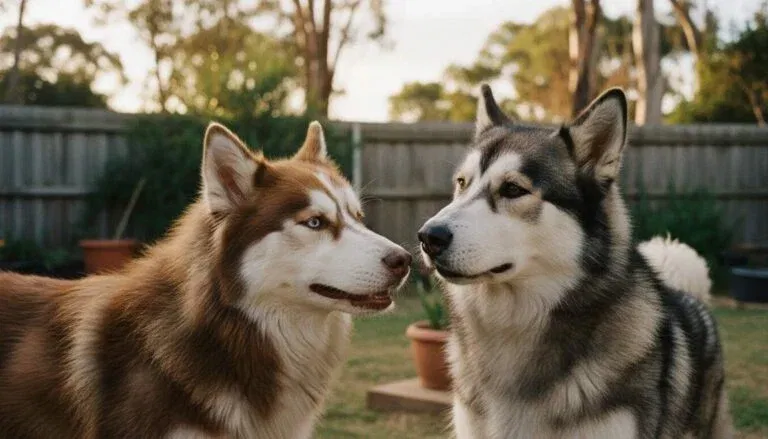
A performance-bred sled dog athlete versus one of the oldest purebred Arctic breeds. Here is everything Australian owners need to know before choosing between these two very different Alaskan dogs.
Key Takeaways
The Alaskan Husky is not a breed. It is an unregistered, mixed-breed working dog type bred purely for sled dog performance. The Alaskan Malamute is one of the oldest recognised purebred Arctic breeds, registered with the ANKC (Group 6 – Utility) and the AKC. This fundamental difference shapes everything from appearance predictability to breeder availability in Australia.
Alaskan Husky vs Alaskan Malamute
| Trait | Alaskan Husky | Alaskan Malamute |
|---|---|---|
| Breed status | Not a recognised breed; mixed-breed working type | Recognised purebred (ANKC, AKC, FCI) |
| Bred for | Speed, endurance, and racing performance | Heavy freight hauling and power |
| Height | 51–66 cm (20–26 in) | 58–64 cm (23–25 in) |
| Weight | 16–34 kg (35–75 lb) | 34–45 kg (75–100 lb) |
| Build | Lean, athletic, variable; hound-like to spitz-like | Thick, muscular, heavy-boned; consistent type |
| Coat | Short to medium; thinner than purebreds | Thick, coarse double coat; longer and denser |
| Eye colour | Typically brown; blue rare | Brown only (blue is a disqualification) |
| Lifespan | 12–15 years | 10–14 years |
| Temperament | Focused, cooperative, high-drive athlete | Dignified, independent, strong-willed |
| Kennel club registration | None (worldwide) | ANKC, AKC, FCI, KC |
| Australian availability | Very rare; specialist sled dog community only | Established ANKC breeders nationwide |
| Price (AUD) | $800–$3,000 (working lines) | $2,500–$5,000 (registered) |
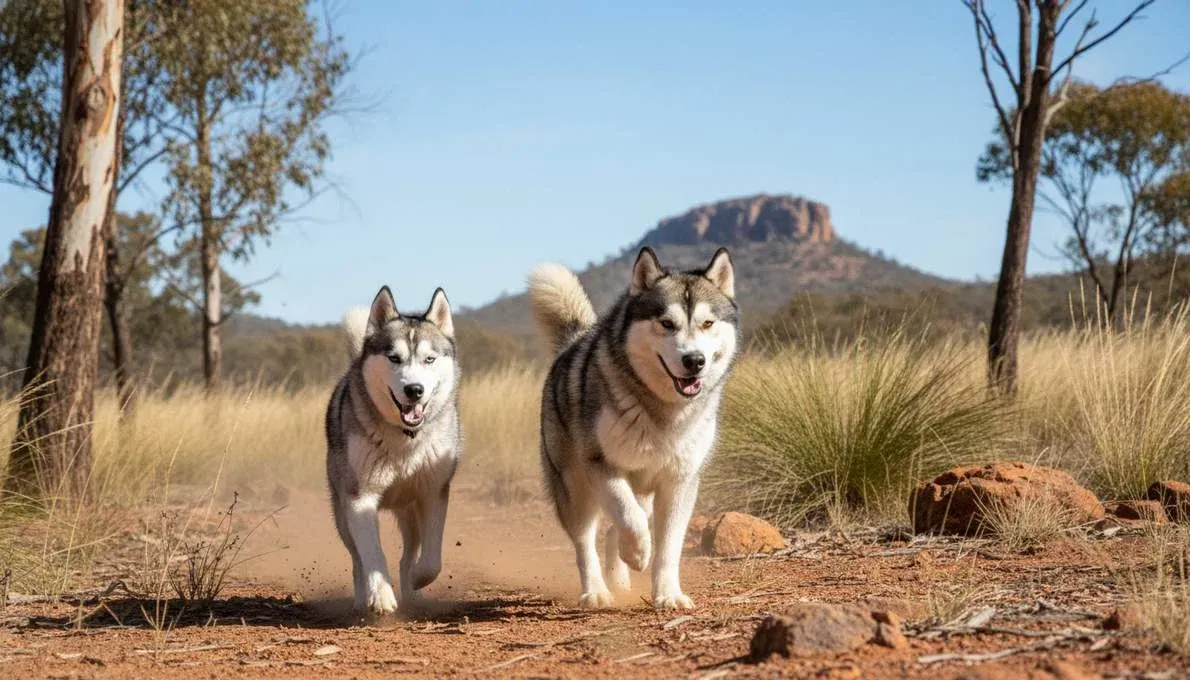
Breed Overview and Origins
The Alaskan Husky: The Breed That Is Not a Breed
The Alaskan Husky is not recognised as a breed by any kennel club in the world. It has no breed standard, no conformation ring, and no predictable appearance from one dog to the next. Instead, it is a working dog type developed over more than a century by mushers in Alaska and northern Canada who bred exclusively for one thing: performance on the sled.
The foundation stock came from Indigenous Arctic village dogs that had lived alongside the Inuit, Athabascan, and other peoples for thousands of years. Over the 20th century, mushers crossed these dogs with Siberian Huskies, Alaskan Malamutes, Greyhounds, German Shorthaired Pointers, Salukis, Border Collies, Labrador Retrievers, and even wolves to produce dogs optimised for specific tasks. A 2015 DNA study confirmed that Alaskan Huskies share a distinct genetic signature traceable to pre-colonial North American Arctic dogs with significant European breed contributions.
Today, two main sub-types exist within the Alaskan Husky population. Distance dogs, bred for races like the Iditarod and Yukon Quest, carry more traditional Arctic breed genetics from Malamutes and Siberians, with thicker coats and steadier temperaments. Sprint dogs, bred for short-distance speed events, show more Pointer and Greyhound influence, with leaner builds, thinner coats, and explosive acceleration. Some sprint Alaskan Huskies look nothing like a traditional husky, instead resembling sleek hound crosses.
The Alaskan Malamute: Ancient Purebred Power
The Alaskan Malamute is one of the oldest Arctic sled dog breeds, believed to descend from the wolf-dogs that accompanied the Mahlemut Inuit people across the Bering Strait into Alaska more than 4,000 years ago. These dogs were essential for survival: hauling heavy loads of food and supplies, hunting seals and polar bears, and providing warmth during brutal winters.
Unlike the Alaskan Husky, the Malamute has a tightly defined breed standard maintained by kennel clubs worldwide, including the Australian National Kennel Council (ANKC Group 6 – Utility). Every registered Malamute can trace its lineage through documented pedigrees. The breed was almost lost during the Alaskan Gold Rush when outside breeds were crossed in to meet demand for working dogs, but the remoteness of the Mahlemut tribe’s homeland preserved relatively pure lines that became the foundation of the modern breed.
The AKC recognised the Alaskan Malamute in 1935. Today, the breed ranks 58th in AKC popularity and is well-established in Australia through dedicated ANKC breeders and breed clubs, including the Alaskan Malamute Club of Victoria (AMCV).
Purpose-Bred Performance vs Purebred Heritage
This is the single most important distinction and the one most people searching this comparison do not realise. The Alaskan Husky exists because mushers wanted the fastest, most efficient sled dog possible and were willing to cross any breed to get it. The Alaskan Malamute exists because the Mahlemut people needed the strongest, most powerful freighting dog possible and preserved the type for millennia.
Think of it this way: the Alaskan Husky is a Formula 1 race car, custom-built from the best components regardless of brand. The Alaskan Malamute is a classic four-wheel-drive truck, purpose-built by one manufacturer with a proven design that has barely changed in centuries. Both are impressive, but they are engineered for fundamentally different jobs.
This difference has enormous practical implications for Australian owners:
- Appearance: You know exactly what a Malamute puppy will look like at maturity. An Alaskan Husky puppy could mature to look like anything from a traditional spitz-type to a lean hound cross.
- Registration: Malamutes come with ANKC papers, pedigrees, and health testing records. Alaskan Huskies have no registration pathway in Australia.
- Availability: Malamutes are readily available from ANKC breeders across Australia. Alaskan Huskies are extremely rare and almost exclusively found within the small Australian dryland mushing community.
- Breeding standards: Malamute breeders follow ANKC health screening protocols. Alaskan Husky breeders select for working traits, which may or may not include formal health testing.
Size and Physical Appearance
| Physical Trait | Alaskan Husky | Alaskan Malamute |
|---|---|---|
| Height (male) | 53–66 cm | 64 cm (breed standard) |
| Height (female) | 51–61 cm | 58 cm (breed standard) |
| Weight (male) | 18–34 kg | 38 kg (breed standard) |
| Weight (female) | 16–27 kg | 34 kg (breed standard) |
| Build | Lean, athletic, variable | Broad, heavy-boned, muscular |
| Head shape | Variable; narrow to medium; fox-like to hound-like | Broad, bear-like; wide-set ears |
| Ears | Prick or semi-prick (varies by lineage) | Prick ears, set wide apart |
| Tail | Variable; may be curled, brush, or straight | Plumed, carried over back |
| Coat length | Short to medium (varies by line) | Medium-long, always thick and coarse |
| Coat colours | Any colour or pattern | Grey, black, sable, red, seal, silver – always with white markings |
| Eye colour | Usually brown; occasionally amber | Brown only |
The visual unpredictability of the Alaskan Husky is one of its defining features. Some look like traditional huskies with prick ears and curled tails. Others resemble lean Greyhound crosses with floppy ears, tucked-up loins, and straight tails. Professional musher Sarah Piano notes that visitors to her kennel are often surprised at how little her Alaskan Huskies resemble the stereotypical husky image.
The Malamute, by contrast, is unmistakable: a massive, wolf-like dog with a broad head, powerful frame, deep chest, and a luxurious plumed tail carried over the back. Their expression is often described as soft and bear-like. No two Alaskan Huskies may look alike, but you will never mistake a Malamute for anything else.
Temperament and Personality
| Temperament Trait | Alaskan Husky | Alaskan Malamute |
|---|---|---|
| Drive level | Extremely high; lives to run | High but more measured; power over speed |
| Independence | Moderate; pack-oriented and cooperative | High; independent thinker, can be stubborn |
| Trainability | Generally more biddable (bred for handler compliance) | Strong-willed; requires experienced handler |
| Friendliness to strangers | Friendly, curious | Friendly but can be aloof |
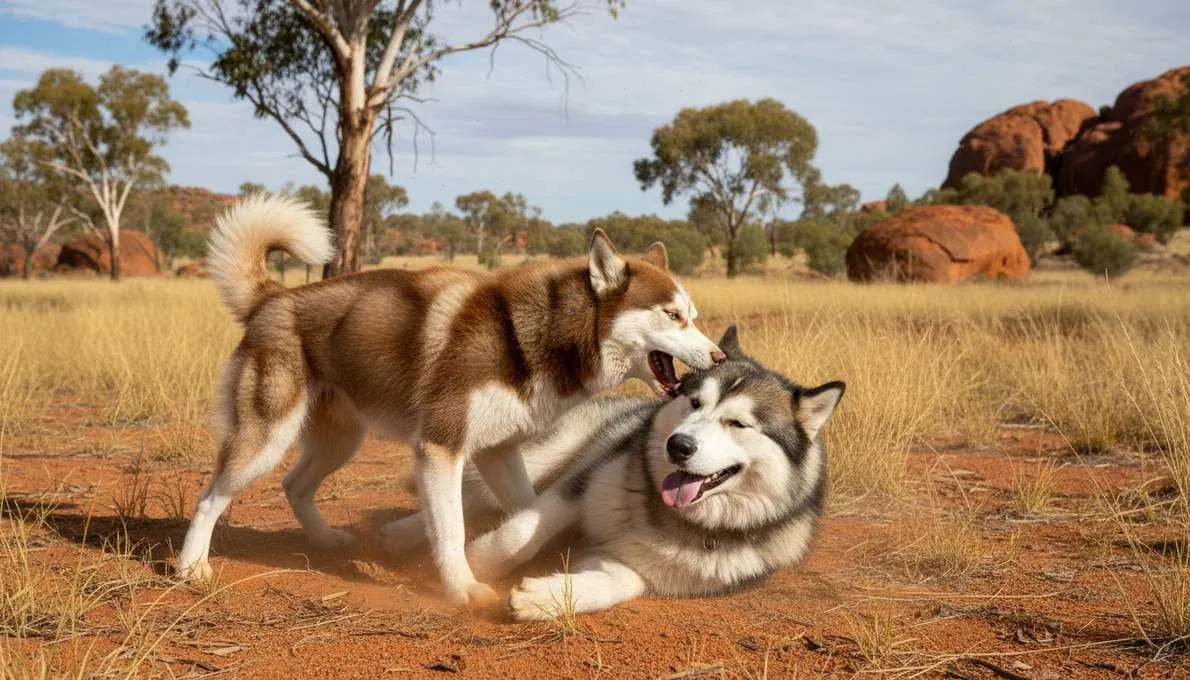
| Same-sex aggression | Generally lower risk | Significant risk; opposite-sex pairing recommended |
| Prey drive | High | High |
| Vocalisation | Moderate; howling and husky-talk | Quieter; soft woo-woos, less dramatic than Siberians |
| Separation anxiety | High risk; strong pack drive | Moderate; more independent |
| Guard dog suitability | Poor; too friendly | Poor; too friendly, though more territorial than Huskies |
The Alaskan Husky’s temperament has been shaped by decades of selection for one trait above all others: the desire to run in harness as part of a team. This produces a dog that is cooperative, focused, handler-responsive, and deeply pack-oriented. They form intense bonds with both people and other dogs. Professional mushers describe them as more reliable and generally calmer than Siberian Huskies because unstable temperaments are ruthlessly culled from working lines. A sled dog that cannot cooperate in a team of 16 dogs running at speed is simply not bred.
The Malamute is a more dignified, independent personality. They are deeply loyal to family but operate with a self-assured confidence that can tip into stubbornness. The Alaskan Malamute Club of America warns that same-sex aggression is a genuine breed trait, recommending that owners with existing dogs choose a Malamute of the opposite sex. Malamutes do have more of an off-switch than many people expect. The AMCA notes that someone who prefers enjoying the scenery rather than a continuous adrenaline rush is a better match for a Malamute than a Husky of any type.
Exercise and Activity Needs
| Exercise Factor | Alaskan Husky | Alaskan Malamute |
|---|---|---|
| Daily minimum | 1–3 hours aerobic exercise | 1–2 hours moderate-to-vigorous exercise |
| Ideal activity | Pulling sports: sledding, bikejoring, skijoring, canicross | Hiking, weight pulling, carting, pack walks |
| Running style | Born to run fast and far; endurance athlete | Powerful but slower; strength over speed |
| Off-leash reliability | Very poor; will bolt | Poor; strong prey drive and independence |
| Destructiveness if under-exercised | Extreme; will destroy a house within hours | High; chewing, digging, howling |
| Mental stimulation needs | Very high; puzzle toys, training variety | High; needs a job or purpose |
The Alaskan Husky was literally engineered to run. Working sled dogs in professional kennels run 30 or more kilometres per day, six days a week. As a pet, an Alaskan Husky needs a minimum of one to three hours of aerobic exercise daily, ideally in a pulling sport such as bikejoring, scooterjoring, or canicross. Without this outlet, boredom-driven destruction is not a possibility; it is a certainty. This is not a breed type for casual pet owners.
The Malamute is powerful and active but operates at a lower intensity. They prefer strength-based activities such as hiking with a loaded pack, weight pulling, or carting rather than flat-out running. Their exercise needs are substantial but more manageable for an active Australian family. A Malamute that receives a solid hour of structured exercise and mental stimulation daily will generally settle well indoors.
Dryland Mushing & Sled Dog Sports
Australia has a surprisingly active dryland mushing community governed by the Australian Sleddog Sports Association (ASSA). Dryland disciplines include scooterjoring, bikejoring, canicross (runner attached to dog), and rig or cart racing. Snow events are also held in Victoria’s Alpine region, including the annual Dinner Plain Dog Sled Sprint and the Mt Baw Baw Dog Sled Dash.
Clubs operate in every state except the Northern Territory:
- Victoria: Northern Victorian Sled Dog Club (NVSDC), Altitude 5000 Sled Dog Group, Gold Seekers Sled Dog Club
- NSW: Siberian Express Sled Dog Club, Hunter Valley Mushers
- Queensland: Sled Dog Racing Queensland (SDRQ), Northern Exposure Gig Racing Club
- ACT: Canberra Sled Dog Club
- SA: SA Sled Dog Club, Wild Dog Mushers
- WA: WA Sleddog Sports Association (WASSA)
Both Alaskan Huskies and Malamutes participate in dryland mushing, but the Alaskan Husky dominates competitive racing classes due to its superior speed. Malamutes excel in weight pull competitions and touring classes. Most clubs offer come-and-try days and will lend beginners harnesses, ganglines, and scooters.
Important temperature note: Sled dog sports in Australia are strictly seasonal. Racing events run April to September (cooler months), with heats typically starting at 7 am. Dogs must not run in temperatures above 15°C, especially in humid conditions. This is a critical welfare consideration for both breeds.
Heat Management in Australia
Sprint-line Alaskan Huskies bred for speed often have thinner, shorter coats than traditional Arctic breeds, sometimes resembling hound coats. These dogs cope better with Australian heat than Malamutes but still require careful management. Distance-line Alaskan Huskies with thicker coats face similar challenges to Malamutes. Working sled dog kennels use dog coats and booties in winter; in an Australian summer, the concern reverses to overheating.
With the thickest, densest double coat of any common Arctic breed, the Malamute is the most heat-vulnerable. They are better suited to cooler Australian climates (VIC, TAS, ACT, SA highlands) and require significant heat mitigation in warmer states.
Essential heat management strategies for both:
- Air conditioning is not optional. Both breeds need access to climate-controlled indoor spaces during Australian summers.
- Exercise only during the coolest parts of the day: before 7 am or after sunset in summer.
- Provide cooling mats, elevated beds, frozen treat puzzles, and paddling pools.
- Never shave the double coat. The undercoat provides insulation from both cold and heat. Shaving removes UV protection and disrupts thermoregulation.
- Learn heatstroke signs: excessive panting, drooling, glazed eyes, vomiting, collapse. Both breeds are at elevated risk compared to short-coated dogs.
- Cooling vests are particularly effective for Malamutes during summer walks.
Grooming and Coat Care
| Grooming Factor | Alaskan Husky | Alaskan Malamute |
|---|---|---|
| Brushing frequency | 1–2 times per week; daily during coat blow | 2–3 times per week; daily during coat blow |
| Coat blow frequency | Twice per year (less dramatic in thin-coated lines) | Twice per year (extremely heavy) |
| Shedding level (overall) | Moderate to heavy (varies by coat type) | Extreme; hair everywhere, year-round |
| Bathing | Every 6–8 weeks or as needed | Every 6–8 weeks; naturally clean, low odour |
| Professional grooming | Occasional; helpful during coat blow | Strongly recommended during coat blow seasons |
| Tools needed | Undercoat rake, slicker brush | Undercoat rake, slicker brush, high-velocity dryer |
| Matting risk | Low to moderate | Higher risk, especially behind ears and thighs |
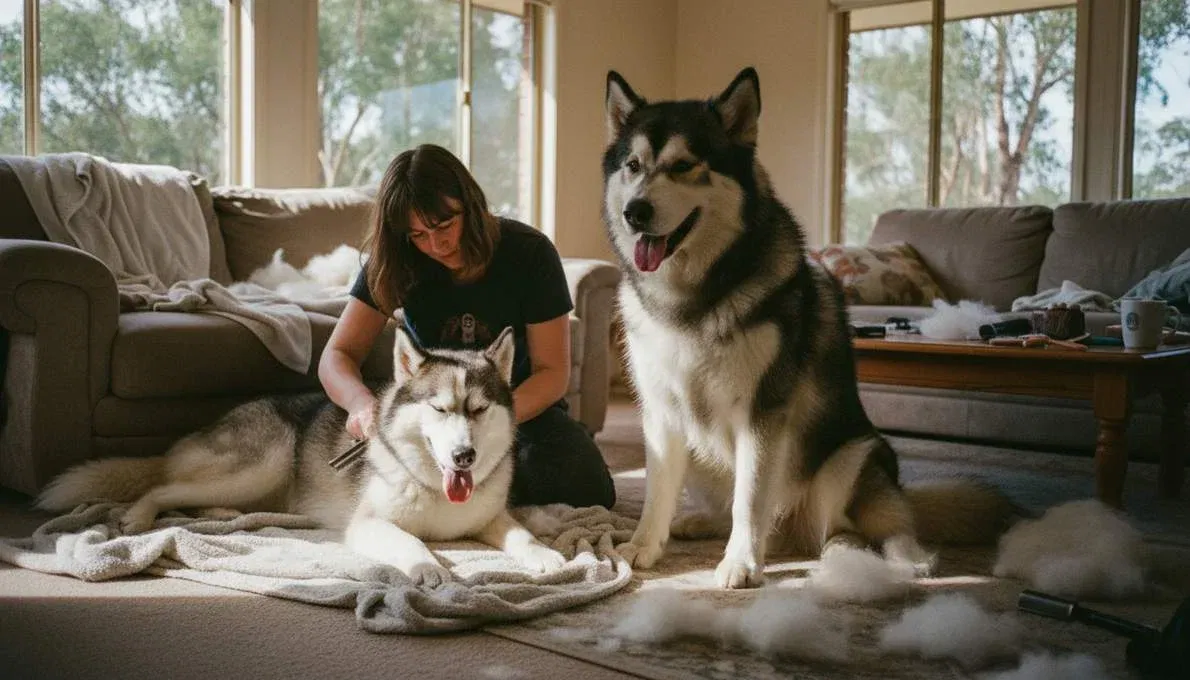
The Malamute’s coat blow is legendary. Twice a year, they shed their entire undercoat in clumps that can fill garbage bags. A high-velocity dryer (available at self-service dog washes across Australia) is the single most effective tool for managing this process. Alaskan Huskies with thicker coats experience similar shedding, but sprint-line dogs with shorter, thinner coats shed significantly less.
Neither breed should be shaved. Both rely on the double coat for thermoregulation. In Australia’s UV-intense climate, a shaved Arctic breed is at risk of sunburn, heat stroke, and permanent coat damage.
Health and Lifespan
| Health Factor | Alaskan Husky | Alaskan Malamute |
|---|---|---|
| Lifespan | 12–15 years | 10–14 years |
| Hip dysplasia risk | Low to moderate | Moderate to high |
| Eye conditions | Progressive retinal atrophy (PRA) | Day blindness (hemeralopia), PRA, cataracts |
| Breed-specific conditions | Alaskan Husky Encephalopathy (AHE); lysosomal storage disease; congenital laryngeal paralysis (wheezing) | Chondrodysplasia (dwarfism); inherited polyneuropathy; thrombopathia; von Willebrand’s disease |
| Thyroid issues | Hypothyroidism risk | Hypothyroidism risk |
| Bloat (GDV) risk | Lower (lighter build) | Moderate to high (deep-chested) |
| Recommended health testing | Hip evaluation, eye exam, thyroid panel | Hip evaluation, eye exam (CERF), polyneuropathy DNA test, chondrodysplasia DNA test |
| Overall health robustness | Generally very healthy due to performance-based selection | Healthy but more breed-specific conditions due to closed gene pool |
The Alaskan Husky’s mixed heritage is actually a health advantage. Performance-based breeding ruthlessly selects against conditions that impair working ability, and the genetic diversity from outcrossing reduces the concentration of deleterious recessive genes. Working Alaskan Huskies in professional kennels routinely live into their mid-teens, with some running sled tours recreationally well past 15 years of age.
Alaskan Husky Encephalopathy (AHE) is a severe, early-onset neurological disorder specific to the Alaskan Husky. It causes seizures, behavioural changes, and incoordination, typically appearing in young dogs. DNA testing is available and should be requested from any Alaskan Husky breeder.
The Malamute’s closed gene pool means certain conditions are more concentrated. Chondrodysplasia, a form of dwarfism that causes shortened, bowed legs, is DNA-testable and should be screened for by all responsible breeders. Inherited polyneuropathy, a neurological disorder causing nerve pain and weakness, is also testable. The Alaskan Malamute Club of America considers these tests essential for any breeding stock.
Training and Intelligence
Both are intelligent dogs, but they express that intelligence very differently.
Alaskan Husky: Generally more trainable and handler-responsive than the Malamute. Sled dogs must follow commands reliably at speed, so working lines have been selected for generations to be cooperative and responsive to direction. They learn quickly, respond well to positive reinforcement, and thrive on having a clear job. Their challenge is focus: without a task, they become restless and inventive in ways you will not appreciate.
Alaskan Malamute: Intelligent but famously independent. They will learn commands quickly and then decide for themselves whether following them is worthwhile. Training a Malamute requires patience, consistency, a sense of humour, and the willingness to never let them sense weakness in your leadership. Positive reinforcement and variety are essential; they bore easily with repetition. Early socialisation is critical, particularly for managing same-sex aggression tendencies.
Neither type is suited to first-time dog owners. The Alaskan Husky is somewhat more forgiving for those with an active lifestyle and willingness to commit to a pulling sport. The Malamute requires genuine experience with strong-willed, independent breeds.
Living Requirements in Australia
| Living Factor | Alaskan Husky | Alaskan Malamute |
|---|---|---|
| Minimum yard size | Medium to large; secure fencing essential | Large; secure fencing essential |
| Fencing requirement | 1.8 m minimum; anti-dig; check for climb points | 1.8 m solid minimum; anti-dig; brute-force resistant |
| Apartment suitability | Not recommended | Not recommended |
| Climate preference | Cooler (but thin-coated lines handle warmth better) | Cool to cold; VIC, TAS, ACT, SA highlands ideal |
| Multi-dog household | Excellent with other dogs (strong pack drive) | Caution: same-sex aggression risk |
| Cat/small pet compatibility | Poor; high prey drive | Poor; high prey drive |
| Time alone tolerance | Very poor; separation anxiety risk | Moderate; more independent |
| Noise level | Moderate; howling, husky-talk | Lower; occasional woo-woos |
Both types are escape artists. The Alaskan Husky inherits the classic husky talent for climbing fences, digging under barriers, and opening latches. The Malamute uses sheer power to force through weak points. Fencing for either must be 1.8 metres minimum, solid (not chain-link that can be climbed), with anti-dig barriers such as buried mesh or a concrete footer, and secure latches that cannot be nudged or pawed open.
Council regulations vary by state and municipality. Neither breed appears on any Australian breed-specific legislation (BSL) lists. Standard council registration applies. Always check local regulations regarding fence heights and the number of dogs permitted per property, particularly if considering multiple sled dogs.
Family Compatibility
The Malamute is the better option, provided you can manage its size. Malamutes are affectionate, gentle with children, and have a calmer indoor presence. Their sheer weight (34–45 kg) means supervision is essential to prevent accidental knockdowns with toddlers. The Alaskan Husky’s intense exercise needs and restless energy make it a more challenging household companion for young families.
The Alaskan Husky is an extraordinary companion for runners, cyclists, and triathletes who want a dog that can match their training schedule. If you are interested in competitive or recreational dryland mushing, the Alaskan Husky is purpose-built for it.
The Alaskan Husky’s strong pack drive makes it excellent with other dogs. The Malamute requires careful consideration: same-sex pairing should be avoided, and introductions to existing dogs must be managed carefully.
Costs in Australia
| Cost Category | Alaskan Husky | Alaskan Malamute |
|---|---|---|
| Purchase price | $800–$3,000 (from sled dog community) | $2,500–$5,000 (ANKC registered) |
| Puppy essentials (first year) | $500–$1,000 | $600–$1,200 |
| Annual food costs | $1,200–$2,500 (high-calorie diet needed) | $1,500–$3,000 (large breed, high calorie) |
| Annual vet costs (routine) | $400–$800 | $500–$1,000 |
| Pet insurance (annual) | $600–$1,200 | $800–$1,500 |
| Grooming (annual) | $200–$500 | $400–$800 |
| Sled dog equipment (initial) | $500–$2,000 (harness, gangline, scooter/bike) | $300–$1,000 (harness, cart, weight pull equipment) |
| Estimated lifetime cost | $20,000–$45,000 (12–15 years) | $30,000–$60,000 (10–14 years) |
The Alaskan Husky has an unusually high metabolism, requiring more calories per kilogram of body weight than most breeds its size. Working sled dog diets are typically 30 percent protein and 20 percent fat, significantly richer than standard dog food. In Australia, high-performance kibble formulations (such as those from Black Hawk Working Dog, Advance Active, or imported sled dog formulas) cost more per bag but are essential for maintaining condition.
The Malamute’s higher purchase price, greater size, and higher grooming costs make it the more expensive breed to own overall. However, finding an Alaskan Husky in Australia will be the bigger practical challenge: they are not available through normal pet channels.
Finding These Dogs in Australia
Straightforward. Contact the Alaskan Malamute Club of Victoria (AMCV), state-based breed clubs, or search the ANKC breeder directory. Expect a waitlist of several months. Rescue organisations such as Malamutes for Adoption and Alaskan Malamute Rehoming Aid Australia (AMRAA) also place surrendered dogs.
Difficult. Because the Alaskan Husky is not a registered breed, there is no formal breeder directory. Your best pathway is through the Australian dryland mushing community. Join your state’s sled dog club through ASSA (www.assa.dog), attend events, and network with mushers. Retired racing dogs occasionally become available for adoption, and some mushers breed for both competition and companion homes. Be prepared for dogs that have specific working backgrounds and high exercise expectations.
Which Dog Is Right for You?
| Choose the Alaskan Husky if you… | Choose the Alaskan Malamute if you… |
|---|---|
| Are an active athlete (runner, cyclist, triathlete) wanting a canine training partner | Want a powerful, majestic companion with a predictable appearance |
| Plan to compete or participate in dryland mushing or sled dog sports | Enjoy hiking, camping, and strength-based activities at a steadier pace |
| Have experience with high-drive working dogs | Have experience with independent, strong-willed breeds |
| Want maximum genetic health diversity and longer lifespan | Want a registered purebred with documented pedigrees and health testing |
| Can provide 1–3 hours of intense daily exercise | Can provide 1–2 hours of structured daily exercise |
| Already have dogs and want a pack-oriented addition | Prefer a single dog or opposite-sex pair |
| Are comfortable sourcing a dog through the sled dog community | Prefer the established ANKC breeder pathway |
| Prioritise working ability over appearance | Want that iconic, unmistakable Arctic wolf-like look |
The Alaskan Husky and Alaskan Malamute are both extraordinary dogs, but they serve fundamentally different purposes. The Alaskan Husky is a performance athlete, bred for speed and endurance, with a temperament shaped by generations of cooperative teamwork. It is not a breed but a working type, and its appearance, health, and availability reflect that. It is the ultimate choice for the serious endurance athlete or dryland musher.
The Alaskan Malamute is a purebred heritage dog, bred for power and strength, with a dignified, independent personality. It offers predictability in appearance, temperament, and health through ANKC registration and established breeding programs. It is the better choice for families and owners who want a majestic, loyal companion with manageable exercise needs.
For most Australian households, the Alaskan Malamute is the more practical choice. Its established breeder network, predictable traits, and slightly lower exercise demands make it a better fit for suburban or rural life. The Alaskan Husky remains a niche dog for a niche lifestyle — one that revolves around high-intensity canine sports.
Whichever you choose, understand that both are Arctic breeds with significant grooming, exercise, and heat management requirements. Neither is a low-maintenance pet. But for the right owner, either can be a deeply rewarding partner for an active Australian life.
Frequently Asked Questions
- Australian National Kennel Council (ANKC) – Alaskan Malamute Breed Standard (Group 6 – Utility)
- American Kennel Club (AKC) – Siberian Husky vs. Alaskan Malamute: Two Similar Yet Different Breeds (2021)
- Wikipedia – Alaskan Husky: Breed history, DNA studies, and sub-type classification (2025)
- Alaskan Malamute Club of America (AMCA) – Breed health, temperament, and same-sex aggression guidance
- Wisdom Panel – Alaskan Husky: Genetic health conditions including AHE and degenerative myelopathy
- Australian Sleddog Sports Association (ASSA) – Beginner resources, club directory, and event calendar (www.assa.dog)
- Sled Dog Racing Queensland (SDRQ) – Dryland mushing disciplines and temperature guidelines
- Bow Wow Meow Pet Insurance Australia – Alaskan Husky breed profile and Australian context
- Windchill Australia – Australian sled dog clubs directory and working dog resources